Guimarães — where Portugal began
Honest guide to Guimarães: the medieval castle, Paço dos Duques, historic centre, and how to do the day trip from Porto properly without rushing it.
Guimarães: Guimaraes Half Day Tour from Porto
Quick facts
- From Porto
- ~1 h 15 min by train, ~1 h by car
- Best for
- Castle, Paço dos Duques, medieval streets, history
- UNESCO status
- World Heritage Site since 2001
- Train fare
- ~3.50 € from Porto Campanhã
- Currency
- Euro (€)
The city where Portugal was born
The slogan “Aqui nasceu Portugal” (Here Portugal was born) appears on the walls of Guimarães castle and on tourist materials throughout the city, and it is not entirely wrong. Afonso Henriques, the first king of Portugal, was born here around 1109 and used Guimarães as his power base when he declared the independence of the County of Portugal from León in 1128. Whether the nation was truly “born” in a single location is the kind of historical oversimplification that works better as a motto than as scholarship; what is accurate is that Guimarães was central to the political events that created Portugal as a distinct entity.
The result is a city with a remarkably intact medieval centre — a UNESCO World Heritage Site since 2001 — and two major monuments (the castle and the Paço dos Duques palace) that tell a coherent story about the 11th and 15th centuries in accessible physical form. As a day trip from Porto, Guimarães combines well with Braga (20 minutes apart by car), and the compact historic centre means you can see the essentials without feeling rushed.
What to be honest about: the castle interior is minimal — the towers are impressive from outside but the interior archaeology has little explanatory material in English. The Paço dos Duques is more rewarding. The city’s café and restaurant culture is better than the tourist overlay suggests.
| Where | Minho region, ~50 km northeast of Porto |
| Cost | Castle ~€2, Paço dos Duques ~€5 |
| Time needed | Full day (half-day minimum without Braga) |
| Getting there | Train from Porto Campanhã, ~1h15; or car, ~1h |
| Best time | May–September; first weekend of August for Festas Gualterianas |
What to do in Guimarães
Guimarães Castle (Castelo de Guimarães)
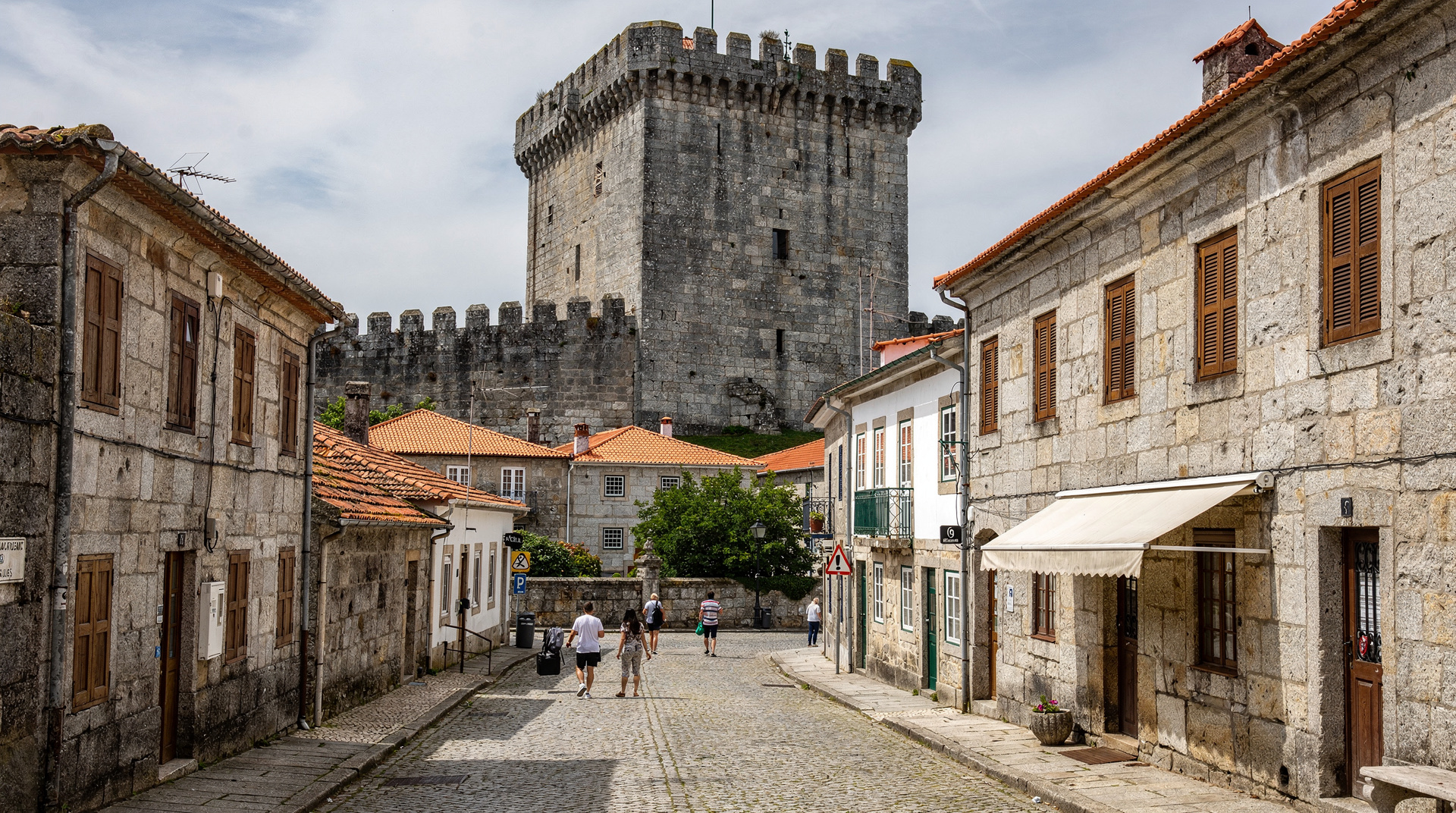
The castle that anchors the city’s skyline dates to the 10th century in its original form — Count Mumadona Dias built a fortress here to defend against Viking and Moorish raids. The current structure, with its eight towers and keep, was significantly rebuilt by Afonso Henriques in the 12th century and again in the 20th century. It is the most visited monument in northern Portugal after the Douro Valley viewpoints.
Entry costs around 2 €. The interior is largely open space with archaeological foundations visible in sections; the towers can be climbed for views over the city and surrounding Minho countryside. Allow 45 minutes. The castle is best visited in the morning before coach tour groups arrive around 11 am.
Adjacent to the castle is the tiny Romanesque chapel of São Miguel do Castelo (11th century), reportedly where Afonso Henriques was baptised. It is rarely more than 20 square metres of space but is one of the oldest surviving ecclesiastical buildings in Portugal.
Paço dos Duques de Bragança
The Paço dos Duques (Palace of the Dukes of Bragança) was built between 1401 and 1422 by Dom Afonso, the first Duke of Bragança, in a Burgundian Gothic style that reflects his connections to French court culture of the period. It is one of the most important examples of 15th-century civil architecture in Portugal. The building was neglected for centuries and substantially restored in the 20th century — the restoration is visible if you look closely, but it does not undermine the overall experience.
The interior holds tapestries, furniture and Portuguese painting spanning the 15th to 20th centuries. The great hall, with its Flemish tapestry cycle depicting the Portuguese campaigns in North Africa, is the architectural highlight. Entry is around 5 €; audio guides are available in English. Allow 60–90 minutes.
A half-day guided tour from Porto to Guimarães includes transport from Porto and guided visits to both the castle and the palace, with time for a walk through the historic centre — a practical format for first-time visitors who want context for what they are seeing.
The historic centre and Largo da Oliveira
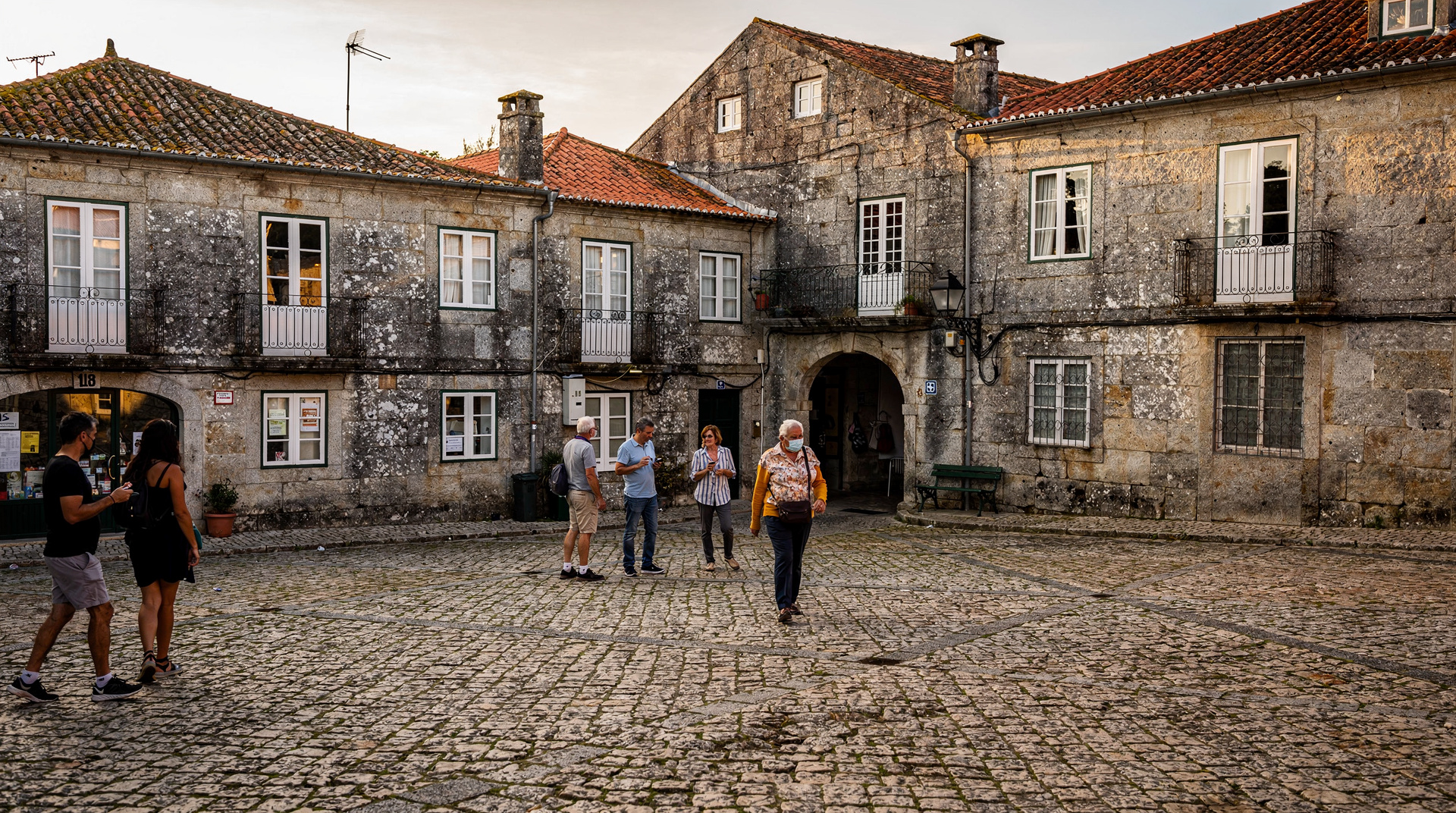
Guimarães’s historic centre clusters around two connected plazas: Largo da Oliveira (with the church of Nossa Senhora da Oliveira) and Praça de Santiago (with its characteristic arcaded houses and outdoor café terraces). The streets between them are paved with granite cobblestones and lined with 15th-to-18th-century buildings in various states of restoration and occupation. It is an authentic living neighbourhood, not a theme park — there are local businesses, dry cleaners and pharmacies alongside the cafés and craft shops.
The church of Nossa Senhora da Oliveira is worth entering: a Gothic building (14th–15th century) with an 18th-century baroque interior, and the adjacent cloister that now forms part of the Sociedade Martins Sarmento museum. Entry to the church is free.
The Sociedade Martins Sarmento museum, housed in the church cloister, holds one of northern Portugal’s better regional archaeology collections — pre-Roman sculpture and artefacts from the Citânia de Briteiros hillfort, one of the most significant Iron Age sites in the Iberian peninsula, located about 12 km outside the city. Entry is modest (around 2–3 €) and the visit takes 30–40 minutes; a good addition for visitors with an interest that predates the castle’s medieval story.
Penha mountain
The Serra da Penha, a 617-metre granite massif east of Guimarães, is accessible by car (30 minutes) or cable car (teleférico, from below the Parque da Cidade; around 4 € each way). The summit offers a wide view over the Minho lowlands, a sanctuary, and trails through the boulders and pine forest. The cable car is closed on Mondays. For visitors with extra time after the historic centre, Penha is a good half-afternoon addition; for a single-day trip from Porto, it is an optional extra.
Guimarães vs Braga: which comes first if time is short
Both cities are covered by most organised day tours, but if you are travelling independently and have to prioritise, the choice depends on interest:
| Guimarães | Braga | |
|---|---|---|
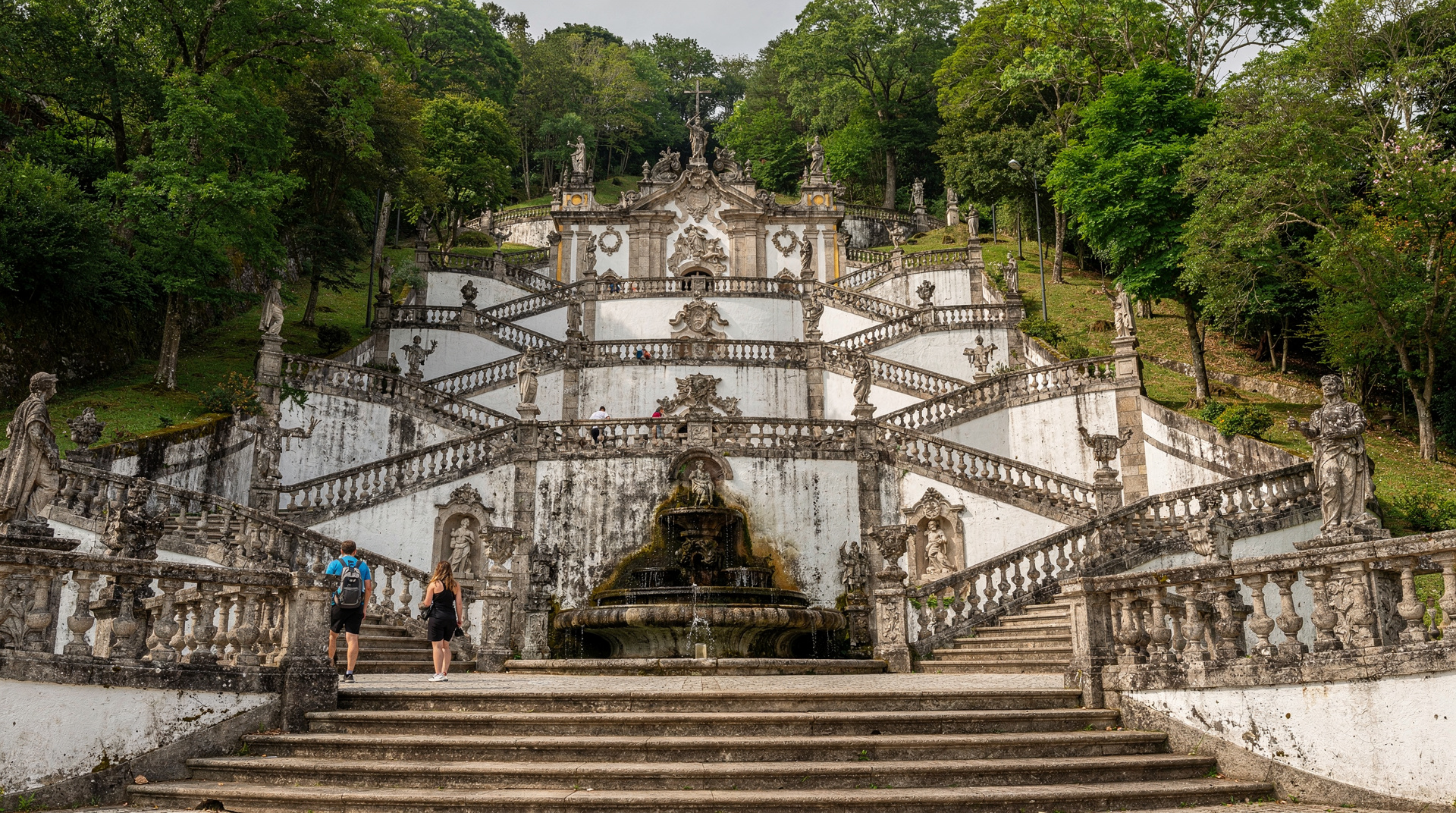
| Defining sight | Castle and Paço dos Duques (medieval/15th-century) | Bom Jesus sanctuary and staircase (baroque) |
| Character | UNESCO medieval centre, compact | Portugal’s religious capital, livelier centre |
| Time needed | 2.5–3 hours for the essentials | 2.5–3 hours, more with Bom Jesus |
| Best for | Medieval history, castle enthusiasts | Baroque architecture, church interiors |
For a fuller comparison, the Braga day trip guide and Guimarães day trip guide each go deeper on their respective cities, while the Braga and Guimarães day trip guide works through combining both properly.
How to get to Guimarães from Porto
By train: CP runs regular services from Porto Campanhã and Porto São Bento to Guimarães; journey time is approximately 1 hour 15 minutes from Campanhã. Fares run around 3.50–4.50 €. The station is about 10 minutes on foot from the historic centre. This is the most convenient option for day trippers, and it removes the parking search that adds friction to the drive on a busy weekend.
By car: The A3 to Braga and then the A11 east to Guimarães covers the 50 km from Porto in approximately 1 hour. Parking is available in the Parque de Estacionamento da Mumadona adjacent to the historic centre.
By organised tour: A small-group day trip from Porto combining Braga and Guimarães handles all logistics and guides both cities in one day. This is the right choice for visitors who want to see both cities without managing connections. The independent train approach is fine for Guimarães solo; the combined day benefits from having someone else manage the timetable.
Where to stay in Guimarães
Guimarães is an easy day trip from Porto and most visitors do not overnight. If you want to stay, the options are limited but decent.
Pousada de Guimarães — Mosteiro de Santa Marinha is the most spectacular option: a converted 12th-century monastery on the Penha hillside, with architecture that predates most of what you will see in the city. Rates 120–220 € per night. Worth the splurge if the budget allows.
Hotel de Guimarães (4-star, central) is reliable and well-located; rates 60–90 € per night. Toural Guest House (near Praça de Santiago) is a smaller, more characterful option in a converted townhouse; rates 50–80 €.
Where to eat in Guimarães
El Rei Dom Afonso (near Praça de Santiago) is a restaurant with a reputation that splits opinion — the setting (in an old stone building facing the square) is excellent, the cooking is competent Minho fare, and the prices reflect the location. Budget 20–28 € per person. It is busy at lunch; reservations help.
Solar do Arco (Rua de Santa Maria) is a better food proposition: a more modest room, better-sourced ingredients and honest pricing around 15–20 € for a full lunch. The bacalhau and grilled fish are consistent.
Café Oriental (Largo do Toural) has been operating in the central square since 1910 and is Guimarães’s answer to a grande café. Coffee, local pastries (the toucinho do céu is a specialty of Guimarães) and a reliable lunch menu. Worth a stop for the atmosphere as much as the food.
Best time to visit Guimarães
May to September is the natural window: outdoor café culture functions, the Penha cable car operates on full schedule, and the medieval centre is at its most animated. The Festas Gualterianas in the first weekend of August are Guimarães’s main annual festival — medieval processions, folk music and general revelry that make the city more colourful than usual.
April and October are quieter and pleasant; the historic centre is easier to photograph without crowds and the palácio is more browsable without tour groups.
November to March: Guimarães in winter has a raw quality — the granite is cold-looking, the streets are quiet, and the monuments are accessible without any waiting. Good for photography; not the natural season for terrace dining. Pousada de Santa Marinha is warmer and more atmospheric in winter than it sounds.
Practical tips
- The castle and Paço dos Duques are separate ticketed sites about 300 metres apart. Budget 2 hours for both plus the walk between them.
- The historic centre is compact — roughly 500 metres across — and entirely walkable. There is no need for any transport within it.
- The Paço dos Duques closes on Mondays.
- Toucinho do céu (almond-egg pastry, often attributed to the Guimarães convents) is the local sweet to try; it is heavier than it looks and pairs well with coffee.
- If you are combining Guimarães with Braga, drive or get a taxi between them (20 minutes, ~15 €); the train journey requires changing in Porto, which makes no sense as a combination.
- If you are unsure how to get around once you arrive, the getting around Porto guide also covers regional train and bus basics that apply to day trips like this one.
- Guimarães fits comfortably into a 3-day Porto itinerary as a single dedicated day, or as part of a longer northern Portugal 7-day itinerary that also covers Braga, the Douro and the coast.
Frequently asked questions about Guimarães
Can you do Guimarães and Braga in the same day from Porto?
Yes, and it is the standard approach. Most organised day trips include both cities. Independently, the most logical sequence is Porto → Guimarães by train in the morning → taxi or bus to Braga in the afternoon (20 km, ~15–20 minutes) → train or bus back to Porto from Braga. Alternatively, drive Porto → Braga → Guimarães → Porto. Allow at least 2.5 hours per city and depart Porto before 9 am. Our Braga and Guimarães day trip guide gives a worked hour-by-hour schedule.
What is the Paço dos Duques like inside?
The palace has three main floors open to the public. The ground floor covers the building’s architectural history with original stone elements and some original furniture. The main floor has the great hall with the tapestry cycle, the chapel and the Ducal bedroom. The upper floor houses the painting collection (predominantly 17th to 20th century). Audio guides are available in English and add useful context. Total visit time: 60–90 minutes at a comfortable pace.
Is Guimarães worth visiting even if you’re not interested in history?
The medieval architecture and atmosphere of the centre are visually appealing regardless of whether you know or care about 12th-century Portuguese politics. The café terraces at Praça de Santiago are among the most pleasant outdoor sitting areas in northern Portugal, and the food is genuinely good. For visitors who find history optional, Guimarães still earns its day trip.
How long does the cable car to Penha take?
The teleférico ride takes approximately 8–10 minutes each way. From the summit, the main path through the boulders to the chapel takes about 20 minutes at a gentle pace. Add lunch or a coffee at the summit café and you have a 2-hour excursion. The cable car is closed on Mondays and in poor weather; check the official schedule before planning your afternoon around it.
Top experiences
Bookable activities with verified prices and instant confirmation on GetYourGuide.