Guimarães day trip from Porto — the honest guide
Guimarães: Guimaraes Half Day Tour from Porto
Is a Guimarães day trip from Porto worth it?
Yes — Guimarães has the best-preserved medieval urban core in Portugal, the castle where the first king of Portugal was born, and a UNESCO-listed old town that genuinely rewards slow exploration. The train takes 1h15 and costs 3.50 €. A half day is enough; a full day is better.
Guimarães is the easiest history-heavy day trip from Porto to get logistically right — cheap train, compact old town, no car needed. Here’s the practical snapshot before the full breakdown.
| Where | 1h15 by train from Porto Campanhã/São Bento |
| Cost | Around 3.50 € train + 10–15 € entries, 25–35 € full day |
| Time needed | Half day (3–4 hrs) minimum, full day better |
| Getting there | Direct CP train, every 1–2 hours, no booking needed |
| Best time | Weekday mornings; summer weekends get crowded |
The cradle of Portugal — what that actually means
The phrase “aqui nasceu Portugal” — here Portugal was born — appears on a plaque on Guimarães castle and in various forms around the city. It is not mere civic pride: the claim has genuine historical grounding.
Afonso Henriques was born in Guimarães around 1109, son of Count Henry of Burgundy (who governed the County of Portucale as a vassal of the Kingdom of León). When his father died, Afonso fought a series of battles to assert his independence from León, declared himself King of the Portuguese in 1139, and was recognised by the Pope as king in 1179. The Kingdom of Portugal — the entity that would eventually expand to establish one of the greatest maritime empires in history — originated in the political and military decisions made in and around this small Minho town.
This is not abstract history for the Portuguese. Guimarães occupies a place in national identity something like Runnymede for the English or Lexington for Americans — the place where the story definitively began. The city trades on this history carefully, and for the most part, the sights live up to the symbolic weight placed on them.
Getting from Porto to Guimarães
Direct trains run from Porto Campanhã and Porto São Bento to Guimarães. The journey takes approximately 1 hour 15 minutes on a comfortable regional service. The fare is around 3.50 €. Trains run every 1–2 hours during the day; check CP (Comboios de Portugal) for the current schedule.
Guimarães station is about 15 minutes’ walk from the historic centre (or a 5-minute taxi ride for around 5–6 €). The walk from the station is mostly flat through unremarkable streets before you reach the old city, so the taxi is a reasonable option if you are short on time.
By car from Porto: the drive takes around 50 minutes via the A3 and A11 motorways. Parking is available in the car parks near the historic centre — Parque de Estacionamento da Câmara Municipal is the most convenient.
Organised guided tours from Porto to Guimarães leave typically at 8:30–9:00 am and return in the evening. The guided experience adds context to what you’re seeing, which matters more in Guimarães than in most destinations given the depth of the history.
Book a guided Guimarães walking tourThe castle
Guimarães Castle sits on a rocky hill at the northern edge of the old city. The current structure dates mostly from the 10th and 12th centuries, built originally as a defensive stronghold by Countess Mumadona Dias and expanded by Count Henry of Burgundy. The circuit of walls and seven square towers is largely intact, and the scale of the fortification — particularly impressive given the modest size of the surrounding landscape — conveys something of the political ambition that drove its construction.
Entry to the castle grounds is free. The Torre de Menagem (the central keep) can be climbed for around 2 € and offers the best elevated views over the city and the surrounding Minho hills. The interior of the keep is largely bare — the interest is in the architecture and the panorama rather than any museum content.
Immediately adjacent to the castle at the base of the hill stands the Igreja de Nossa Senhora da Oliveira, and below that the Paço dos Duques — the medieval sequence of hill, church and palace creates one of the more coherent ensemble views in Portugal.
Paço dos Duques de Bragança
The Paço dos Duques is the most architecturally interesting interior in Guimarães and worth the 5 € entry. Dom Afonso, the first Duke of Bragança (son of King João I), built the palace in the early 15th century as his primary residence. The Bragança dynasty eventually became Portugal’s royal line, reigning from 1640 to 1910 — the significance of the building extends well beyond its physical scale.
The palace fell into severe disrepair after the dynasty moved to Lisbon, and what you see today is partly a 20th-century reconstruction carried out under the Estado Novo regime (which invested heavily in the palace as a symbol of national identity). The restoration is not always historically precise, which is honestly acknowledged in the signage. What remains is a substantial and atmospheric palace interior: high ceilinged halls with oak-beamed roofs, four 15th-century Flemish tapestries (exceptional, and genuinely original), a collection of Portuguese furniture and ceramics, and rooms of arms and armour.
The tapestries are the highlight — four large scenes depicting the Portuguese conquest of Arzila and Tangier in 1471, woven in Tournai, Flanders, with extraordinary detail. They are the kind of primary-source historical objects that photographs don’t do justice.
Allow 45–60 minutes in the Paço.
The UNESCO old town
Below the castle hill, the medieval old town of Guimarães is a UNESCO World Heritage Site recognised for the exceptional integrity of its medieval urban structure. The designation is well-earned: the two main historic squares and the streets connecting them have changed very little in 500 years.
Largo da Oliveira: The upper square, anchored by the Igreja de Nossa Senhora da Oliveira (a 14th-century church built by Dom João I to celebrate victory at the Battle of Aljubarrota). The square is surrounded by arcaded medieval buildings and the Padrão do Salado — a Gothic canopy erected in 1342 to commemorate a Portuguese victory over the Moors. The square functions as a genuine civic space; locals pass through it constantly.
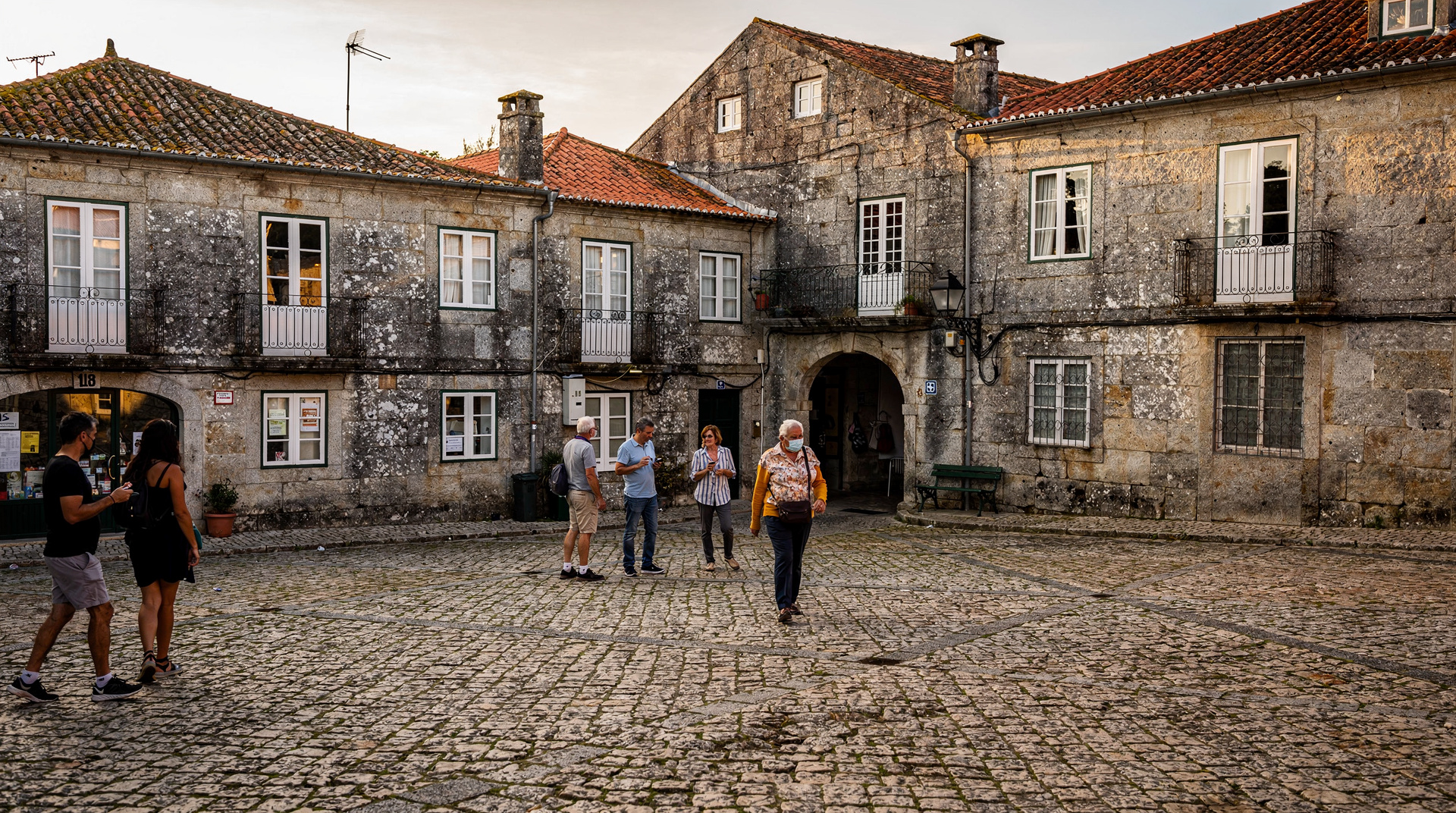
Rua de Santa Maria: The main street connecting Largo da Oliveira to the Largo do Toural below, Rua de Santa Maria is the best-preserved medieval street in the city. Granite arcades run along the ground floors; the upper storeys have wooden balconies and traditional iron railings. The buildings date from the 14th to 17th centuries. Walk it slowly and look up at the details — the carved stone lintels, the medieval doorways, the street-level fountains that once served as the neighbourhood water supply.
Largo do Toural: The lower square is the civic heart of modern Guimarães — cafés, banks, the main post office. The 18th-century Chafariz fountain in the centre is a useful landmark for orientation.
Museu Alberto Sampaio: On Rua Alfredo Guimarães, adjacent to the Igreja de Nossa Senhora da Oliveira, the museum houses a collection of medieval religious art, silverware and textiles from the region’s churches and monasteries. Entry around 3 €. The collection includes the silver triptych that Dom João I supposedly carried at the Battle of Aljubarrota — a primary historical object of real significance.
The cable car to Santa Catarina hill
The Teleférico de Guimarães connects the city centre to the Penha hill, a forested granite summit 5 km east with viewpoints that look back across the city and out toward the Minho valley. The cable car takes about 10 minutes and costs around 7.50 € return. The viewpoints at the top are good, and the forest trails (including some rock formations used for climbing) make it a pleasant stop if you have afternoon time to spare.
It is not the first priority in Guimarães, but it rounds a full day visit well. The top also has a café and the Santuário da Penha, a pilgrimage church embedded into the granite rocks.
Where to eat in Guimarães
Taberna da Praça: On Largo da Oliveira, consistently rated among the best traditional restaurants in the city. Honest regional cooking — vitela à Braga (veal), bacalhau preparations, rojões (pork with lard and potatoes). Lunch mains 12–18 €. Reservations recommended for weekend lunch.
El Rei Dom Afonso: In the medieval centre, reliable regional food in a space that doesn’t lean too hard into the medieval theme. Good value lunch menu at 12–14 €.
Cervejaria Martins: On Rua Paio Galvão, a local institution — unpretentious, grilled meats and fish, local wine. Lunch 10–14 €. Typically crowded with locals at midday, which is the reliable indicator in Portugal.
For a coffee: Café Elegância on Largo do Toural is the historic option — traditional interior, genuine coffee, reasonable prices.
Honest assessment
Guimarães is one of the best-value day trips from Porto precisely because there is very little that disappoints. The castle delivers, the old town delivers, the Paço dos Duques delivers, and the food scene is genuinely good. The tourist infrastructure is modest compared to Porto or Lisbon — this keeps prices reasonable and crowds manageable outside summer.
The one honest warning: summer weekends in July and August bring significant tourist volumes into the old city (it is a very popular destination for Spanish visitors from Galicia). The castle area and Rua de Santa Maria can feel congested between 11 am and 3 pm. Arriving early and finishing your outdoor sightseeing before lunch avoids this completely.
Combining Guimarães with the rest of your Porto trip
Guimarães pairs naturally with Braga, both as a day trip combination and as a multi-day northern Portugal itinerary stop. The northern Portugal 7-day itinerary uses both cities as anchor points. If you are spending more than three days in Porto, Guimarães is the single most historically significant thing to add.
The best day trips from Porto overview gives the comparative ranking across all major options.
Half day vs full day: what you actually get
| Half day (3–4 hrs) | Full day (6–8 hrs) | |
|---|---|---|
| Castle + Torre de Menagem | Yes | Yes |
| Paço dos Duques | Yes | Yes |
| Rua de Santa Maria walk | Rushed | Unhurried |
| Museu Alberto Sampaio | No | Yes |
| Cable car to Santa Catarina | No | Yes |
| Sit-down lunch | Quick | Relaxed |
| Realistic budget | 15–20 € | 25–35 € |
If you are combining Guimarães with Braga in the same day, the half-day version of Guimarães is the one that fits — see the Braga and Guimarães combined guide for how to split the hours between the two.
Shoulder-season and off-peak timing
April, May, September and October are the sweet spot for a Guimarães day trip: warm enough for the outdoor sightseeing that dominates the visit (castle walls, Rua de Santa Maria, the two squares), but without the July–August crowd volumes that build up around the castle and the cable car queue. Winter is genuinely workable too — the old town’s granite architecture and covered arcades hold up well in light rain, and the Paço dos Duques and Museu Alberto Sampaio are indoor options if the weather turns. The one winter caveat is the cable car to Santa Catarina hill, which occasionally suspends operation in high winds; check before planning your day around it. Outside these windows, expect thinner crowds but also slightly reduced hours at some smaller attractions, so confirm opening times the day before rather than assuming peak-season schedules apply.
Where Guimarães fits against Porto’s other day trips
Guimarães is not the only historic option within reach of Porto, and it’s worth knowing how it compares. Against Braga, Guimarães wins on medieval atmosphere and history while Braga wins on baroque church architecture and the Bom Jesus sanctuary. Against Aveiro, the two are almost opposite experiences — canals and Art Nouveau versus stone castle and Gothic streets — so pairing one of each across a multi-day Porto trip covers more ground than repeating similar themes. The best day trips from Porto overview ranks all the realistic options side by side if you are still deciding where Guimarães should rank in your itinerary.
Frequently asked questions about the Guimarães day trip
Is Guimarães worth visiting if I’ve already been to Porto?
Yes — Guimarães offers something entirely different from Porto. The medieval urban fabric, the castle, and the historical significance of the site are not replicated in Porto. If you have a free day and have already done Porto’s main sights, Guimarães is the most culturally rewarding use of that time.
How much money do I need for a day in Guimarães?
Budget around 25–35 € for a full day: 7 € for train return, 5 € for Paço dos Duques, 2 € for castle interior, 12–15 € for lunch, 2 € for coffee, and a small reserve for the cable car or museum if you choose. Very affordable by Western European standards.
Is Guimarães good for families with children?
Yes — the castle is engaging for children who like walls to climb and towers to look from. The old town streets are safe for walking with children. The cable car is a hit with most ages. The Paço dos Duques interior is more rewarding for adults, but the armour and weapons collection holds children’s attention reasonably well.
What is the best souvenir from Guimarães?
Cutlery and knives — Guimarães has been a centre for cutlery production for centuries. The shops around the historic centre stock handmade knives, scissors and cutlery from local workshops. The craft is genuine, the prices are reasonable, and a good knife is more useful than most travel souvenirs.
Is Guimarães accessible on foot from the train station?
The walk from the station to the old town takes about 15 minutes on a largely flat route. The castle hill adds some additional climbing once you are in the historic centre. Overall, mobility requirements are moderate — the key sites involve some steps and uneven stone surfaces, but there are accessible routes around most of the historic core.
Frequently asked questions — Guimarães day trip from Porto — the honest guide
How do I get from Porto to Guimarães by train?
Take a direct train from Porto Campanhã or Porto São Bento to Guimarães. The journey takes about 1 hour 15 minutes and costs approximately 3.50 €. Trains run every 1–2 hours. The CP (Comboios de Portugal) app or website has current schedules. There is no need to book in advance for this service.How long do you need in Guimarães?
A half day (3–4 hours) covers the castle, the Paço dos Duques and a walk through the medieval old town. A full day allows you to add the Museu Alberto Sampaio, a cable car to the Santa Catarina hill viewpoint, lunch at a good restaurant and time to sit in the main square without rushing.Is the Guimarães castle worth visiting?
The castle exterior and the Torre de Menagem (keep) are impressive and the views from the walls are the best in the city. Entry to the castle grounds is free; the interior museum has a small charge (around 2 €). The Paço dos Duques next to it is the more architecturally rewarding interior.What is the significance of Guimarães in Portuguese history?
Guimarães Castle is traditionally identified as the birthplace of Afonso Henriques, who became Portugal's first king in 1139 and established the independent Kingdom of Portugal. The phrase 'aqui nasceu Portugal' (here Portugal was born) appears throughout the city. The Paço dos Duques was later the 15th-century palace of the Dukes of Bragança, who became Portugal's royal dynasty.What is the Paço dos Duques de Bragança?
The Paço dos Duques (Duke's Palace) is a 15th-century palace at the base of Guimarães hill, originally the residence of the first Duke of Bragança. It fell into disuse and was heavily restored in the 20th century. The museum inside houses Flemish tapestries, Portuguese furniture, ceramics, arms and armour from the 15th and 16th centuries. Entry costs around 5 €.Can I visit Guimarães and Braga in one day?
Yes. The two cities are connected by a direct regional train (around 40–45 minutes). Arriving in Braga first by 9 am, spending the morning there, and moving to Guimarães by early afternoon is tight but achievable. See the combined guide for the logistics.
Top experiences
Bookable activities with verified prices and instant confirmation on GetYourGuide.