Best day trips from Porto — the honest guide
Porto: From Porto Braga and Guimaraes Full Day Trip
What is the best day trip from Porto?
Braga or Guimarães for culture and history on an easy train ride. Aveiro for the canal boats and coastal scenery. The Douro Valley for wine and dramatic landscape. Gerês National Park for those who want wild nature and swimming holes. Santiago de Compostela is the longest option but genuinely rewarding.
How to choose your day trip from Porto
Porto sits at the heart of a region that packs more variety into a two-hour radius than most countries manage in their entirety. You have medieval hilltop towns, baroque staircases, Atlantic canals, ancient universities, Europe’s only continental national park and a pilgrimage cathedral all within easy reach. The practical constraint is time — you have one day, possibly two — and the honest challenge is choosing wisely.
This guide ranks the eight best day trips from Porto with specific guidance on transport, realistic timing, what each destination actually delivers and who it suits best. The rankings are based on return value, ease of access and what makes each trip genuinely different from spending another day in Porto itself.
| Easiest by train | Braga, Guimarães, Aveiro (all around 1 hour) |
| Needs a car | Gerês National Park; Arouca is easiest with a car too |
| Cheapest DIY option | Braga or Guimarães, around 3.50 € each way |
| Longest trip | Santiago de Compostela, ~2.5 hrs each way |
| Best time of year | April–June and September–October |
The eight ranked at a glance:
| Rank | Destination | Distance | Transport | Best for |
|---|---|---|---|---|
| 1 | Braga | 50 km | Train, 1 hr | Architecture, Bom Jesus staircase |
| 2 | Guimarães | 50 km | Train, 1h15 | Medieval history, UNESCO centre |
| 3 | Braga + Guimarães | 50–60 km | Train or tour | Combining both in one day |
| 4 | Aveiro | 75 km | Train, 1 hr | Canals, moliceiro, Costa Nova |
| 5 | Coimbra | 130 km | Fast train, 1 hr | Universities, Biblioteca Joanina |
| 6 | Gerês National Park | 90 km | Car or tour | Waterfalls, swimming, hiking |
| 7 | Arouca | 75 km | Car or tour | 516 bridge, Paiva walkways |
| 8 | Santiago de Compostela | 230 km | Car or tour | Pilgrimage cathedral, Galicia |
1. Braga — the best single day trip overall
Distance from Porto: 50 km north | Transport: direct train 1 hour, around 3.50 € | Best for: architecture, religious culture, viewpoints
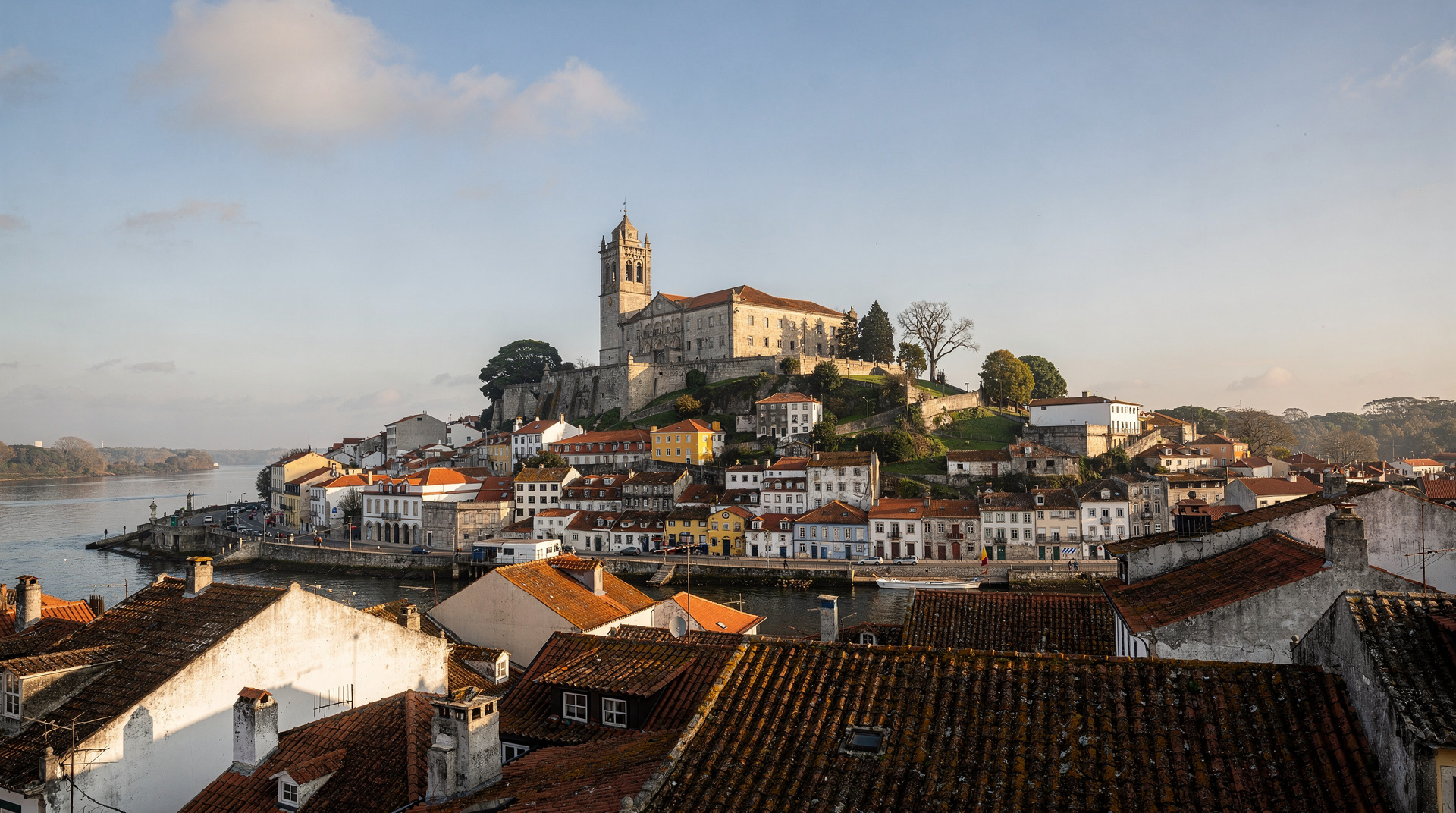
Braga is the closest thing to a perfect day trip from Porto. The train journey is short and the station drops you close to the historic centre. The cathedral, the Sé Catedral de Braga, is the oldest in Portugal — construction began in 1070, and layers of every architectural period from Romanesque to baroque are visible in a single building. The ornate south portal and the impressive interior chapels reward an hour of slow attention.
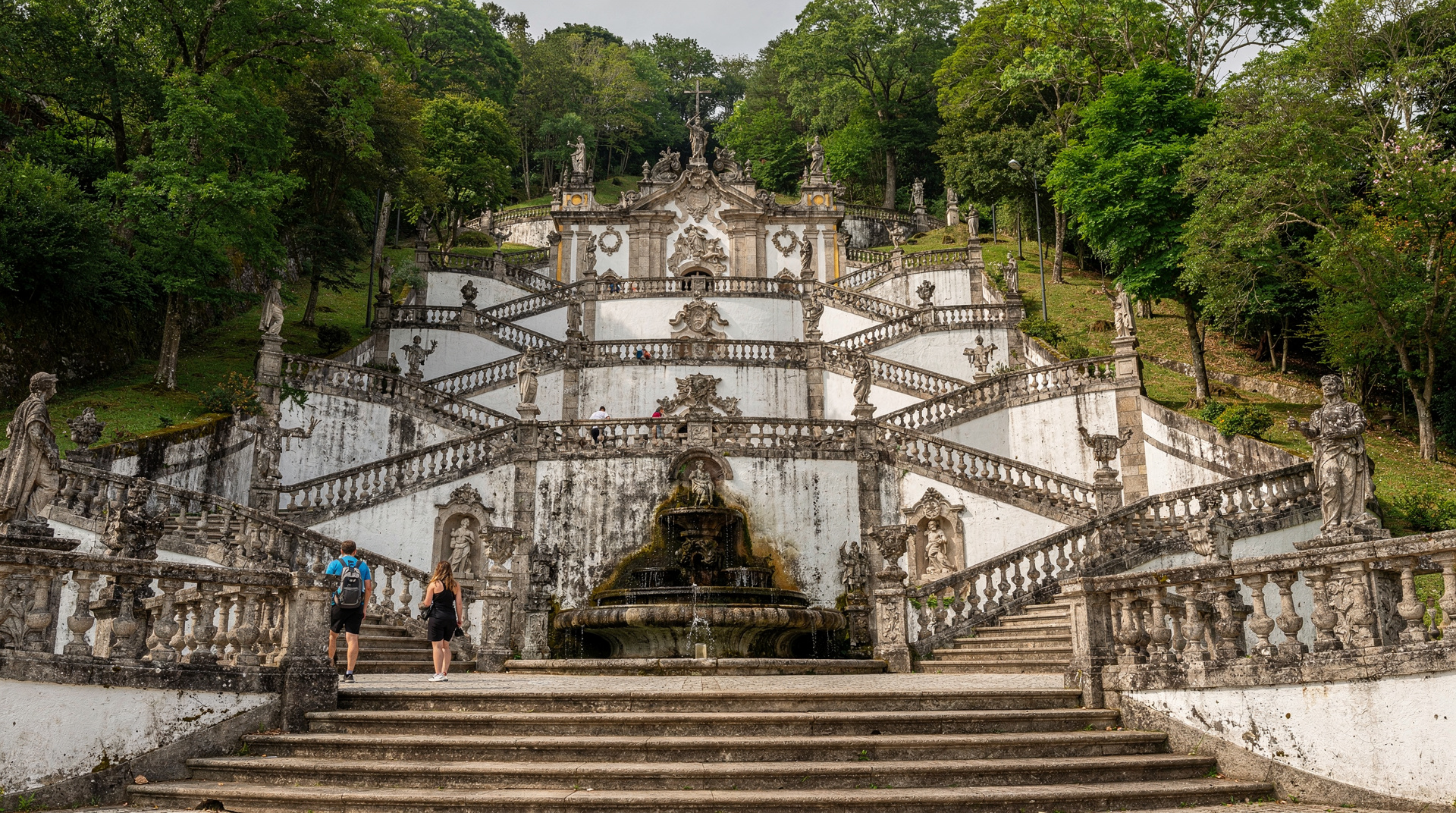
The real draw is Bom Jesus do Monte, a baroque sanctuary perched on a forested hill 5 km east of the city. The external staircase — a 116-metre cascade of granite steps flanked by fountains, chapels and statues of the five senses and the twelve apostles — is one of the most impressive architectural compositions in Portugal. You can walk up (roughly 20 minutes, steep) or take the 1882 water-powered funicular, which is one of the oldest of its kind in the world. The views across the Minho valley from the top terrace are excellent. A combined Braga and Bom Jesus visit takes around four to five hours, leaving time for lunch and a wander through the pedestrianised city centre.
The Braga market around Praça do Município is worth passing through on weekday mornings. Lunch near the university district (the city has a large student population) produces better value than the tourist restaurants on Rua Dom Diogo de Sousa.
The full Braga day trip guide covers the practical detail, timing and what to skip.
2. Guimarães — the cradle of Portugal
Distance from Porto: 50 km north | Transport: direct train 1 hour 15 minutes, around 3.50 € | Best for: medieval history, UNESCO heritage, castle walls
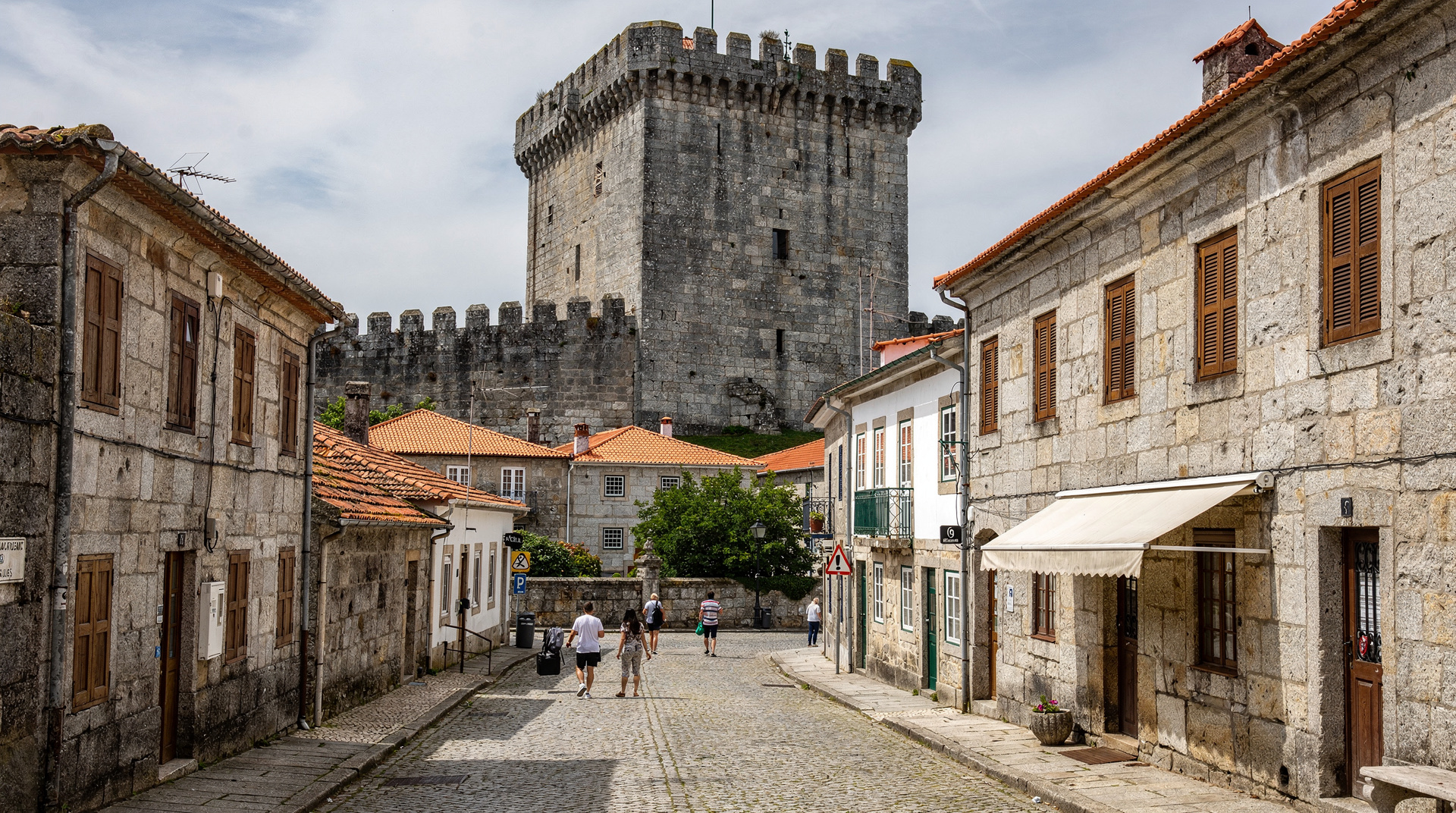
Guimarães holds a unique place in Portuguese national consciousness. The castle here is where Afonso Henriques, the first king of Portugal, was born in 1110, and the phrase “aqui nasceu Portugal” — here Portugal was born — appears on plaques throughout the old city. The historic centre is a UNESCO World Heritage site, and deservedly so: the medieval quarter around Largo da Oliveira and Rua de Santa Maria is one of the best-preserved in the Iberian Peninsula, with granite arcaded streets and balconied townhouses that have remained largely unchanged for 500 years.
Two sites anchor the visit: the 10th-century castle on the hill above the city, and the Paço dos Duques de Bragança at its foot. The palace was the 15th-century residence of the Dukes of Bragança (who later became Portugal’s royal dynasty), now restored as a museum. The interior has an impressive collection of Flemish tapestries, furniture and period weaponry. Entry costs around 5 € for the palace, free for the castle grounds.
The descent through the old city from castle to Largo do Toural takes 40–50 minutes if you move slowly and look at doorways. The streets around Largo da Oliveira have several good lunch options. Guimarães as a day trip is one of the most straightforward excursions from Porto.
3. Braga and Guimarães combined — the full northern culture day
Distance from Porto: 50–60 km north | Transport: train or organised tour | Best for: maximising one day in the Minho
The two cities are 22 km apart and connected by a direct regional train (around 45 minutes), which makes combining them in a single day genuinely viable. The typical route: take an early train to Braga, spend the morning at the Sé and Bom Jesus, have lunch in Braga, take the regional train to Guimarães in early afternoon, walk the historic centre and castle, and catch an evening train back to Porto from Guimarães.
The schedule is tight but manageable if you leave Porto by 8:30 am. An organised combined tour handles the logistics and adds a local guide — useful for understanding the layers of history at both sites. Tour prices for a combined Braga and Guimarães day run around 40–60 €, which is competitive given you’d spend 7 € on train tickets and potentially lose an hour to logistics on the DIY version.
Book the combined Braga and Guimarães day trip from PortoThe combined Braga and Guimarães guide compares the tour and DIY options in detail.
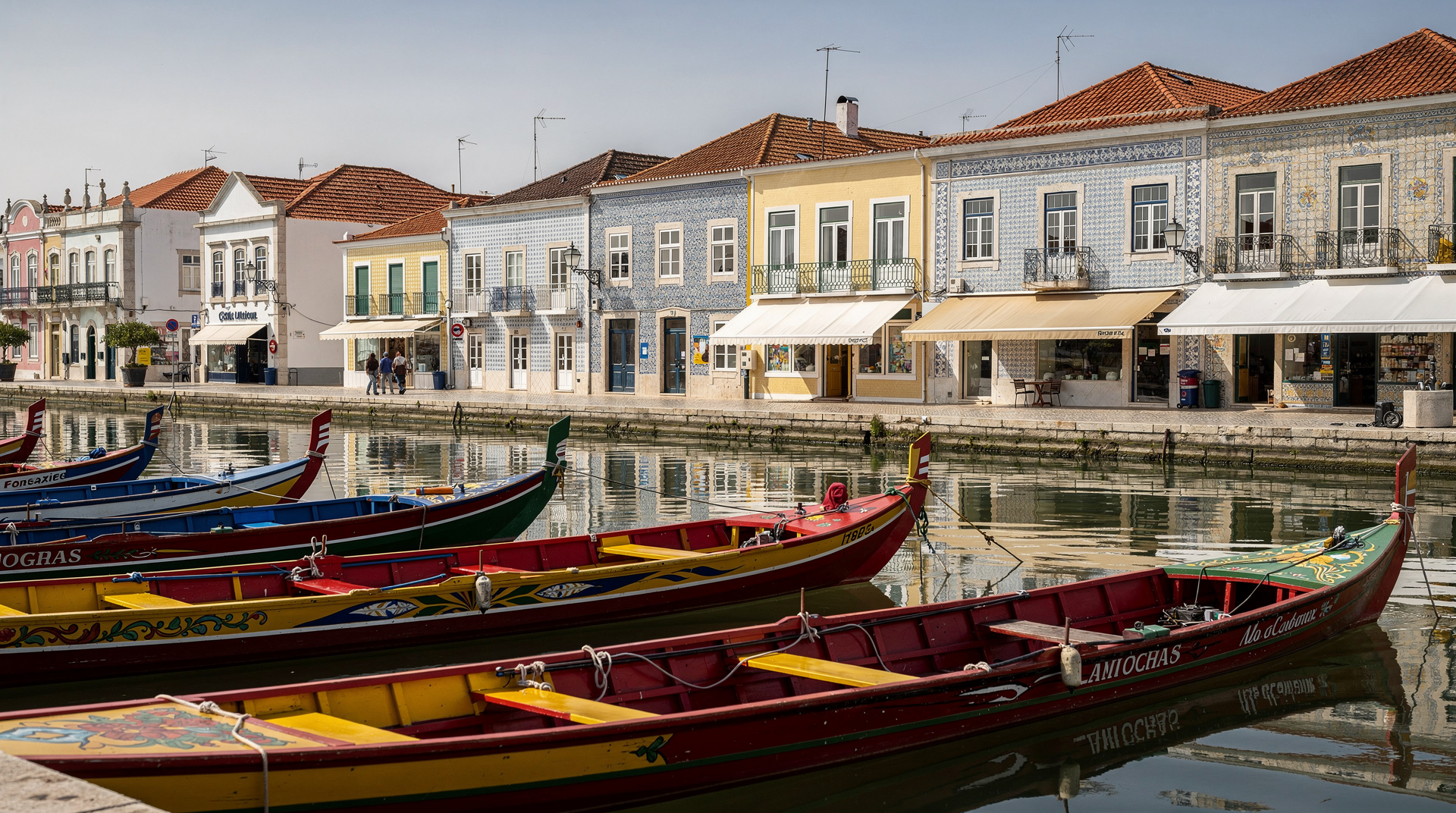
4. Aveiro — the Venice of Portugal (with caveats)
Distance from Porto: 75 km south | Transport: direct train 1 hour, around 3.80 € | Best for: canal boats, ovos moles, Costa Nova stripes
Aveiro earns the “Venice of Portugal” comparison more honestly than most cities given that label. The central canals are narrow, genuinely photogenic, and still worked by traditional moliceiro boats — wooden flat-bottomed vessels with high painted prows that were historically used to collect seaweed fertiliser from the lagoon. A moliceiro canal cruise takes around 45 minutes and costs around 15 €; it is the single thing most worth doing in Aveiro.
The town itself is compact. Art Nouveau architecture from the late 19th century dominates the centre — Aveiro had a prosperous period from Atlantic trade and the buildings from that era are distinctive. The Museu da Cidade houses azulejos and tiles from the region. Ovos moles — a local sweet made from egg yolk and sugar, traditionally sold in small wooden barrels shaped like shells or fish — are the culinary souvenir: genuinely good and very local.
Costa Nova, 8 km south of Aveiro, adds the striped fishermen’s houses (palheiros) that appear on every Aveiro photograph. The brightly coloured vertical stripes on white houses along the beach road are a peculiarly photogenic tradition. Combined with Aveiro, a half-day covers both comfortably with a car; with public transport, factor in a local bus connection.
Book the Aveiro and Costa Nova full day trip from PortoThe full Aveiro day trip guide covers the moliceiro, the sweets and the logistics in detail.
5. Coimbra — Portugal’s Oxford
Distance from Porto: 130 km south | Transport: Alfa Pendular train 1 hour, around 7.50 € | Best for: universities, medieval history, libraries
Coimbra has the oldest university in Portugal — founded 1290 — and the most spectacular library in the country. The Biblioteca Joanina is an 18th-century baroque library with three rooms of floor-to-ceiling shelves, painted ceilings, and a colony of bats that live inside and protect the manuscripts from insects. Entry to the library costs around 22 € (or 12.50 € for the Old University complex alone). The time-slotted ticketing is strict: book online in advance.
The old university area sits high above the city. The walk up through the medieval streets is strenuous but rewarding — the views over the Mondego river from the Alta neighbourhood are among the best urban viewpoints in Portugal. Below, the Sé Velha (Old Cathedral) is a Romanesque fortress-church that survived the Moorish occupation; the cloister is particularly striking.
Coimbra is also associated with its own variant of fado — more literary and lament-filled than Porto’s tradition, sung by university students in black capes. If you are visiting in the evening (Coimbra merits an overnight stay for the full experience), the fado performance is worth seeking out.
Book the Coimbra and Fátima full day tour from PortoThe Coimbra day trip guide covers the Biblioteca Joanina booking, the fado scene and what else to see in a single day.
6. Gerês National Park — the wild option
Distance from Porto: 90 km northeast | Transport: car (essential) or organised tour | Best for: waterfalls, swimming holes, mountain hiking
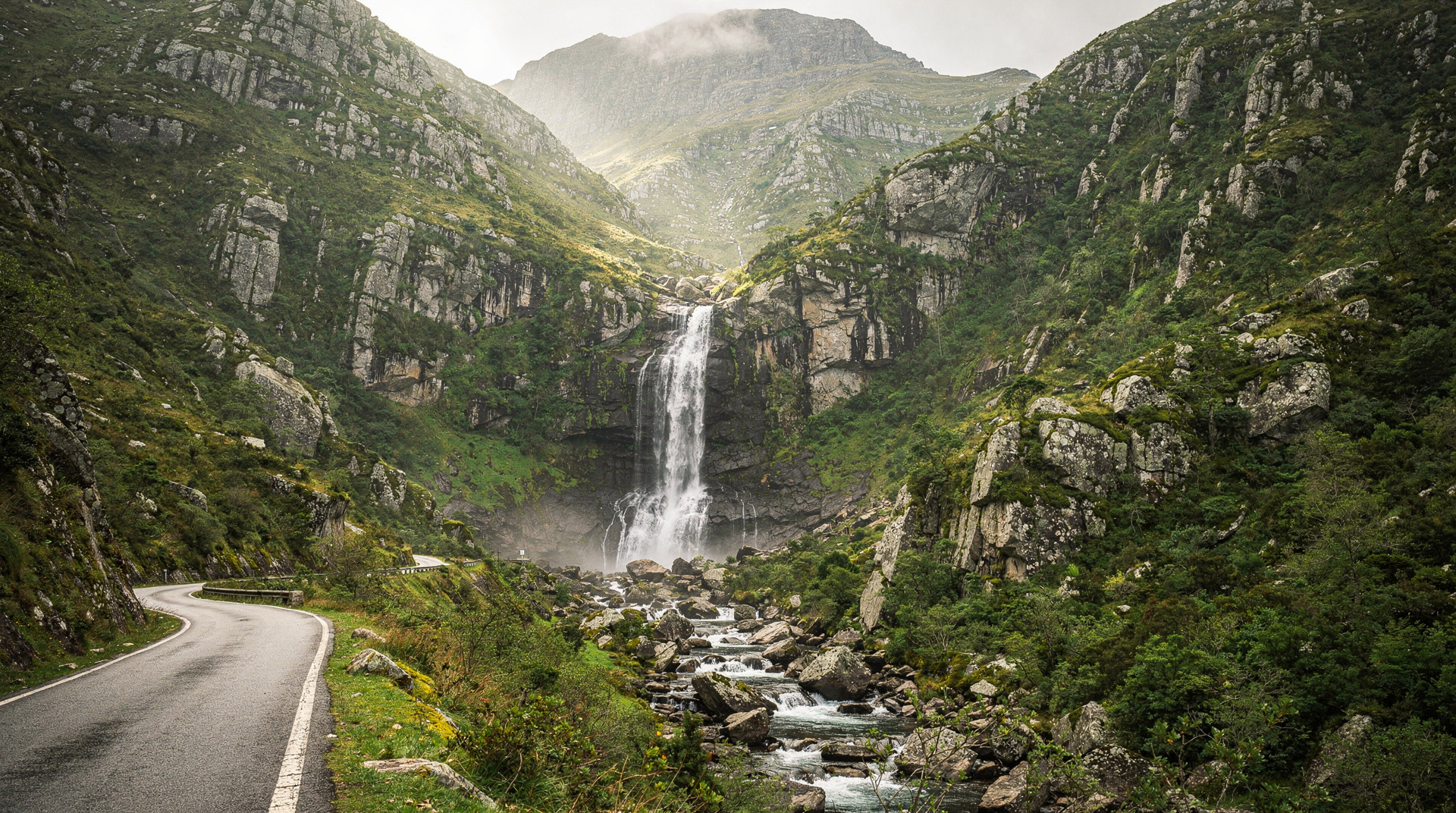
Peneda-Gerês is the only official national park in Portugal and the only one in continental Europe with a “national park” designation rather than the more permissive “nature park” classification. It is correspondingly wild: granite mountains, Celtic-period villages, waterfalls that feed rivers cold enough for swimming in summer, and wolves and wild ponies (garranos) in the less-visited sections.
The park is genuinely difficult to reach without a car. Public transport from Porto involves a bus to Braga and a connection that drops you at the park periphery, not inside it. An organised tour is the practical alternative for those without a vehicle — and several tours include swimming stops at specific pools, which makes the logistics considerably easier.
The most visited section is around the village of Gerês itself and the Cávado reservoir, where a good network of trails reaches viewpoints and waterfalls within 3–5 km of the road. The Tahiti pool (Praia Fluvial de Adrão) and the waterfall at Fecha de Barjas are among the most visited natural features. In July and August these get crowded by midday — arrive by 10 am.
Book the Gerês National Park day trip from PortoThe Gerês day trip guide covers the specific trails, swimming holes and how to plan the logistics.
7. Arouca — the 516 walkway and Paiva river
Distance from Porto: 75 km southeast | Transport: car or organised tour | Best for: Europe’s longest pedestrian suspension bridge, river walkways
Two separate experiences converge at Arouca. The first is the 516 Arouca suspension bridge — 516 metres long, strung between canyon walls above the Paiva river at a height of 175 metres, and until recently the longest pedestrian suspension bridge in the world. The crossing takes around 10–15 minutes; the views of the river gorge below are genuinely vertiginous even for confident walkers.
The second is the Passadiços do Paiva — 8.7 km of wooden boardwalks built along the Paiva river through a protected valley. The trail passes waterfalls, rocky swimming pools and granite gorge walls. It is a one-way route (start at Espiunca for the most scenic downhill direction) and takes 3–4 hours at a comfortable pace. Good footwear is essential — the path is well-maintained but rocky in places.
The bridge and the walkways are separate tickets and separate starting points. The bridge costs around 12 € and requires advance booking; it sells out weeks ahead in summer. The Passadiços trail entry is around 8 €. A combined day doing both is achievable but long — leave Porto by 8 am.
Book the Arouca 516 bridge and Paiva walkways day tripThe detailed Arouca and Paiva guide covers the booking logistics, what to expect on the bridge and how to plan the trail.
8. Santiago de Compostela — crossing into Galicia
Distance from Porto: 230 km north | Transport: car or organised tour | Best for: pilgrimage culture, Galician architecture, cathedral
Santiago de Compostela is the longest day trip on this list — the city is across the Spanish border in Galicia, roughly 2.5 hours by car from Porto. The extra effort is worthwhile if cathedrals and pilgrimage culture hold genuine interest: the Catedral de Santiago de Compostela is one of the great Romanesque buildings of Europe, the endpoint of the Camino de Santiago pilgrimage routes that draw hundreds of thousands of walkers annually from across the world.
The pilgrim atmosphere in the old city — the Zona Monumental is a UNESCO World Heritage site — is distinctive and unlike anything in Portugal. The Plaza del Obradoiro, the cathedral square, is one of Europe’s most impressive urban spaces. Inside, the botafumeiro (a giant incense burner swung on a pulley across the transept during certain masses) is one of the memorable spectacles of Iberian Catholicism. The pilgrims’ mass is celebrated at noon; arriving before 11 am secures a reasonable position.
An organised day tour from Porto handles the driving and includes a local guide who explains the pilgrimage history and the city’s architecture. DIY by car requires crossing the border (bring your passport — this is Spain, though in the Schengen area) and dealing with Santiago’s complex parking situation.
Book the Santiago de Compostela full day trip from PortoThe Santiago de Compostela day trip guide covers the cathedral in detail, the old city logistics and what to do with a full day across the border.
Combining day trips into a longer northern Portugal loop
If you have four days or more beyond your time in Porto itself, several of these day trips combine naturally into a multi-day loop rather than remaining isolated single-day excursions from a fixed Porto base.
The Minho loop (2–3 days): Braga and Guimarães on consecutive days, with an optional detour to Viana do Castelo on the coast, covers the Minho region’s essential culture and architecture without excessive backtracking. Basing yourself in Braga or Guimarães for a night rather than returning to Porto each evening saves transit time and allows a more relaxed pace at Bom Jesus do Monte or the Guimarães castle.
The Douro extension (2–4 days): Rather than treating the Douro Valley as a single rushed day trip, spending one to three nights in the valley — around Peso da Régua, Pinhão or a quinta stay — transforms the experience. Combine this with Amarante on the way in or out, since it sits directly on the route between Porto and the valley. The Douro wine lovers 4-day itinerary and the Porto and Douro 5-day itinerary both structure this properly.
The southern coast loop (1–2 days): Aveiro, Costa Nova and, with more time and a car, Arouca’s bridge and walkways, form a natural southern arc. Doing Aveiro and Costa Nova on one day and Arouca on a separate day (rather than trying to combine all three) keeps each day at a sustainable pace.
Adding Coimbra or Santiago de Compostela: Both of these work better as standalone additions to a longer Portugal trip — Coimbra as a stop en route further south (toward Lisbon or the Algarve), and Santiago de Compostela as a bridge into a Galicia extension — rather than as pieces of a tight northern Portugal loop focused on Porto itself.
The common thread across all these combinations: resist the temptation to see everything from a single Porto base. Moving your base for one or two nights, even within a relatively compact region, changes a trip from a series of rushed day trips into a genuinely layered exploration of northern Portugal.
Luggage logistics for a multi-base trip: Most Porto hotels will store luggage for a night or two if you plan to return to the city after a valley or Minho extension — worth confirming when you book, since it lets you travel light for the extension itself rather than hauling full luggage on a regional train.
When a rental car pays off: For a Minho-plus-Douro combination lasting three days or more, a rental car for that specific window often works out cheaper and considerably more flexible than a sequence of individual train tickets and taxis, even accounting for Porto’s more limited parking in the city centre itself.
Practical planning notes
Train tickets: Buy on the CP (Comboios de Portugal) website or app. Regional train prices rarely change but Alfa Pendular (fast service) tickets to Coimbra are cheaper booked in advance.
Organised tours vs DIY: For Braga and Guimarães, DIY by train is so easy and affordable that a tour offers marginal advantage unless you want the narrative guide element. For Gerês and Arouca, the transport problem makes a tour significantly more practical. For Douro Valley, both options are defensible depending on priorities — the Douro Valley day trip guide makes the comparison in detail.
ETIAS (from 2026): Visitors from outside the Schengen area should verify ETIAS requirements for crossing into Spain when visiting Santiago de Compostela. Portugal is Schengen; the border crossing is technically free but crossing into Spain still falls under ETIAS obligations.
Day trip cards: Porto’s Andante card is not valid on regional trains to Braga or Guimarães — you need a CP ticket for those services. The Andante covers urban metro and bus within the Porto metropolitan area.
Seasonal notes: Gerês swimming holes are only enjoyable from June to September. Vindima season (mid-September to early October) adds atmosphere to the Douro Valley but requires booking weeks ahead. São João festival (23–24 June) makes Porto itself the best place to be — worth planning other day trips around it rather than during it.
Frequently asked questions about day trips from Porto
How many day trips can I do in a week in Porto?
A week gives you a realistic three to four day trips if you pace yourself. The optimal sequence: Braga and Guimarães combined on day one, Douro Valley on day two, Aveiro on day three. Longer options like Santiago de Compostela or Coimbra work best as standalone full days.
Is it worth hiring a car for day trips from Porto?
A car opens up Gerês, Arouca and flexible Douro Valley access. For Braga, Guimarães and Aveiro, the train is faster than driving once you factor in Porto city traffic and parking. Hiring for two to three days of combined day trips makes more sense than a daily rental.
Are day trips from Porto suitable for families with young children?
Braga’s Bom Jesus funicular is fun for children. Aveiro’s moliceiro canal boats are a reliable hit. Gerês swimming holes work well for families from June to August. The Arouca walkways are unsuitable for children under about 6. The Douro Valley is long and wine-focused — better suited to older children and teenagers.
What should I pack for a day trip from Porto?
Comfortable walking shoes for any historical city. Sunscreen and a hat from April onwards. A light waterproof layer — northern Portugal weather shifts quickly, especially in the mountains and near the coast. Water bottle for Gerês and Arouca walks. Passport or ID card for Santiago de Compostela.
Frequently asked questions — Best day trips from Porto — the honest guide
Which day trips from Porto can I do by train?
Braga (1 hour, around 3.50 €), Guimarães (1 hour 15 minutes, around 3.50 €), Aveiro (1 hour, around 3.80 €) and Coimbra (1 hour, around 7.50 € on the fast service) are all excellent by train. Santiago de Compostela requires a car, tour bus, or a change in Vigo. Gerês and Arouca have no practical rail access.How much does a day trip from Porto typically cost?
Train-based DIY trips to Braga, Guimarães or Aveiro cost around 7–15 € per person for transport plus entry fees. Organised tours for Braga and Guimarães run 35–50 €. A Douro Valley tour costs 60–130 €. Arouca walkways with transfer run around 45–60 €. Santiago de Compostela organised tours cost around 50–80 €.What is the easiest day trip from Porto?
Braga is the easiest: direct trains run frequently, the main sights are concentrated and the Bom Jesus do Monte staircase can be reached by funicular. Guimarães is equally manageable and equally rewarding for a half-day visit.Which day trips from Porto require a car?
Gerês National Park is the only one where a car is genuinely necessary — public transport to the park interior is impractical. Arouca is technically reachable by bus, but the connections are slow and inconvenient. For all other major day trips, train or organised tour are the better options.Can I do two day trips in one day from Porto?
Braga and Guimarães work well as a combined full day — many tours offer exactly this combination. Aveiro and Costa Nova also pair naturally. Mixing, say, Coimbra and the Douro Valley in one day is not realistic.What is the best time of year for day trips from Porto?
April to June and September to October offer the best balance of weather, crowds and scenery. July and August are hot, crowded and more expensive. November to March is quieter, which works well for Braga and Guimarães but less so for Gerês swimming holes.
Top experiences
Bookable activities with verified prices and instant confirmation on GetYourGuide.