Aveiro day trip from Porto — the honest guide
Porto: Portoaveiro Cruise Costa Nova Capelha da Pedra Full Day
Is an Aveiro day trip from Porto worth it?
Yes — Aveiro is the most photogenic canal city in Portugal, the moliceiro boat ride is genuinely enjoyable, and Costa Nova's striped houses are worth the short detour. The train takes an hour and costs 3.80 €. A half day covers the essentials; a full day lets you add Costa Nova and a proper lunch.
Aveiro — the honest version of the Venice comparison
Every travel article calls Aveiro the “Venice of Portugal” and most of them move on quickly, as if the comparison is self-explanatory. The honest version: Aveiro has a genuine network of navigable canals through the city centre, traditional flat-bottomed boats that are actively used on those canals, and an old town built around the waterway system in a way that makes the water central to the experience rather than incidental to it. That earns the comparison more honestly than most cities given the label.
What it is not: a city of equivalent architectural grandeur to Venice, or one where the canal experience is as immersive. Aveiro is a mid-sized Portuguese city of around 80,000 people, most of whose fabric is ordinary. The historic centre around the canals is compact — perhaps 500 metres in any direction from the central Rossio canal. The quality of that central zone, and the specific pleasures of a moliceiro ride and an ovos moles stop, make a day trip from Porto genuinely worthwhile. The Venice comparison describes a flavour, not a scale.
| Where | Aveiro, ~75 km south of Porto |
| Cost | Train around 3.80–14 €; moliceiro cruise ~12–15 €; museums €2–5 |
| Time needed | Half day for the canal and centre; full day to add Costa Nova |
| Getting there | ~1 hour by train from Porto Campanhã or São Bento |
| Best time | Weekday mornings, and outside July–August for smaller crowds at the moliceiro dock |
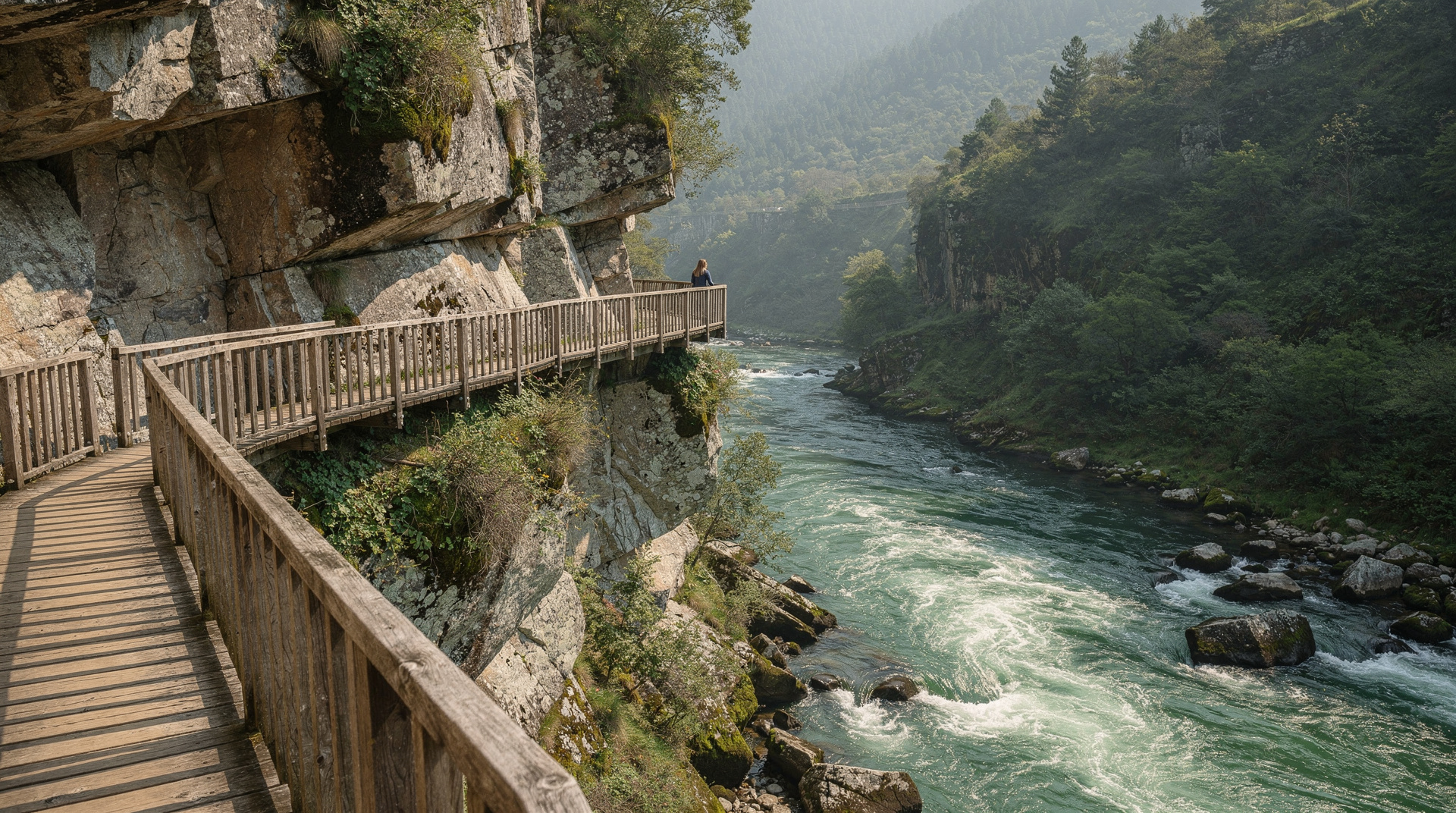
This guide compares against Porto’s other options in the best day trips from Porto guide, and pairs naturally with a look at the Arouca 516 bridge and Paiva walkways if you have a car and want to combine southern day trips.
Getting from Porto to Aveiro
Direct trains run from Porto Campanhã and Porto São Bento to Aveiro throughout the day. The journey time depends on the service:
Alfa Pendular or Intercidades (fast service): Around 55–60 minutes. Prices vary from around 7–14 € depending on class and advance booking. Comfortable, air-conditioned carriages.
Regional (Urbanos de Lisboa / Comboios Regionais): Around 1 hour 30 minutes. Around 3.80 €. Slower but the cheapest option.
The fast service is worth the modest price premium if you want to maximise time in Aveiro. Buy tickets on the CP (Comboios de Portugal) app or website — the fast services have seat reservations and sell out ahead of time on weekends.
Aveiro station is 10 minutes’ walk from the canal district. Taxis from the station to the canal are available for around 5 €.
Organised tours from Porto handle transport and often include the moliceiro boat and Costa Nova in a single package — useful if you do not want to organise the Costa Nova bus connection independently.
Book the Aveiro and Costa Nova full day trip from PortoBy car: Aveiro is 75 km south of Porto on the A1/A29 motorway. The drive takes around 50 minutes. Parking is available in the centre but can be congested in summer. Driving is worth it if you are also adding Costa Nova or nearby Ílhavo.
The moliceiro boat ride — the essential experience
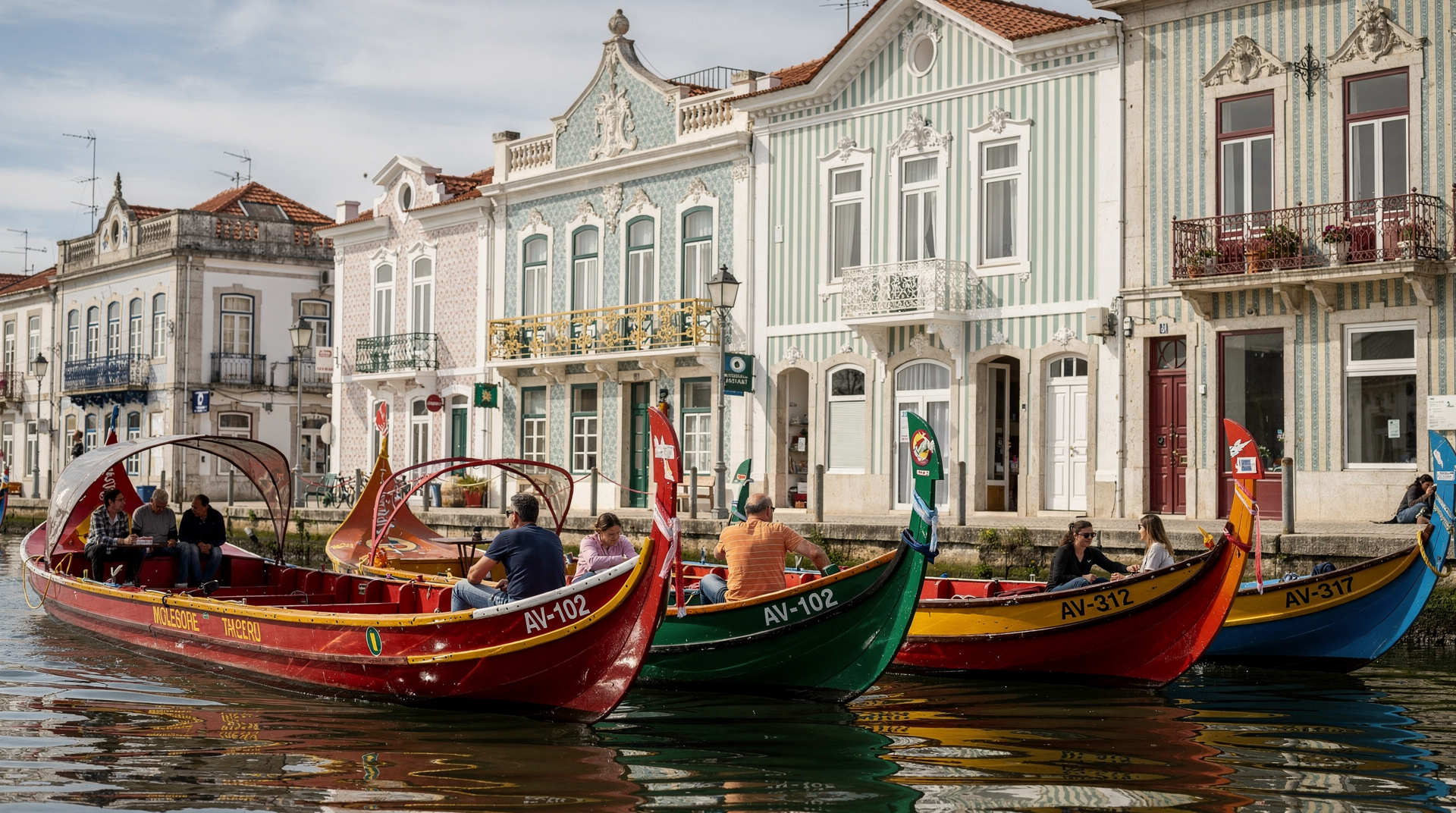
A moliceiro canal cruise is the single most enjoyable thing in Aveiro. The traditional flat-bottomed wooden boats, painted with vivid decorative panels on their high curved prows, move slowly through the central canals at a pace that allows you to look properly at the Art Nouveau buildings and the life of the canal banks.
Cruises depart from the Rossio canal, the main central waterway, and last around 45 minutes to an hour. The price is approximately 12–15 € per person. Multiple operators line the canal side — services are broadly equivalent, and the boats themselves are the attraction rather than the operators. Book in advance on weekends and in summer; on weekday mornings in low season you can often board directly.
The prow panels of the moliceiros are an art form in their own right. Traditionally they depicted comic scenes, religious subjects, and satirical commentary on current events — a kind of floating popular illustration. The panels on modern moliceiros continue the tradition, with hand-painted scenes ranging from religious images to football commentary. Look at each boat’s prow panels before choosing which cruise to take: the variety is genuine and entertaining.
Book the Aveiro moliceiro cruise from PortoThe Art Nouveau architecture
Aveiro’s prosperity in the late 19th and early 20th centuries — built on fishing, salt extraction and the seaweed fertiliser trade — produced a significant wave of Art Nouveau building that remains unusually concentrated in the historic centre. Portuguese Art Nouveau (Arte Nova) used azulejo tiles as an exterior cladding in ways that created particularly striking facades.
The standout example is the Casa de Major Pessoa (now a small museum on Rua Barbosa de Magalhães), a private house whose exterior is entirely covered in polychrome azulejo tiles in organic Art Nouveau patterns. The Museu Art Nova (Casa de Major Pessoa) charges a small entry fee (around 2 €) and is worth 20 minutes inside. More broadly, a walk along the Rossio canal and the surrounding streets reveals a consistent quality of Art Nouveau decoration on commercial and residential buildings — look for the tiled facades, the organic ironwork on balconies, and the curved window surrounds.
The Museu da Cidade de Aveiro occupies the former Monastery of Jesus, where the blessed queen consort Joana de Portugal is entombed. The Gothic cloister and the baroque tile panels (18th century, exceptionally fine) make this the most significant interior in Aveiro outside the Art Nouveau houses. Entry around 4 €.
Ovos moles — the correct approach
Ovos moles are the culinary identity of Aveiro. Made from egg yolk beaten with sugar syrup and encased in a thin white wafer shell, they are sold in almost every shop in the city centre — but quality varies significantly.
The best ovos moles come from one of the licensed artisan producers: Casa Constância (Rua Elísio Belo) and Confeitaria Peixinho (Rua do Tenente Resende) are the most consistently recommended. The wafer should be thin and slightly dry, the interior silky and rich without being cloying. Cheap versions from souvenir shops are made in bulk and lack the textural contrast.
The traditional vessel for ovos moles is a small barrel-shaped wafer, but the maritime shapes — fish, crabs, shells, boats — are the most appealing visually and taste no different. A small box of 12–15 pieces costs around 5–8 € and travels well for a day’s journey back to Porto.
Costa Nova — the striped houses
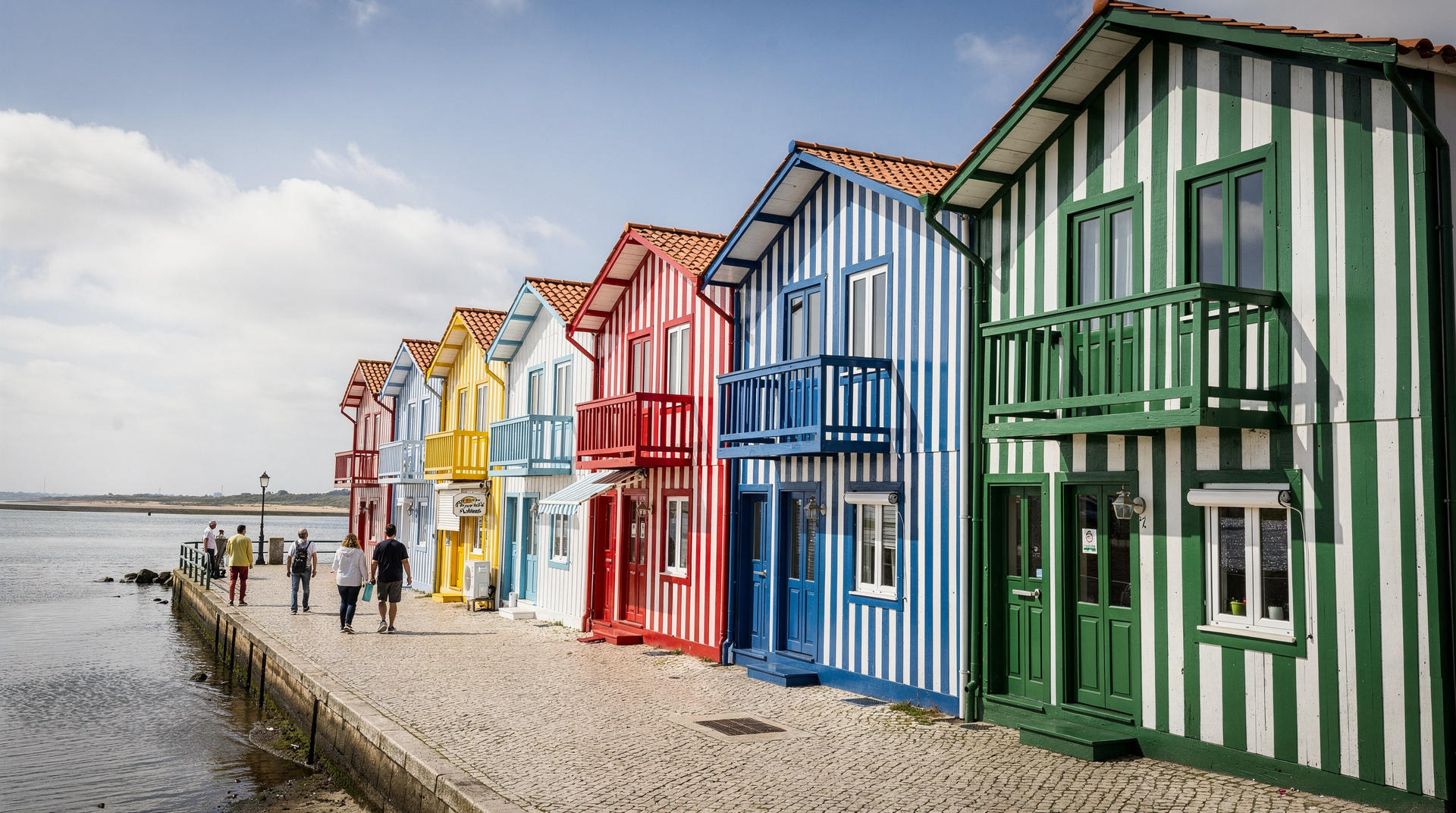
Costa Nova do Prado sits on a narrow sandy tongue between the Aveiro lagoon and the Atlantic ocean, 8 km south of the city. The village’s fame rests on its palheiros — fishing families’ houses and storage sheds painted with vertical stripes in contrasting colours. The most photographed row of palheiros is on Rua dos Palheiros: alternating red-and-white, blue-and-white, green-and-white facades, two storeys, consistently painted and maintained.
The visual impact of the stripes is genuinely stronger in person than in photographs, which is rare for a purely aesthetic experience. The colours are bright, the pattern is consistent, and the narrow street with the lagoon visible at one end and the dunes at the other creates a setting that photographs well from multiple angles. It is entirely a visual pleasure, not a cultural one — there is no museum or interior to visit, just a fishing village that happens to look unlike anywhere else in Portugal.
Getting to Costa Nova: Local bus 39 runs from Aveiro city centre (Platform 7 at the bus terminal near the train station) to Costa Nova in around 30 minutes, approximately every 30–45 minutes. Fare around 1.80 €. Taxi from Aveiro is around 12–15 € one way.
The beach at Costa Nova (Praia da Costa Nova) is a wide Atlantic beach with strong waves — good for surfing and beach walking, less suitable for young children swimming due to the ocean currents. In summer (June to September), the beach is popular with Portuguese families from the surrounding region. See the best beaches near Porto guide for how Costa Nova compares with the beaches closer to the city.
Combining Aveiro and Costa Nova comfortably requires at least a full day. If you are arriving at Aveiro at 10 am, plan to reach Costa Nova by 2–2:30 pm at the earliest after covering the city centre sights and lunch. The last buses from Costa Nova to Aveiro are in the early evening.
Where to eat in Aveiro
Tasca da Ermelinda: A compact, cheerful restaurant on Rua João de Moura. Generous portions of traditional regional food, local wine, prices that reflect the local economy (lunch 10–14 €). Popular with Aveiro locals at midday — a reliable indicator in Portugal.
Mercado do Peixe: The fish market area on the Rossio canal has several informal lunch options using the morning’s catch. Not a formal restaurant district, but an honest seafood experience close to the water.
O Bairro: Rua de Coimbra, slightly away from the canal tourist zone. Straightforward regional cooking, good bacalhau, reasonable prices. Lunch prato do dia around 9–12 €.
Salpoente: A more upscale option in a converted salt warehouse on the canal — regional cuisine with more contemporary presentation. Mains around 18–25 €. Better for an evening meal if you are staying overnight.
For something quick: the canal-side cafés serve sandwiches, espresso and pastries throughout the day. Avoid the most tourist-facing ones on the Rossio (prices rise rapidly within sight of the moliceiro dock) — walk one street back for better value.
Practical timing
Aveiro is busiest from late June to August. The moliceiro docks are crowded from 10 am to 3 pm in peak summer. Weekend mornings in particular fill quickly. If you are visiting in peak season, take the earliest train and board a moliceiro before 10 am.
November to March: Aveiro is quiet and the weather is cool and often overcast. Costa Nova beach is empty and atmospheric. The Art Nouveau buildings are more accessible without summer crowds. Ovos moles are available year-round.
The salt pans south of Aveiro (the Museu do Sal is on the edge of the lagoon) are at their most active in the summer harvesting season — if salt production interests you, June to September is the right time.
Aveiro by season:
| Season | Weather | Crowds | Notes |
|---|---|---|---|
| Jun–Aug | Warm, sunny | Busiest — moliceiro docks crowded 10am–3pm | Board a boat before 10am; Costa Nova beach at its best |
| Sep–Oct | Mild, occasional rain | Moderate | Good light, salt-pan harvest winding down |
| Nov–Mar | Cool, often overcast | Quiet | Empty Costa Nova beach, easy Art Nouveau viewing |
| Apr–May | Mild, changeable | Moderate | Good balance of weather and lower crowds |
Aveiro sits an hour south and Arouca an hour inland, in opposite directions from Porto, so combining them without a car costs most of the day in transfers: a Aveiro, Paiva walkways and Arouca day from Porto makes the geography work by driving it in one loop.
Getting around Aveiro on foot and by bike
Aveiro’s historic centre is compact enough to cover entirely on foot — the walk from the train station to the Rossio canal takes about 10 minutes, and the core sights (canal district, Art Nouveau streets, Museu da Cidade) sit within a roughly 15-minute walking radius of each other. Comfortable shoes are enough; there is no need for public transport within the city centre itself.
For a different pace, several rental shops near the canal offer bicycles by the hour or day (typically 8–12 € for a half day). Aveiro’s flat terrain — unlike Porto’s hills — makes cycling genuinely easy, and a bike extends your practical range along the lagoon-side paths beyond what is comfortable on foot, including toward the Museu do Sal and the quieter northern stretches of the Ria de Aveiro. This is a good option if you have a full day and want to see beyond the central canal district without relying on the Costa Nova bus schedule.
Local buses also connect the train station to the canal district and Costa Nova, though most visitors find walking more practical for the compact centre and reserve the bus specifically for the Costa Nova leg described above.
Combining Aveiro with Arouca
If you have a car and an early start, Aveiro and Arouca (the 516 suspension bridge and Paiva walkways) are both south and southeast of Porto and can theoretically be combined — though the Paiva walkways alone take 3–4 hours and Aveiro merits another 3–4 hours. A combined day is very long and leaves no time for Costa Nova. For most visitors, these work better as separate day trips.
Frequently asked questions about the Aveiro day trip
Do I need to book the moliceiro in advance?
In July and August, booking ahead (via one of the operators online or through a day trip package) avoids a long wait. In spring and autumn, same-day booking from the canal side is fine. On weekday mornings in low season, boats depart when they have enough passengers (typically 6–8 minimum).
Is Aveiro suitable for families with young children?
Very much so. The moliceiro boat ride is excellent for children. The compact historic centre is manageable with a pushchair on the main canal paths (some sections are cobbled). Costa Nova beach is less suitable for swimming with young children due to the ocean swell, but the striped houses and beach walk are fine for all ages. The Porto with kids itinerary has more on fitting a day like this into a family trip.
What is the Aveiro lagoon (Ria de Aveiro)?
The Ria de Aveiro is a large coastal lagoon system south of Aveiro, connected to the ocean by a narrow channel at Barra. It extends approximately 45 km and encompasses salt pans, fishing villages, wildlife reserves and the distinctive low-lying landscape that produces the seaweed the moliceiros once harvested. Boat tours of the wider lagoon are available from Aveiro and offer a different perspective from the urban canal cruise.
Is there a market in Aveiro worth visiting?
The Mercado Municipal on Rua Eng. Alberto Diniz de Oliveira operates Monday to Saturday mornings and has fresh produce, fish, regional cheeses and some artisan stalls. It is not a tourist market — it is where local residents buy their food, which means prices are realistic and the produce is genuinely regional.
How much does a full day in Aveiro cost?
Budget around 30–45 € per person: train around 8–14 € return (fast service), moliceiro cruise around 15 €, museum entries around 5–7 €, lunch around 12–15 €. The Costa Nova bus costs around 3.60 € return. Ovos moles are around 5–8 € for a box. A very comfortable day’s spending. For a longer stay in the region, the northern Portugal 7-day itinerary shows where Aveiro fits alongside Porto, Braga and the Douro Valley.
Frequently asked questions — Aveiro day trip from Porto — the honest guide
How do I get from Porto to Aveiro by train?
Direct trains run from Porto Campanhã and Porto São Bento to Aveiro. The journey takes around 1 hour on the fast Alfa Pendular or Intercidades service (approximately 3.80–7 €) or around 1 hour 30 minutes on the slower regional service (approximately 3.80 €). The fast service is worth the slight premium for the time saving.What is a moliceiro?
A moliceiro is a traditional flat-bottomed wooden boat with high, curved prows that were historically used to collect moliço (seaweed and algae) from the Aveiro lagoon for use as agricultural fertiliser. They are no longer working vessels, but the surviving boats — painted with vivid decorative panels — have been repurposed for tourist canal cruises. A 45-minute cruise through the central canals costs around 15 €.What are ovos moles?
Ovos moles are Aveiro's signature sweet — a very delicate confection made from egg yolks beaten with sugar syrup. The mixture is encased in a thin wafer shell moulded into shapes of fish, shells, barrels and other maritime forms. They are made in a process certified as artisan heritage and are genuinely worth trying: sweet but delicate, nothing like the egg tarts you find elsewhere in Portugal. Sold in almost every shop in the city centre.How far is Costa Nova from Aveiro?
Costa Nova is 8 km south of Aveiro along the lagoon coast. Local buses run from Aveiro centre (approximately 30 minutes, around 1.80 €). By car or taxi (around 15 €) the journey takes 15–20 minutes. Most organised tours include Costa Nova as part of the full-day Aveiro excursion.What is special about Costa Nova?
Costa Nova is a narrow strip of land between the Aveiro lagoon and the Atlantic ocean. The fishing village is known for its palheiros — traditional fishermen's houses painted with bold vertical stripes in two or three colours, typically red, blue, green or yellow on white. The striped houses along Rua dos Palheiros are extremely photogenic and unlike anything else in Portugal. The beach (Praia da Costa Nova) is wide, Atlantic-facing and good for swimming in summer.Can I combine Aveiro with another destination in one day?
Aveiro combines naturally with Coimbra (both south of Porto on the same rail line) if you are willing to make it a very full day. Arouca is an entirely different direction. Most travellers do Aveiro alone or Aveiro plus Costa Nova as a complete day.Is Aveiro worth visiting if I have already seen Venice?
Yes, on its own terms rather than as a substitute. Aveiro is a fraction of Venice's scale and grandeur, but the moliceiro cruise, the Art Nouveau facades, and the ovos moles are genuinely distinct pleasures that stand up regardless of prior Venice experience — it is a pleasant half-day rather than an attempt to replicate a different city.
Top experiences
Bookable activities with verified prices and instant confirmation on GetYourGuide.