Azulejos of Porto — the best tile route and what to look for
Porto: Porto Historical Center Walking Tour
What is the best azulejo walking route in Porto?
Start at São Bento station (free, 20,000 tiles), walk to the Sé cloister (€3), continue to the Igreja das Almas on Santa Catarina, then to Igreja do Carmo near Lello, and finish at the Museu Nacional do Azulejo if you make the trip to Lisbon. In Porto, this 2 to 3-hour walk covers the finest tile panels in the city.
Why Porto takes azulejos seriously
Walk through any neighbourhood in Porto for more than ten minutes and you will encounter azulejos. They appear on church façades, on the exterior walls of apartment buildings, on railway stations, in cloister gardens, on staircase linings, and framing the doorways of ordinary houses. The tile tradition in Portugal is not a museum-piece curiosity — it is a living surface treatment that has been continuously used for five centuries and continues to be applied to contemporary buildings.
Porto’s relationship with azulejos is particularly deep. The city’s long history as a commercial port exposed it to the trade routes that brought the tile tradition from its Moorish origins through Spanish influence to the Dutch-influenced blue-and-white panels of the 17th century, and eventually to the grand narrative commissions of the 19th and early 20th centuries. Understanding even the basics of this history makes every azulejo encounter more interesting.
| Where | São Bento, Sé, Santa Catarina, Carmo — historic centre |
| Cost | Free (exteriors, São Bento hall) to around €3 (Sé cloister) |
| Time needed | 2–3 hours for the full walking route |
| Getting there | All on foot within the historic centre |
| Best time | Morning light at São Bento; avoid midday for photography |
A short history of the Portuguese azulejo
The word azulejo derives from the Arabic al-zulaij — polished stone. The tradition entered the Iberian peninsula with the Moorish conquest, and the earliest Portuguese examples, from the 15th century, are geometric polychrome patterns closely related to their Moorish predecessors. The Palace of Sintra has the most famous surviving examples of this early phase.
In the 16th century, the Spanish technique of majolica — painting directly onto the fired tile surface before a final glaze — arrived in Portugal and opened up figurative possibilities that the geometric tradition had not allowed. This period produced the polychrome figurative panels (blue, yellow, green, and brown on white) that appear on many Portuguese Renaissance buildings.
The decisive shift came in the second half of the 17th century, when the Dutch influence — particularly the Delft tradition of blue-and-white tin-glazed earthenware — arrived via trade connections. Portuguese tile painters adopted the blue-and-white palette with enthusiasm and began producing increasingly ambitious figurative compositions. The massive narrative panels that cover the walls of Portuguese churches and palaces — depicting biblical scenes, hunting scenes, architectural fantasies, and historical events — are products of this period and its successors.
The 18th century saw a crisis followed by an extraordinary recovery. An earthquake in 1755 destroyed much of Lisbon and created enormous demand for rebuilding and re-cladding; tile production expanded rapidly to meet this demand, and the quality of the best work remained extraordinary. The 19th century brought industrial production techniques, which reduced costs but also average quality — though the finest commissions continued to attract master painters.
The early 20th century produced a final flowering of the high tradition: Jorge Colaço’s São Bento panels (1905–1916) represent one peak; the tile-covered exterior walls of the Igreja das Almas on Rua de Santa Catarina, dating from 1929, represent another.
The Porto azulejo walking route
This route covers the major azulejo sites in the historic centre in a logical sequence. Allow 2 to 3 hours including time to look carefully at each site. All exterior panels are free; interior access costs where noted.
1. São Bento station — the unmissable starting point
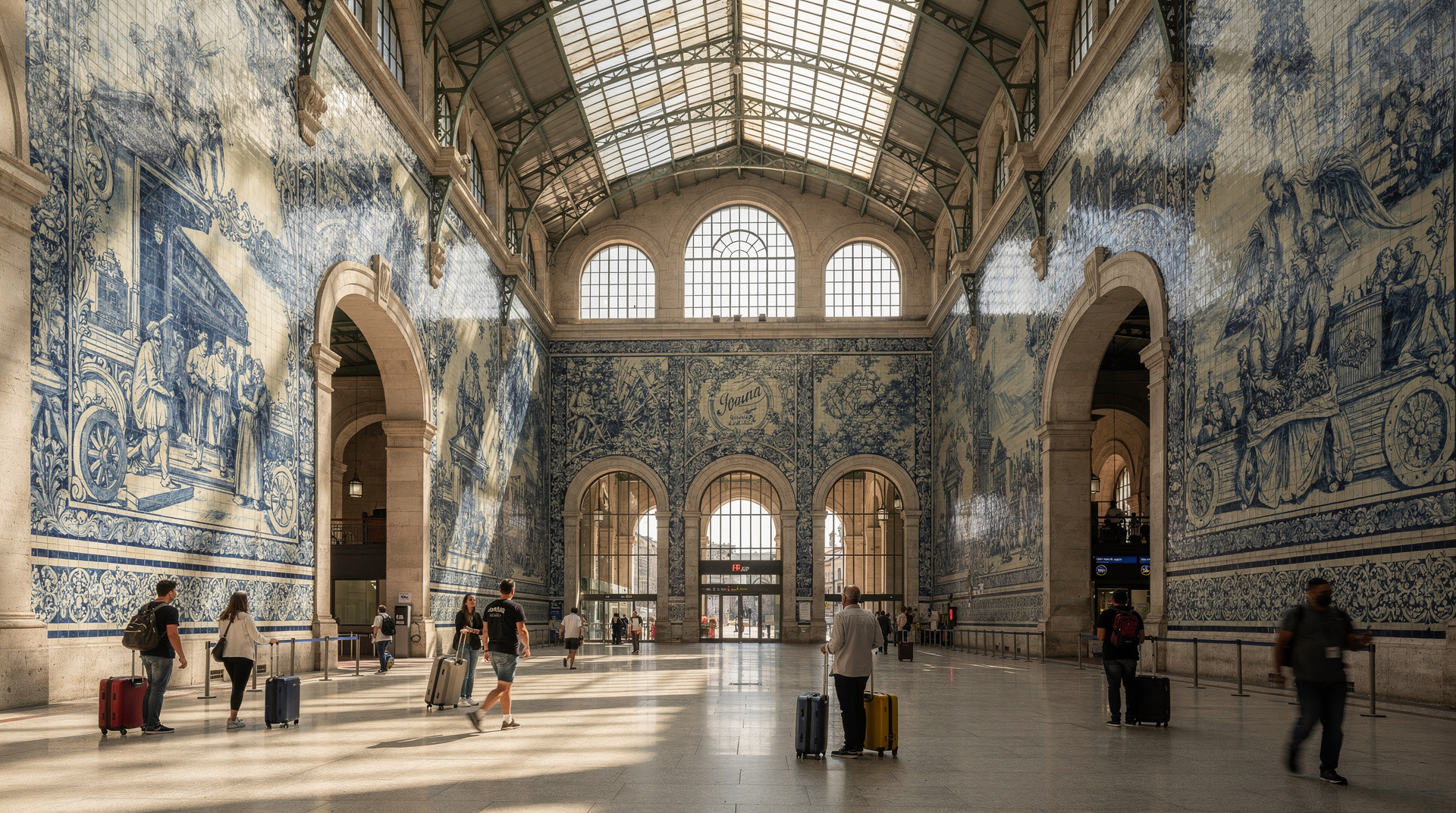
Begin at São Bento station. The main hall’s 20,000 blue-and-white tiles by Jorge Colaço (1905–1916) are the largest and most narratively ambitious azulejo commission in Porto. The end wall depicts key scenes from Portuguese history; the side panels show regional life. Entry is free — the station is a working transport hub.
Arrive before 9 am for the quietest experience; the station is at its most photogenic in morning light. Spend at least 20 to 30 minutes here, studying the panels at close range as well as from the centre of the hall.
2. Sé Catedral cloister — the most sophisticated panels in Porto
From São Bento, walk uphill east for 7 to 10 minutes to the Sé Catedral. The cloister (entry approximately €3) is decorated with blue-and-white panels by Valentim de Almeida (early 18th century), depicting scenes from the Song of Songs and the life of the Virgin Mary. The quality of these panels is very high — considered by some specialists to surpass São Bento in technical refinement, though the São Bento panels are more immediately dramatic.
Walk around the cloister perimeter in sequence. The panels on each arm of the cloister were designed as compositional units; reading them in order reveals the narrative structure. Look particularly at the border elements — the architectural frames, garland patterns, and grotesque masks that frame each main scene are extraordinarily fine at close range.
The upper level of the cloister (accessible via a staircase near the chapter house) provides a different perspective on both the panels and the cloister garden.
3. Igreja de Santa Clara — tiles in a church interior
From the Sé, continue east on the same hillside to the Igreja de Santa Clara (a 5-minute walk). This Gothic convent church has an interior that transitions from Gothic architecture to an overlay of 17th and 18th-century tile panels. The tiles here are simpler than the Sé cloister panels — primarily blue-and-white geometric and floral patterns rather than narrative compositions — but they illustrate how the tile tradition was applied to existing medieval spaces.
The church is open for visiting with free entry; hours vary.
4. Azulejo facades of Rua das Flores
Walk back toward the centre through Rua das Flores, one of Porto’s most photogenic streets. Along this route, notice the tiled exterior cladding on several of the 18th and 19th-century townhouses — the use of azulejos as exterior wall cladding is distinct from the interior panel tradition and represents the practical building tradition rather than the artistic one.
Blue-and-white diamond patterns, geometric polychrome cladding, and simple floral borders appear on different buildings. None of these is a major single panel, but the cumulative effect of a street lined with tiled buildings is significant and worth photographing in morning light.
5. Igreja das Almas — the spectacular exterior
From Rua das Flores, walk north and west for about 12 minutes to Rua de Santa Catarina and the Igreja das Almas (Chapel of Souls). The exterior of this church is covered on its north and west façades in a continuous panel of blue-and-white azulejos depicting the life of Saint Francis and the martyrdom of Saint Catherine.
The panels were executed in 1929 by Eduardo Leite and cover approximately 15,000 tiles across the exterior walls. The scale is dramatic — the entire building is a tile surface, the white and blue visible from the end of the street. The work belongs to the historicist revival tradition of early 20th-century azulejo production: technically accomplished, compositionally traditional, and genuinely impressive when encountered at street level.
Entry to the church interior is free; the exterior panels are visible from the pavement at no cost.
6. Igreja do Carmo — the finest exterior panel in Porto
Continue northwest from Santa Catarina for about 10 minutes (past Rua de Cedofeita) to Rua das Carmelitas and the Igreja do Carmo. The large azulejo panel covering the entire north exterior wall of this church is, in the opinion of many specialist observers, the single finest exterior azulejo composition in Porto.
The panel was designed by Silvestri Silvestre and executed in 1912, covering approximately 1,500 tiles depicting the founding of the Carmelite Order in the Holy Land. The figures — monks, nuns, knights, and supernatural presences — are arranged in a narrative that reads from left to right across the full width of the wall. The scale (around 15 metres wide and 8 metres tall) and the quality of the compositional organisation give the panel a monumentality that the individual panels at Santa Catarina, despite their larger tile count, do not quite achieve.
Stand at the corner of the building, at a distance of 15 to 20 metres, to see the full composition as intended. Then approach to examine individual tiles for the quality of the brushwork.
Note the Igreja das Carmelitas immediately adjacent — practically touching the Carmo church, separated only by what is reputedly Porto’s narrowest inhabited building. The two churches together, nearly identical in their façades but built by different religious orders, form an architectural pair that has been noted since at least the 18th century.
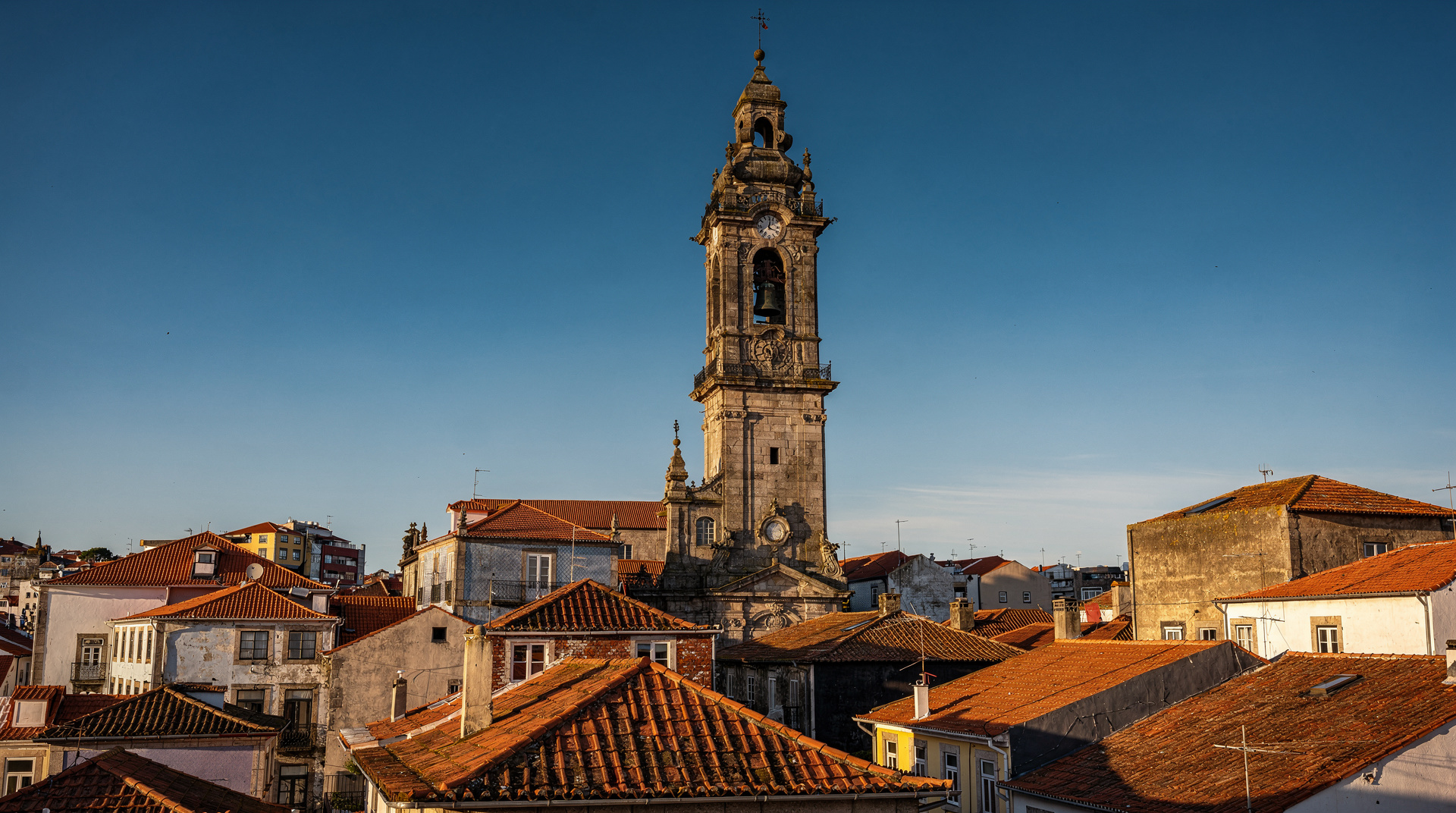
Livraria Lello is a 5-minute walk from here — a natural combination for a morning visit, and the Clérigos Tower is a further short walk beyond that if you want a panoramic view over the rooftops you have just been examining at street level.
7. Estação de Campanhã — a lesser-known station tile panel
If you have time and energy, Porto Campanhã station (the main intercity station) has azulejo panels on its waiting-room walls depicting regional scenes — less grand than São Bento but worth a brief stop if you are passing through for a train connection.
Techniques and terms: how to look at azulejos
Majolica: The technique of painting directly on the unfired tile surface using metallic oxide pigments, then firing to fix the glaze. Most narrative Portuguese azulejos use this technique.
Cuerda seca: An older technique using raised lines of manganese dioxide to separate different glaze colours. Common in early (pre-17th century) geometric Portuguese tiles.
Aresta: A moulded tile with raised edges forming partitions between colour areas. Common in geometric and plant-pattern tiles.
Albarrada: A vase-with-flowers motif, common in 17th and 18th-century Portuguese azulejo borders and smaller panels.
Brutesco/grottesco: Grotesque mask and foliage border elements common in Baroque tile borders. Look for these in the Sé cloister border panels.
When examining a narrative panel, look first at the overall compositional structure — how scenes are arranged and separated. Then move to examine individual tiles for the precision of the painted line and the quality of the colour application. The finest Portuguese azulejo painters achieved extraordinary precision working at tile scale; at close range, their brushwork is as skilled as anything in oil painting.
Using an azulejo tour
For visitors who want guided context on the tile tradition rather than a self-directed walk, several Porto walking tours include the azulejo panels as a core element. The historic centre walking tour covers São Bento, the Sé district, and the Carmo area with a guide who can explain the technical and historical context in detail.
For a more focused azulejo experience combined with transport across the city, the tuk-tuk city tour can be directed toward the tile sites as a priority. Tuk-tuks are useful for covering the dispersed sites more quickly, though they sacrifice the quality of close examination that a walking approach allows.
If you want to learn the technique yourself, azulejo painting workshops are available from several studios in Porto — typically 2 to 3 hours, producing a small panel in the traditional blue-and-white style. These are bookable via tour platforms and provide an experiential understanding of the craft that no amount of looking can substitute.
Azulejos beyond the main route — Foz, Cedofeita and Bonfim
The seven-stop walking route covers the historic centre’s essential panels, but Porto’s tile tradition extends well beyond the tourist core, and visitors staying longer or based in different neighbourhoods will encounter it in less curated but still rewarding ways.
Cedofeita: This residential neighbourhood, a short walk uphill from Rua das Flores, has a strong concentration of 19th-century townhouses with tiled exterior cladding — mostly the practical, domestic tradition rather than grand narrative panels. Walking Rua de Cedofeita and the surrounding streets rewards slow observation: geometric patterns, floral borders and the occasional figurative panel appear on ordinary residential buildings without any signage or curation. This is azulejo-viewing in its everyday, unglamorous context, which is arguably closer to how most Porto residents actually encounter the tradition.
Bonfim: Porto’s working-class eastern neighbourhood has a more modest but genuine tile heritage, visible on older apartment blocks and a handful of smaller parish churches. It is not a destination for azulejo tourism specifically, but if you are in Bonfim for other reasons — visiting Casa da Mariquinhas for fado, for instance — keep an eye on the building facades along the way.
Foz do Douro: The upscale coastal neighbourhood has fewer historic panels than the centre but some notable examples on early 20th-century villas near the Passeio Alegre, reflecting the wealth that built Foz as a resort district in that period. The style here tends toward the more restrained, decorative use of tile as an architectural accent rather than a dominant narrative surface.
Railway stations beyond São Bento: Several smaller stations on the regional network outside Porto — including some stops on the line toward Aveiro and the Douro line toward Régua — have azulejo panels depicting local scenes, a tradition that extended the São Bento model to secondary stations in the early 20th century. These are incidental discoveries for train travellers rather than dedicated destinations, but worth a glance if you have a few minutes on a platform.
Taken together, these secondary sites reinforce a point that the main walking route only implies: azulejos in Porto are not confined to a handful of monuments. They are a continuous, citywide surface language, and noticing them becomes almost automatic after a day spent deliberately looking.
A practical suggestion: Keep your camera or phone ready throughout any Porto walk, not just on the dedicated azulejo route — some of the most striking panels are found by accident on ordinary residential streets that no guidebook singles out, and part of the pleasure of Porto’s tile tradition is discovering it unplanned.
If you are staying in Cedofeita or Bonfim rather than the historic centre, treat your daily walk to and from the main sights as an extension of the tile route rather than a separate errand — the incidental panels along the way are, for many visitors, just as memorable as the curated stops.
What you cannot see in Porto
The most comprehensive single overview of the Portuguese azulejo tradition — from the earliest Moorish-influenced geometric tiles to contemporary artists working in the medium — is at the Museu Nacional do Azulejo in Lisbon, housed in the former Madre de Deus convent. Entry costs approximately €5 and the collection is extraordinary.
If Lisbon is on your itinerary (it is 3 hours by train from Porto, the Alfa Pendular service running approximately every hour), a morning at the Museu Nacional do Azulejo provides context that enriches every azulejo encounter in Porto and throughout Portugal. The museum’s most famous piece is a 23-metre panorama of Lisbon before the 1755 earthquake, painted in blue-and-white tiles in the 1730s — the most detailed surviving image of a European city from this period.
Frequently asked questions about azulejos in Porto
What are azulejos?
Glazed ceramic tiles used as surface decoration. The tradition entered Portugal from Moorish Spain and developed over five centuries into one of Portugal’s most distinctive art forms, from geometric patterns to elaborate figurative narrative panels.
Are the azulejos in Porto free to see?
Many exterior panels are free — Igreja do Carmo, Igreja das Almas, São Bento exterior. The São Bento station interior is free (working station). The Sé cloister costs approximately €3.
What is the difference between blue-and-white azulejos and polychrome tiles?
Blue-and-white azulejos use cobalt oxide on white tin glaze — dominant from around 1650, influenced by Dutch Delftware. Polychrome tiles use multiple colours and are older in origin, appearing more commonly in secular exterior cladding.
Why do Portuguese buildings have so many azulejos on their exteriors?
Tiles serve as decoration, weather protection (significant in Porto’s wet climate), and thermal regulation simultaneously. The practical advantages reinforced the aesthetic tradition.
What is the best azulejo site in Porto?
São Bento station interior (free, 20,000 tiles) for concentrated accessible impact. Igreja do Carmo exterior for the finest single outdoor panel. Sé Cathedral cloister (€3) for the most technically accomplished interior panels.
Are there azulejo workshops where I can make tiles in Porto?
Yes — several studios offer 2 to 3-hour painting workshops in the traditional blue-and-white style. Bookable through tour platforms.
Frequently asked questions — Azulejos of Porto — the best tile route and what to look for
What are azulejos?
Azulejos are glazed ceramic tiles used as surface decoration on buildings, interiors, and monuments. The word derives from the Arabic 'al-zulaij', meaning polished stone. Introduced to the Iberian peninsula by the Moors, they were adopted enthusiastically by Portugal and developed over five centuries into one of the country's most distinctive art forms. Portuguese azulejos range from geometric patterns inherited from Islamic tradition to elaborate figurative narrative panels of the 17th to 20th centuries.Are the azulejos in Porto free to see?
Many of the finest panels in Porto are on building exteriors and visible from the street at no cost — the Igreja do Carmo façade, the Igreja das Almas, the São Bento station exterior. The interior panels require entry: the São Bento station hall is free (it is a working station); the Sé Cathedral cloister costs approximately €3; the Museu Nacional do Azulejo in Lisbon costs €5.What is the difference between blue-and-white azulejos and polychrome tiles?
Blue-and-white azulejos use cobalt oxide to create blue designs on a white tin-glazed earthenware base. This style was strongly influenced by 17th-century Dutch Delftware and became dominant in Portuguese church and public building decoration from about 1650 onward. Polychrome tiles — using yellow, green, brown, and other colours — are older in origin, drawing on Spanish and Moorish influences, and appear more commonly in secular building decoration and exterior cladding. Both traditions are present in Porto.Why do Portuguese buildings have so many azulejos on their exteriors?
Exterior azulejo cladding serves multiple functions simultaneously: it is decorative, it protects the wall surface from rain and moisture (significant in Porto's wet climate), and it provides thermal regulation (the ceramic surface reflects heat in summer). The practical advantages of tile as an exterior finish in Portugal's Atlantic climate made it a logical as well as aesthetic choice.What is the best azulejo site in Porto?
São Bento station (the main hall, free) is the most concentrated and accessible display. For exterior panels, the Igreja do Carmo façade is arguably the most spectacular single tile tableau in the city. For paid interior access, the Sé cloister's narrative panels by Valentim de Almeida are among the most sophisticated in Porto. For those who can reach Lisbon, the Museu Nacional do Azulejo in the former Madre de Deus convent is the definitive overview of the entire tradition.Are there azulejo workshops where I can make tiles in Porto?
Yes. Several ceramic studios in Porto offer azulejo painting workshops, typically lasting 2 to 3 hours and allowing you to paint a small panel in the traditional blue-and-white style. These workshops are available through various tour operators. The experience gives considerable appreciation for the skill involved in the historic panels you have been looking at.What is the azulejo at Largo do Rato (Mercado de Matosinhos)?
Porto's contemporary azulejo tradition extends beyond historic panels. Newer buildings in the city often use tiles in contemporary ways — geometric cladding in supermarkets, public transport stations, commercial buildings. The Matosinhos market has some good examples of modern tile use. Contemporary Portuguese artists continue to work in the azulejo medium, and the Serralves Foundation occasionally commissions tile installations.
Top experiences
Bookable activities with verified prices and instant confirmation on GetYourGuide.