São Bento station — Porto's 20,000-tile azulejo hall, honestly reviewed
Porto: Porto Historical Center Walking Tour
Are the São Bento azulejos worth seeing?
Yes — and entry to the station hall is completely free. The 20,000 blue-and-white tiles by Jorge Colaço, installed in 1916, are among the finest azulejo work in Portugal. Arrive early morning (before 9 am) or late afternoon to avoid tour group congestion at the main panel.
The free sight that most Porto visitors almost miss
There is a peculiar thing about São Bento station. It contains what many specialists regard as one of the finest collections of azulejo tile work in the world — 20,000 individually painted blue-and-white tiles covering the main hall of a functioning train station — and entry is completely free. Anyone can walk in, stand in front of the panels, and spend as long as they like looking. No ticket, no booking, no timed entry.
And yet most Porto visitors see it at the worst possible moment: jostled through by a tour group at 11 am, phone raised to photograph a panel they have not had time to actually look at, swept back out onto the street thirty seconds later. This guide is about doing it differently.
| Where | Baixa district, central Porto |
| Cost | Free — no ticket or booking required |
| Time needed | 20–30 minutes; up to an hour for enthusiasts |
| Best time | Before 9 am or after 5 pm to avoid tour groups |
| Getting there | Metro Aliados (8 min walk); 10–12 min from Ribeira |
What São Bento actually is
São Bento station opened in 1916 on the site of a former Benedictine convent — the Convento de São Bento da Avé-Maria, which dated from 1518 and was demolished following the dissolution of religious orders in the 1860s. The name persisted, and the station that replaced the convent after decades of planning retained it.
The building was designed by architect José Marques da Silva, who won the commission in a competition in 1896. Marques da Silva studied in Paris and returned to Porto with a Beaux-Arts sensibility that sat comfortably alongside the heavy granite architecture of the city. The exterior is imposing rather than decorative: a monumental granite facade with classical proportions and a large arched entrance that frames the view of the interior hall from the street.
The interior is the point. Marques da Silva designed the main hall as a space for public spectacle as much as for transit — high vaulted ceilings, large windows admitting substantial natural light, and above all the decision to commission the tiles that now define the building.
Jorge Colaço and the 20,000 tiles
The azulejo commission was given to Jorge Colaço (1868–1942), the most prominent Portuguese tile artist of his generation. Colaço had trained in Lisbon and worked on major commissions across the country; the São Bento panels were his largest and most narratively ambitious project.
Work proceeded between 1905 and 1916. The tiles are blue-and-white — blue glaze over white tin-glazed earthenware, in the tradition inherited from 17th-century Dutch faience — and were manufactured by the Fábrica de Cerâmica das Devesas in Vila Nova de Gaia. Colaço painted each scene on individual tiles, working at scale across the vast wall surfaces, a process that required exceptional precision to ensure the finished panels read coherently when assembled.
The subject matter of the panels is deliberate and programmatic. At a moment when Portugal was asserting its national identity — the republic had been declared in 1910, the station opened in its first Republic era — Colaço was asked to paint scenes that told stories of Portuguese history, culture, and geography.
Reading the panels: what you are looking at
The end wall (main panel): The most photographed section, facing you as you walk in from the entrance. This is divided into large compositional scenes depicting key moments in Portuguese history:
The Battle of Valdevez (1140), a victory over Castile that helped establish the independent county of Portugal as a political reality. The scene shows medieval mounted knights in battle, rendered with the kind of muscular detail that rewards close examination.
The Conquest of Ceuta (1415), the opening campaign of Portugal’s overseas expansion, showing the fleet under João I preparing for the crossing to North Africa.
The Marriage of João I and Philippa of Lancaster (1387), which took place in Porto — the royal couple entering the city through the gate. This panel has particular local resonance, as it celebrates Porto’s historical role in the founding of the Avis dynasty and the Portuguese-English alliance.
The side panels: These move from historical epic to documentary realism. The side walls carry scenes of regional Portuguese life — ox-drawn carts crossing granite bridges in the Minho, fishermen hauling boats on the Atlantic coast, figures in regional dress going about agricultural work, river transport on the Douro. These panels are less dramatically staged than the end wall but are richer in ethnographic detail. Look carefully at the small human figures in the crowd scenes: Colaço had a sharp eye for the gestures of ordinary people.
The upper registers: Running above the main narrative scenes, decorative borders and smaller panels carry heraldic motifs, architectural vignettes, and framing elements. These are often overlooked as visitors focus on the larger compositions, but the heraldic work in particular is finely executed.
How to look at the tiles properly
The panels are large and reward a deliberate approach. Most visitors plant themselves in front of the end wall and photograph it from the centre of the hall. This is the natural instinct but it gives you the broadest view at the cost of detail.
Walk up to within a metre or two of the panels and look at individual tiles. You will see the brushwork — Colaço’s hand in each stroke — and the slight texture variations where tiles were fired at fractionally different temperatures. At close range, the scenes become both more human and more technically astonishing: the fact that thousands of individually painted squares assemble into coherent, emotionally legible scenes is the real achievement, and you cannot appreciate it from across the hall.
The morning light entering the hall from the upper windows changes the colour of the tiles substantially. In early morning, the blue-and-white has a cool clarity. In late afternoon, the warmer light makes the blues richer and the whites more golden. Both are worth seeing if you have the time to return.
Context: azulejos in Porto
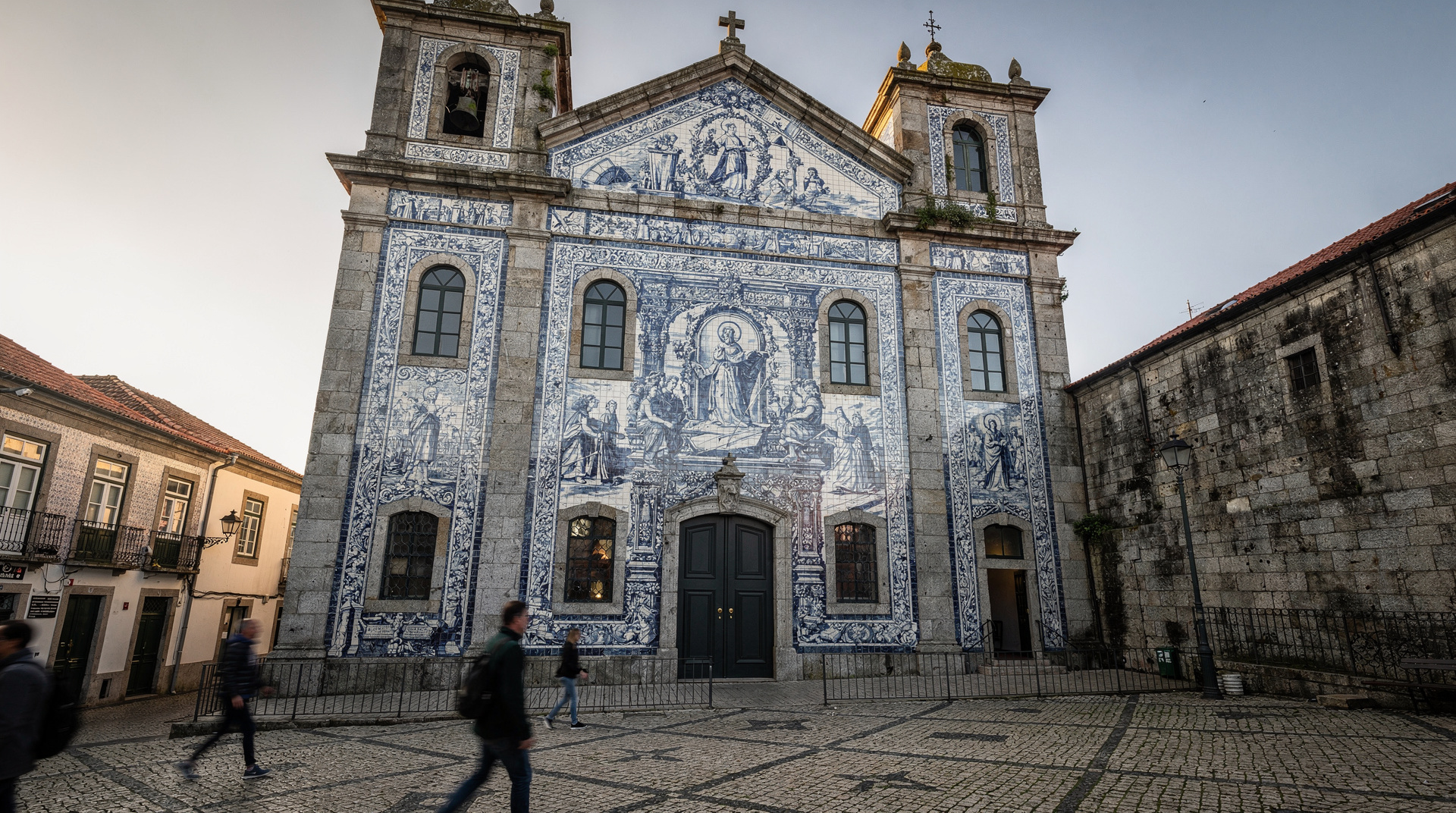
São Bento is the most concentrated single display of azulejos in Porto, but it is not the only one, and understanding it in the context of the wider tradition makes the visit more rewarding. The azulejos walking route covers the key tile panels scattered across the city — the exterior of the Igreja do Carmo, the Chapel of Souls (Igreja de Santa Catarina), the Sé Catedral cloister — and São Bento connects naturally to all of them as a starting point or conclusion.
For the broader context of how azulejos developed from their Moorish origins through the 17th-century Dutch influence to the 19th-century industrial production and Colaço’s generation, the culture-heritage guide to churches of Porto traces some of the history as it appears on religious façades across the city.
The station as a transit hub
São Bento is also a functioning station, and its train connections are genuinely useful for visitors. From São Bento:
The suburban lines (S1, S21) run to Aveiro and Espinho along the coast. Journey time to Espinho is about 40 minutes; to Aveiro approximately 75 minutes. These are cheap and frequent.
Regional trains to Braga and Viana do Castelo operate from São Bento, with journey times of around 1 hour to Braga and 1.5 hours to Viana do Castelo. For the Braga and Guimarães day trip, this is the most practical connection.
The Douro line to Pinhão and Peso da Régua — the most scenically spectacular train journey in Portugal — originates from São Bento and then continues through Campanhã. Trains run twice daily, with the journey to Pinhão taking approximately 2 hours 15 minutes. If the Douro Valley is on your itinerary, this is worth considering, though note that very few quintas are walkable from the small stations in the valley.
For Lisbon and other intercity connections, you need Porto Campanhã, not São Bento. Campanhã is 15 minutes by metro from the city centre.
The neighbourhood around the station
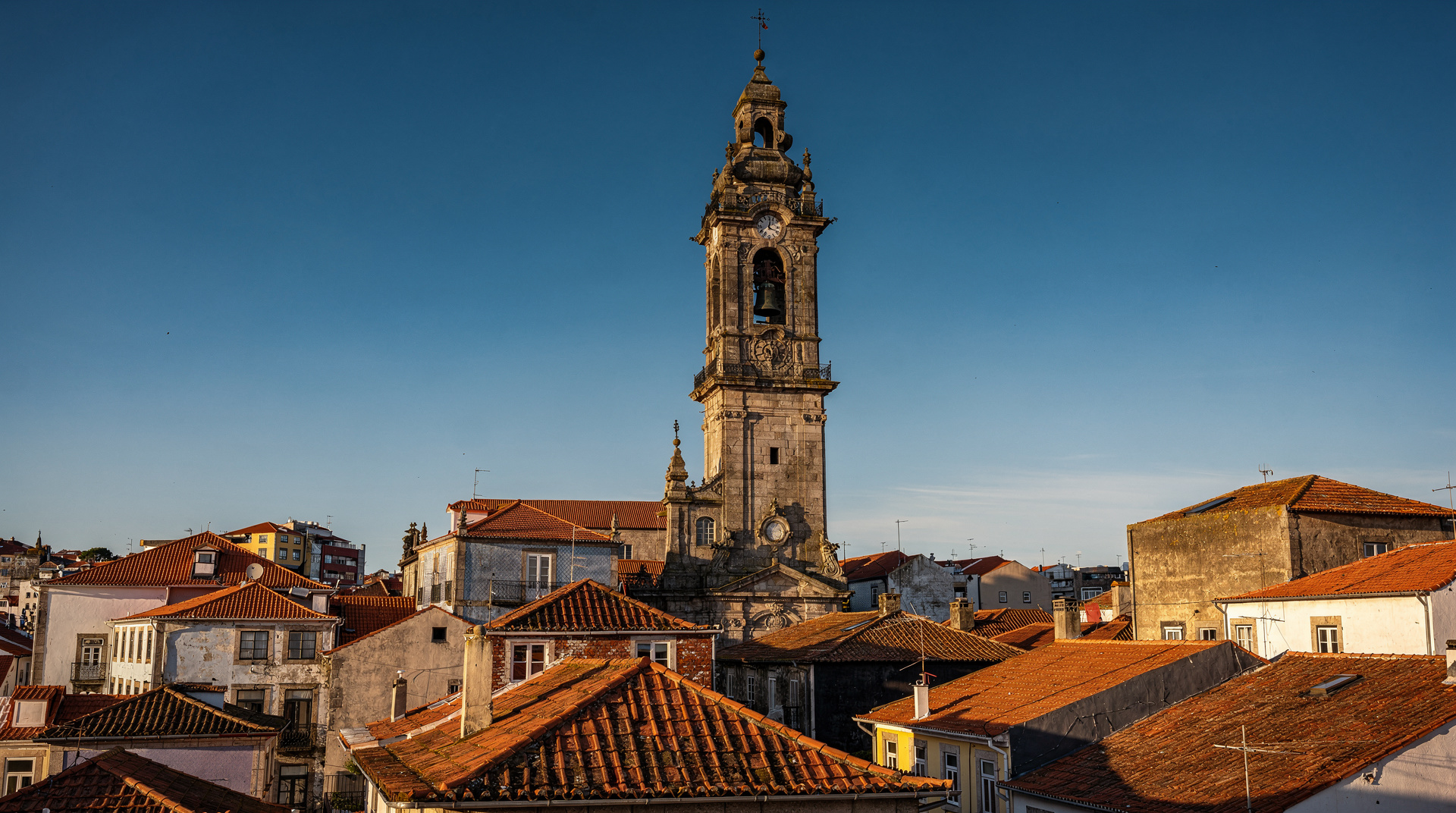
São Bento sits at the junction of several of Porto’s most walkable routes. The Ribeira waterfront is 10 to 12 minutes downhill to the southeast. Clérigos Tower is 12 minutes northwest uphill. The Sé Catedral is 7 minutes east along steep cobbled streets. Livraria Lello is 12 minutes northwest on foot.
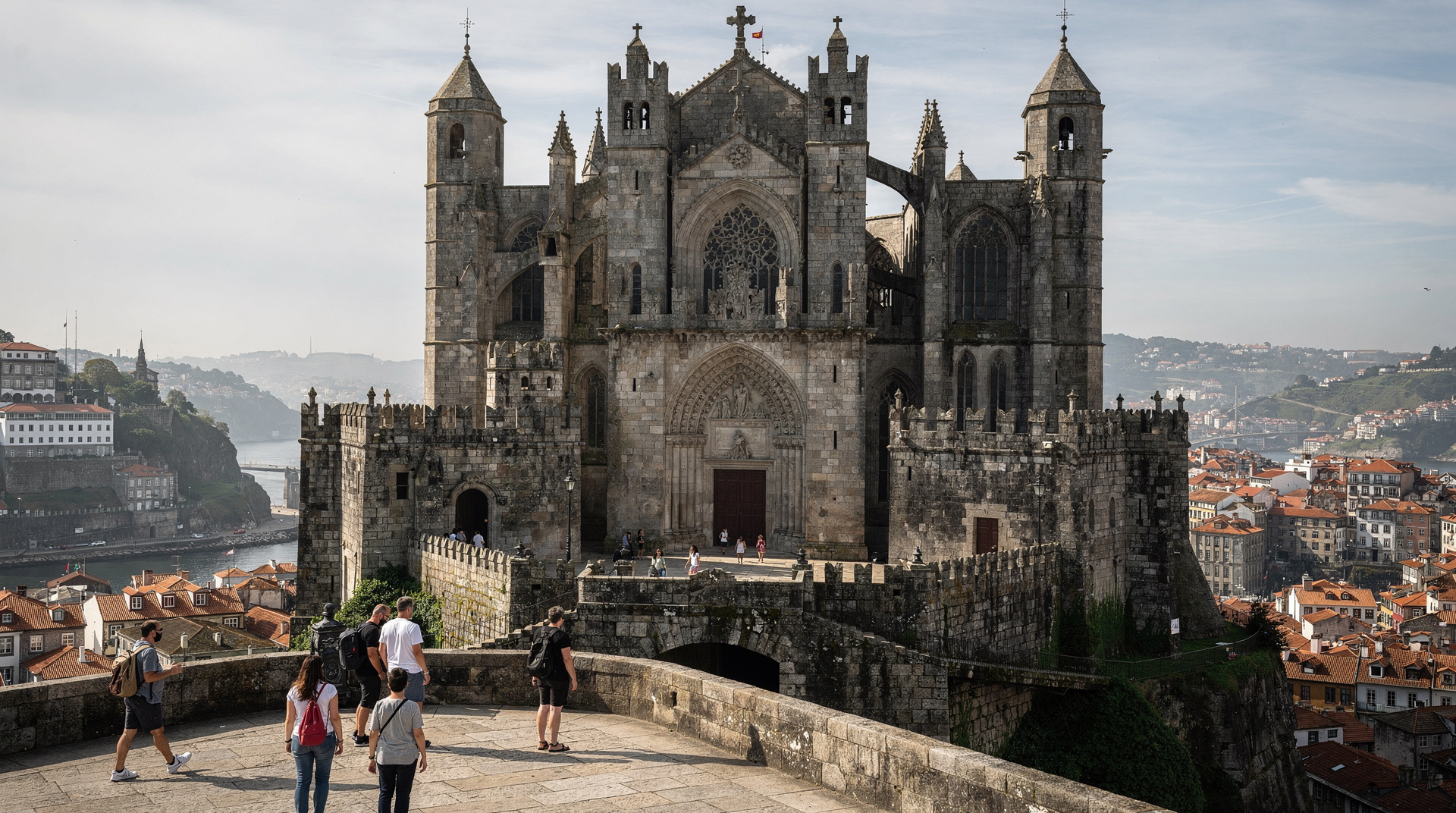
This makes São Bento an ideal anchor point for a half-day walk through the historic centre. A natural route: arrive at São Bento by 8:30 am to see the tiles in relative quiet, walk east to the Sé for the Romanesque exterior and Gothic cloister, then loop back through Rua das Flores toward Clérigos and Lello.
For lunch, Rua das Flores (the street running northwest from near São Bento) has several reliable mid-range restaurants serving regional Portuguese food at honest prices — typically €12 to 18 for a main course. Avoid the terrace restaurants immediately in front of the station, which are priced for tourist passing trade rather than quality.
A practical note on crowds
São Bento is on almost every Porto tour itinerary, which means tour groups arrive between 10 am and noon with predictable regularity. A group of 30 people standing in front of the main panel takes up most of the hall. If your visit coincides with multiple groups, the experience is substantially diminished.
The solution is simple: arrive before 9 am (the station opens early for commuter services) or after 5 pm. In both windows you will likely have the hall largely to yourself, or at worst shared with a handful of other visitors rather than a coach-load.
The Porto historic centre walking tour that includes São Bento typically schedules the station visit at an off-peak time, which is one advantage of a guided morning walk over an independent visit at an arbitrary hour.
Getting to São Bento station
São Bento is in the Baixa district, well-connected by foot from most central Porto accommodation.
From the Ribeira waterfront: 10 to 12 minutes uphill northwest along Rua Infante Dom Henrique and then Rua Mouzinho da Silveira.
From Clérigos Tower: 12 minutes downhill southeast along Rua das Flores.
By metro: the nearest metro station is Aliados (lines A, B, C, E, F), about 8 minutes’ walk south along Avenida dos Aliados. Note that São Bento in the metro system refers to the regional rail station, which is the same building — metro line D does not stop at the São Bento rail station; the nearest metro stop for the rail station is Aliados.
By bus: multiple bus lines stop on Praça de Almeida Garrett immediately in front of the station.
Frequently asked questions about São Bento station
Does São Bento station charge an entry fee?
No. Entry to the main hall is free for everyone. No ticket or booking is required.
Who painted the São Bento azulejos?
Jorge Colaço (1868–1942), the leading Portuguese azulejo artist of his era. The panels were executed between 1905 and 1916.
What do the São Bento tiles depict?
The main end panel shows scenes from Portuguese history: the Battle of Valdevez (1140), the Conquest of Ceuta (1415), and the 1387 royal wedding of João I and Philippa of Lancaster in Porto. The side panels depict scenes of regional Portuguese rural and coastal life.
When is the best time to visit São Bento?
Before 9 am or after 5 pm to avoid tour group congestion. Morning light is particularly good for the tiles. November through February is quieter at any time of day.
Is São Bento a real working train station?
Yes. It serves suburban and regional lines to Braga, Viana do Castelo, Aveiro, and the Douro Valley (Pinhão). For Lisbon, use Porto Campanhã instead.
How long should I spend at São Bento?
Twenty to thirty minutes is enough for most visitors. Azulejo enthusiasts may want an hour to examine individual tiles closely and read the panel narratives in detail.
What is the history of the São Bento building?
Designed by José Marques da Silva, opened 1916. Built on the site of the Convento de São Bento da Avé-Maria (1518), demolished in the 1860s following the dissolution of religious orders.
Frequently asked questions — São Bento station — Porto's 20,000-tile azulejo hall, honestly reviewed
Does São Bento station charge an entry fee?
No. The main hall of São Bento station is a working train station, and entry is free for anyone. You do not need a train ticket to walk in and view the azulejo panels. The station is open during operating hours, typically from early morning until around 11 pm.Who painted the São Bento azulejos?
The 20,000 azulejo tiles were painted by Jorge Colaço between 1905 and 1916. Colaço was the leading Portuguese azulejo artist of his era, responsible for major tile commissions across Portugal. He painted the São Bento panels using a blue-and-white colour palette and depicted scenes of Portuguese historical events, rural life, and regional transportation.What do the São Bento tiles depict?
The main panel on the end wall, which is the most photographed, shows scenes from Portuguese history: the Battle of Valdevez (1140), the Battle of Ceuta (1415), and the entry of King João I and Philippa of Lancaster into Porto for their royal wedding in 1387. The side panels show scenes of regional life — ox-drawn carts, figures in traditional dress, river scenes — representing different regions of Portugal.When is the best time to visit São Bento?
Early morning before 9 am is the quietest, when the station is busy with commuters but not tourist groups. The light in the main hall is also best in the morning. Late afternoon around 5 to 6 pm is another good window. Avoid 10 am to 2 pm when tour groups are most concentrated.Is São Bento a real working train station?
Yes. São Bento serves suburban and regional lines operated by CP (Comboios de Portugal). From São Bento you can catch trains to Braga, Viana do Castelo, Guimarães, and the Douro Valley (Pinhão). The station does not serve the main intercity high-speed network — for Lisbon, travellers use Porto Campanhã.How long should I spend at São Bento?
Twenty to thirty minutes is enough to examine all the main panels properly. If you are seriously interested in azulejo art — the technique, the narrative content, the positioning of individual scenes — you could spend an hour. Most visits fall naturally in the 20 to 30-minute range.What is the history of the São Bento station building?
The current station building was designed by architect José Marques da Silva and opened in 1916. It was built on the site of a former Benedictine convent (the Convento de São Bento da Avé-Maria, founded 1518), which gives the station its name. The convent was demolished in the 1860s following the dissolution of religious orders, and the station replaced it after several decades of planning and construction.
Top experiences
Bookable activities with verified prices and instant confirmation on GetYourGuide.