Surfing in Porto and Matosinhos — spots, schools, seasons, and honest beginner guide
Matosinhos: Begginner Surf Lesson with the First Surf School in Porto
Can beginners surf near Porto, and where is the best spot?
Yes. Matosinhos beach, 8 km north of Porto centre, is the most accessible spot for beginners and intermediates. Several surf schools operate there year-round. For total beginners, a 1.5-hour group lesson costs 30–45 €. Conditions are best from September through November and from March through May.
Porto is not the first city that comes to mind for surfing, but the Atlantic swell that made Portugal a world-class surf destination reaches its beaches too — closer, cheaper, and less crowded than the famous breaks further south. Matosinhos, 8 km from the historic centre, gives visitors a genuine surf lesson without a special trip, and the beach’s seafood strip makes the whole outing feel like a proper local day rather than a bolt-on activity.
| Where | Matosinhos beach, 8 km north of Porto centre |
| Cost | around 30–45 € for a 1.5-hour group lesson |
| Time needed | half a day (lesson + lunch), or a full day combined with cycling or the beach |
| Getting there | Metro Line A to Matosinhos Sul, about 15 minutes from Trindade |
| Best time | September–November and March–May for the most consistent, learnable waves |
Porto’s surf geography — what you are actually dealing with
Porto sits at the mouth of the Douro, facing a stretch of Atlantic coast that runs broadly north to south for several hundred kilometres. The same Atlantic swells that make Portugal one of Europe’s premier surfing destinations also reach Porto’s beaches — sometimes with considerable force.
The coastline within comfortable day-trip range of Porto offers several surf environments:
Matosinhos (8 km north of centro): The primary beginner and intermediate hub. Sandy beach break, surf schools, board rental shops, easy public transport. This is where most Porto-based surf lessons happen.
Foz do Douro (5 km west of centro): The beach at the river mouth has some surf potential but is more exposed to currents from the Douro outflow, which makes it unsuitable for beginners. Better as a beach destination than a learning spot.
Espinho (15 km south): A more powerful beach break with fewer amenities and a more local crowd. Intermediate to advanced. Less accessible without a car.
Leça da Palmeira (10 km north): A rocky reef break with a smaller local surf community. Not for beginners. The rock pools at low tide are genuinely beautiful if you are not surfing.
For visitors staying in Porto and wanting a surf experience as part of a broader trip, Matosinhos is the practical answer to almost every question.
Matosinhos beach — a realistic description
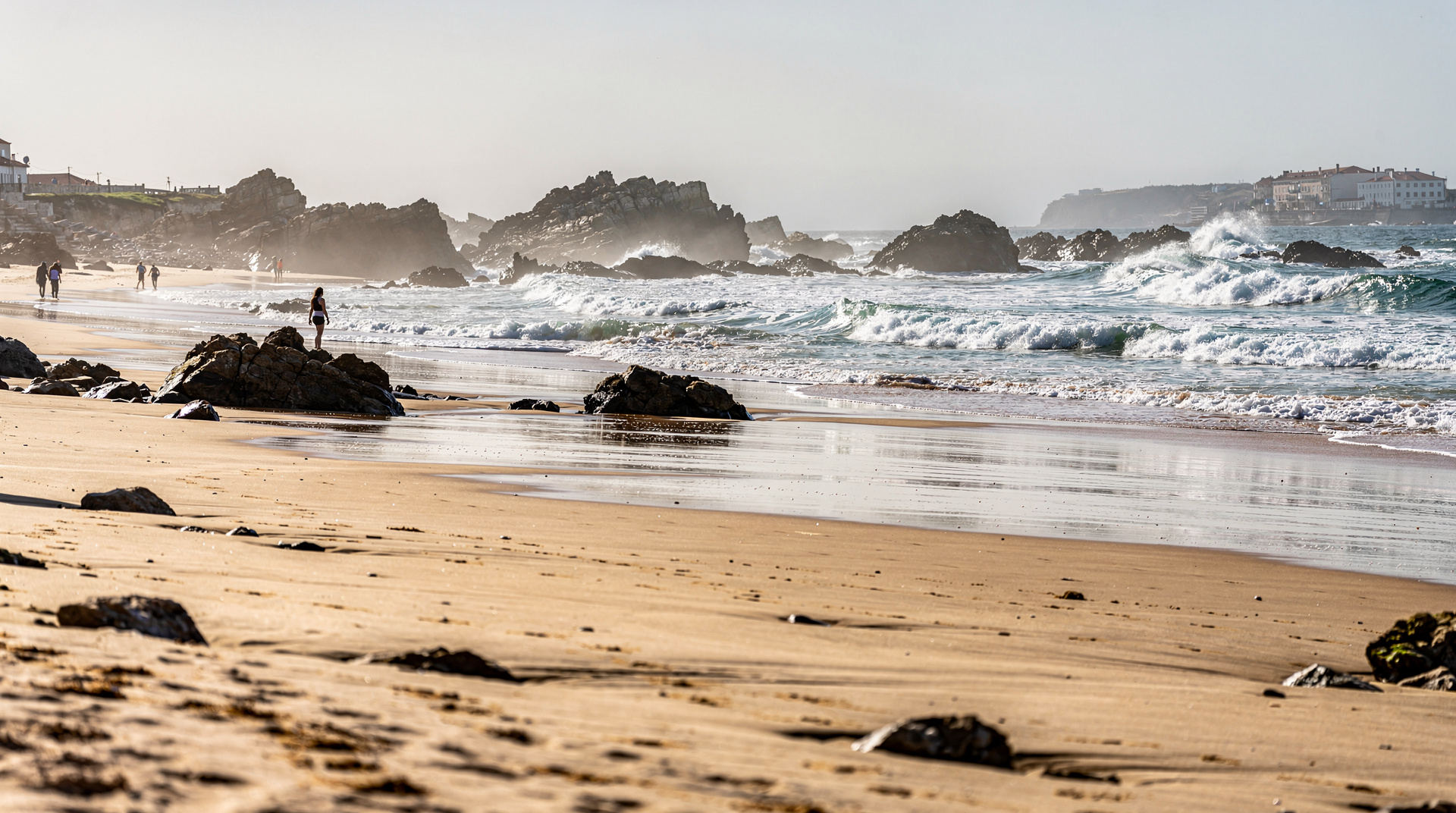
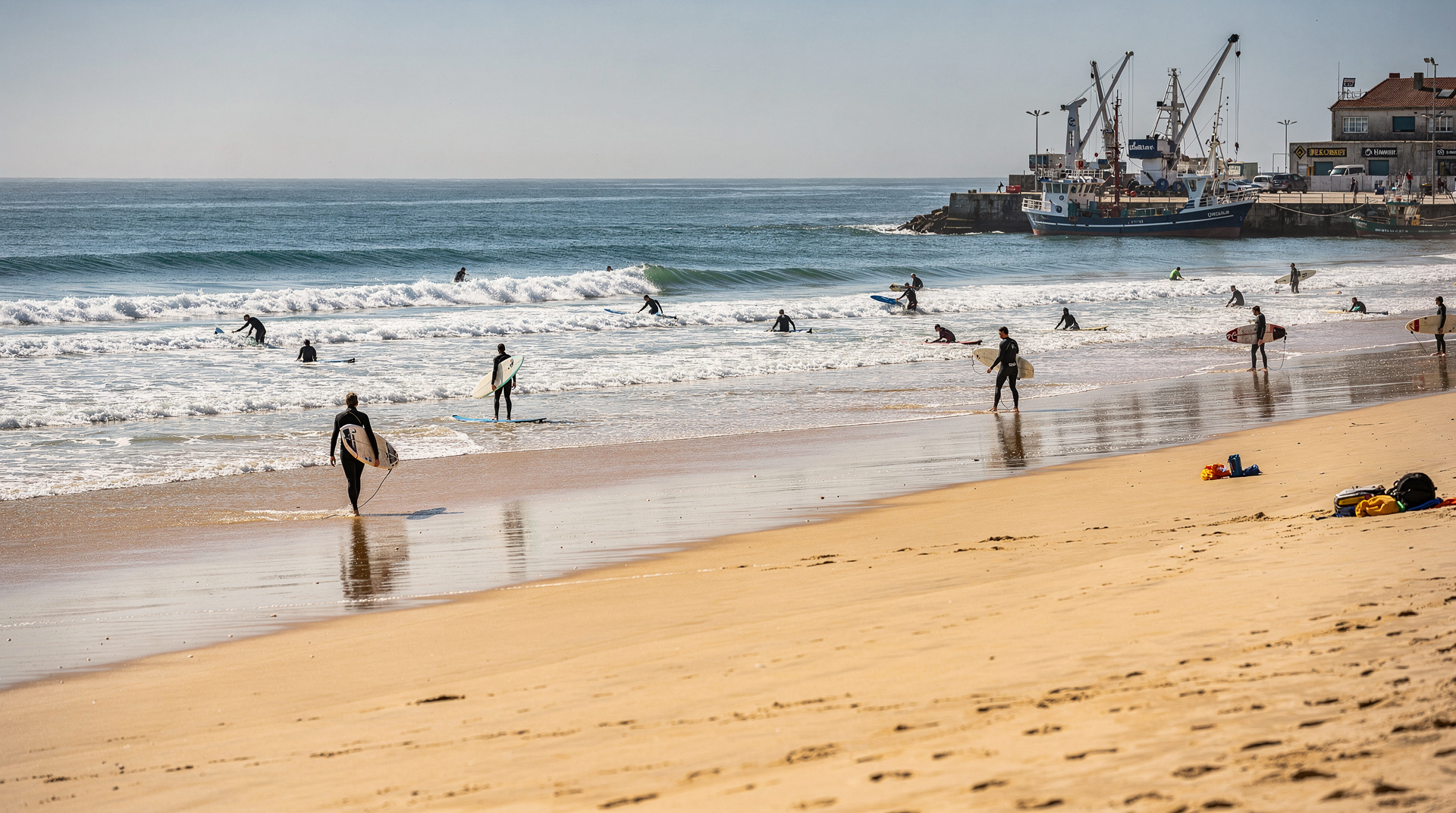
Matosinhos is a sandy Atlantic beach about 4 km long, backed by a promenade (Avenida da Liberdade) lined with seafood restaurants that have a strong local following alongside the tourist trade. The beach itself is wide and clean, monitored by lifeguards from June through September. In summer it is genuinely busy — particularly on weekends when Porto residents escape the city heat.
The beach break at Matosinhos creates several peaks across its length. The south end, closest to the harbour wall, tends to produce slower, more forgiving waves that suit beginners and improvers. The north end can be more powerful, especially when north-northwest swells arrive. Surf schools tend to position students at the south end.
Water quality at Matosinhos has improved significantly since European Union bathing water regulations took hold. The beach consistently achieves “excellent” EU bathing quality ratings in annual assessments. This was not always the case — industrial Porto had a troubled history of coastal water quality — but it is now genuinely clean.
Surf schools — who to use and how much to pay
Several established surf schools operate on Matosinhos beach, and most are competent. The honest differences are in student-to-instructor ratios, the quality of the equipment, and whether the school has the capacity to properly assess and separate students by ability before the water.
Group lessons (1.5–2 hours): 30–45 € per person. Groups of 4–8 students typically. Wetsuit, board, and basic theory session included. Suitable for absolute beginners through early intermediates. The theory covers board positioning, how to read a wave, and paddling technique. On-water time is roughly 60–75 minutes.
Private lessons (1 hour): 60–90 €. One-to-one attention means faster progression and more personalised feedback. Worth the premium for anyone who has tried group lessons and reached a plateau, or for visitors with only one day who want to maximise learning time.
Book a surf lesson at Matosinhos through GetYourGuide — the first-timers school format with small groups and wetsuit included.
Book the 1.5-hour Matosinhos surf lesson — the most popular standard format, appropriate for beginners through early intermediates.
For visitors who prefer their lesson to include transport from central Porto — avoiding the metro journey with a surfboard rental shop to navigate — some operators provide pickup from Porto centre:
Book surf lesson with transport from Porto centreWho should not attempt surfing here
Honest assessment: surfing is harder than it looks and Porto’s Atlantic coast is a real ocean. The following visitor profiles are likely to have a frustrating rather than enjoyable experience:
Non-swimmers: The water at Matosinhos, even in beginner lessons, can be chest-deep when a set arrives. If you cannot swim confidently, do not surf.
People expecting to stand up on their first day: Some people do. Many do not. If you are booking a single 1.5-hour lesson and expecting a core surf experience, manage expectations — the lesson may end with a few assisted rides rather than independent wave-catching. Two to three sessions produces dramatically better results.
Visitors during very small summer days: July and August can bring flat spells of one to three days with surf under 30 cm — barely enough to ride. If surf is the primary purpose of your visit, check a forecast site (Surf-Forecast, Windguru, Magic Seaweed) for your specific dates before booking.
Advanced surfers wanting powerful reef breaks: Matosinhos is not a performance wave. Experienced surfers will find it flat and crowded. Research Peniche (90 km south), Ericeira, or Viana do Castelo for more serious conditions.
Seasonal guide
Winter (December–February): Biggest Atlantic swells, 2–4 metre waves possible. Water temperature 14–15°C. Suitable only for experienced surfers in proper cold-water equipment. Beaches are quiet, empty, often spectacular. Not for tourists visiting for a first lesson.
Spring (March–May): Swells settling to a more consistent 0.8–2 metre range. Water warming from 15°C to 17°C. Best overall conditions for learning — waves are forgiving but have enough power to be engaging. Crowds minimal, especially weekdays. This is the best time for a first surf experience.
Summer (June–August): Water temperature 18–20°C. Waves typically small (0.5–1.2 metres) and slow, which makes them manageable but sometimes frustratingly weak. Beaches crowded in July and August, especially on weekends. Surf schools are at maximum capacity — book early. The conditions are enjoyable rather than exciting.
Autumn (September–November): The best season for intermediate surfers. Atlantic swells return in September and build through October. Water is still warm from summer (17–19°C in September, cooling to 16°C by November). Crowds drop sharply after the school holidays. October is often considered the best single month of the year for consistent quality conditions near Porto.
Seasonal conditions at a glance
| Season | Wave height | Water temp | Who it suits |
|---|---|---|---|
| Winter (Dec–Feb) | 2–4 m | 14–15°C | Experienced surfers only |
| Spring (Mar–May) | 0.8–2 m | 15–17°C | Best for first lessons |
| Summer (Jun–Aug) | 0.5–1.2 m | 18–20°C | Beginners, but crowded |
| Autumn (Sep–Nov) | growing swell | 16–19°C | Best overall for intermediates |
Where to stay for a surf-focused trip
Visitors building a trip around Matosinhos surf sessions get the most out of staying near Foz do Douro or in the Matosinhos area itself rather than deep in the historic centre — it cuts the metro commute to a short walk and keeps a wetsuit-and-board routine simple. Those splitting time between surf and sightseeing usually prefer to stay closer to Ribeira or Baixa and treat Matosinhos as a half-day excursion by metro, which is still an easy, well-connected trip.
Equipment — what you need and what it costs to rent
All surf lessons at Matosinhos include board and wetsuit. If you want to rent independently for a session:
Longboard (easier for beginners): 20–25 € per day Funboard/mini-malibu: 18–22 € per day Performance shortboard: 15–20 € per day (not suitable for beginners) Wetsuit 4/3 mm: 10–15 € per day Leash: Usually included with board rental; check when booking
Several rental shops operate on or near the Matosinhos promenade. Shops also sell sunscreen, wax, and basic gear. If you are staying in Porto for a week and plan more than two surf days, buying a basic board is rarely cost-effective at these rental prices — the maths rarely work out for short trips.
Booking logistics — what actually matters
Most Matosinhos surf schools take bookings online with a small deposit, and confirmation usually arrives within a day. A few practicalities that are easy to overlook: check the meeting point carefully, since several schools have kiosks spread along different sections of the promenade rather than one shared office; ask whether the quoted price includes the wetsuit and board or only the instructor’s time; and if you wear glasses or contact lenses, ask about options, since surfing in a strong prescription without contacts is genuinely difficult. Cancellation policies vary — some schools reschedule for free if the surf is unsurfable on your date, others do not, so ask before paying in full.
Arriving 15–20 minutes before your slot gives time to get into the wetsuit, which takes longer than people expect on a first attempt, and to fill out any waiver paperwork without rushing. Bring a plastic bag for wet clothes and swimwear for underneath the wetsuit — most schools have basic changing space but not full lockers, so valuables are best left at your accommodation.
After the surf — Matosinhos seafood
One of the better accidental coincidences of Porto’s geography: Matosinhos beach sits directly adjacent to what is arguably Portugal’s best concentration of seafood restaurants outside Lisbon. The Rua Heróis de França stretch behind the beach is lined with restaurants serving freshly grilled fish, seafood rice, percebes (barnacles), and the finest grilled cherne and robalo at prices that undercut central Porto considerably.
Post-surf hunger is real. Arriving wet and salty at a Matosinhos restaurant at 1 pm on a Tuesday, ordering a whole grilled sea bream and a carafe of vinho verde, is one of the more straightforward pleasures Porto offers. Budget 15–25 € per person for a full meal.
The best beaches near Porto guide covers Matosinhos in more detail alongside Espinho, Foz, and the beaches south of the city.
Combining surf with other Porto activities
Matosinhos makes for an easy half-day excursion from Porto that can be combined with other activities. Options:
Morning surf lesson + afternoon in Porto: Take the 10 am lesson, be back in Porto by 1 pm. Walk from São Bento toward Livraria Lello or the Ribeira waterfront in the afternoon.
Matosinhos seafood lunch + afternoon beach: Book the noon lesson, have lunch at 2:30 pm at one of the beach restaurants, and spend the afternoon on the sand.
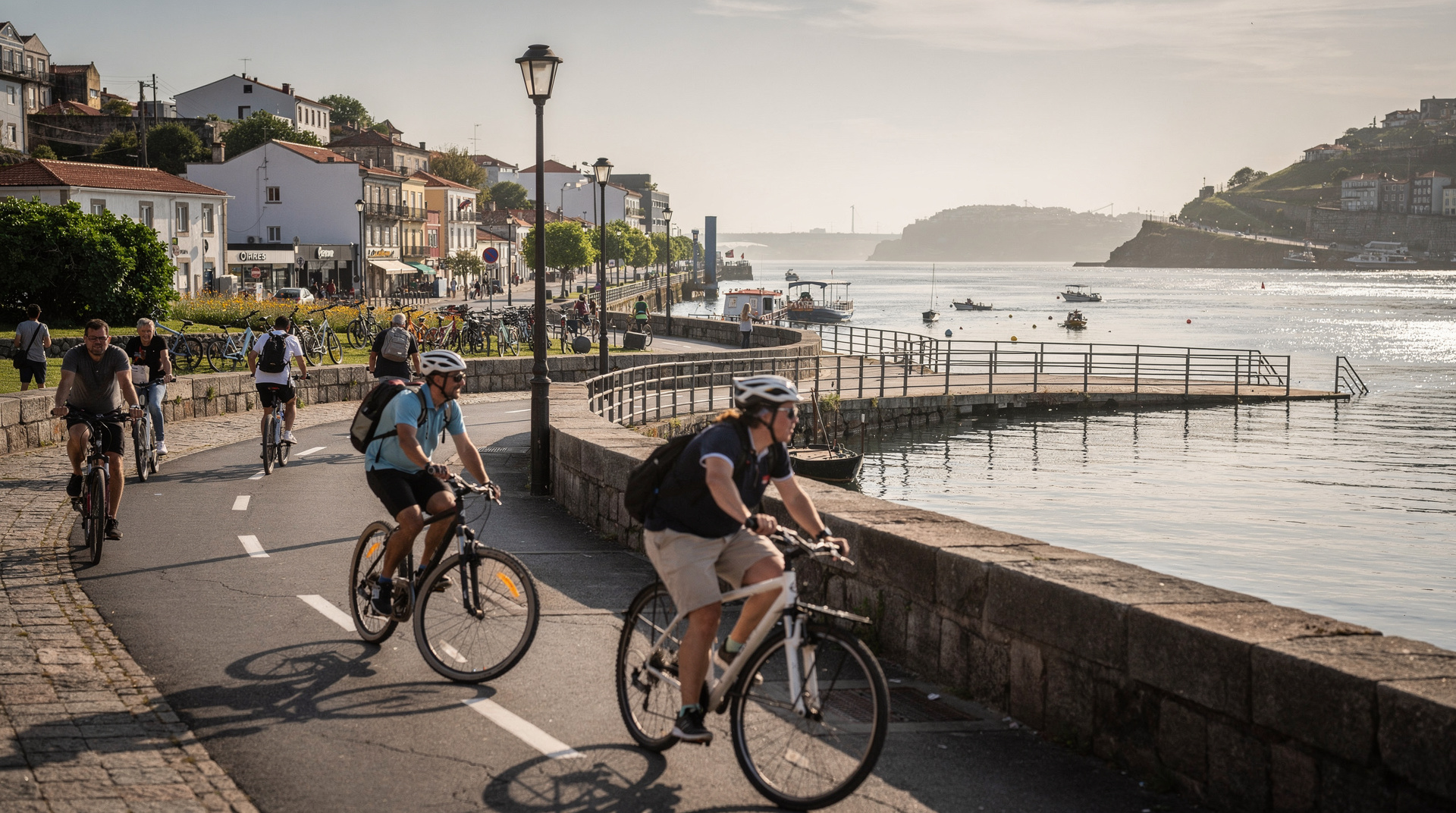
Multi-activity day: Combine with a cycling route to Foz in the morning — ride from Ribeira to Foz, continue to Matosinhos by bike (about 8 km total), surf lesson at 2 pm, metro back to Porto.
For a Porto trip that integrates outdoor adventure with city sightseeing, the Porto 4-day itinerary suggests how to sequence activities without feeling rushed.
Rainy or windy day contingency: Porto’s weather can turn quickly, and a scheduled lesson sometimes gets cancelled or postponed for safety by the school itself, particularly if onshore wind is chopping up the surface badly. Build a half-day of slack into your itinerary if surfing matters to you, rather than scheduling it for your last available slot before a flight — schools are generally good about rebooking within the same trip if you give them the flexibility.
What to expect on your first surf lesson — an honest account
First surf lessons at Matosinhos follow a fairly consistent pattern across schools. Understanding what actually happens will help you arrive with the right expectations.
The first 20–30 minutes — land theory: You will be shown how to pop up from lying flat on the board — the “pop-up” motion that gets you from prone to standing in one movement. This is practiced on the sand. It looks easy; for most people it is less easy in the water. The instructor will also cover how to read a wave (which way to look, when to start paddling), the safest way to fall (always fall to the side, never forward onto the board), and basic ocean safety.
The first attempts in the water: You paddle out to the instructor, who is standing in waist-deep water. They push the board into waves for you — your job is to pop up as the wave carries the board forward. In the first session, this often results in falling off: the board pitches, you slide sideways, or the wave dumps you before you are ready. This is normal. Most people fall 20–30 times in their first lesson.
When something works: The first time you stand up properly on a moving wave — even for three seconds — is genuinely exhilarating. The feeling of forward motion on water with nothing mechanical pushing you is unlike anything else. This is why people get addicted to surfing. Getting to this moment typically requires 40–60 minutes of attempts.
The reality check: One 1.5-hour lesson is enough for a memorable experience, but not enough to “learn to surf.” Learning to surf independently — reading waves, paddling out through breaks, catching waves without a push, turning — takes 15–30 hours of water time. Visitors who book a single lesson as a tourist activity should expect exactly that: a fun experience, some waves ridden, and a genuine taste of what the sport is. That is worth doing; just know what it is.
The Portuguese surf culture — why Matosinhos has a serious scene
Portugal is one of Europe’s leading surf destinations — Nazaré (150 km south) hosts the largest waves ever surfed, Peniche (90 km south) is a world championship circuit venue, and Ericeira (near Lisbon) is Europe’s first World Surf Reserve. The surf culture around Porto is less celebrated internationally but has been authentic for decades.
Matosinhos has a genuine local surf community that predates tourism. Local surfers have been riding these waves since the 1970s, and the beach still has a mixed local-and-visitor character that more established tourist surf destinations often lose. The surf schools at Matosinhos are run by Portuguese surfers, not imported surf-instructor franchises — which makes the experience feel embedded in real ocean culture rather than packaged for visitors.
The water quality conversation is also relevant here. Matosinhos was not always a good beach — industrial Porto’s history left its mark on the Douro estuary and adjacent coast. The European Union Blue Flag certification programme and Portuguese clean-water regulations have transformed the situation over the last 30 years. The beach now consistently meets or exceeds EU bathing water standards. This matters for surfers, who spend more time in the water than swimmers.
Wetsuits — understanding what you actually need
The Atlantic off Porto does not feel cold in the way an alpine lake feels cold. At 18–20°C in summer, it initially shocks and then becomes comfortable within five to ten minutes. Most people swim at Matosinhos in summer without a wetsuit and enjoy it. For surfing, the calculation is different: you spend 60–90 minutes in the water with significant time inactive (waiting for waves), and the wind chill on a wet body coming out of the water can be significant.
The practical guide:
June–August: A 3/2 mm wetsuit (3 mm on the body, 2 mm on arms) is comfortable. Surf without a wetsuit if you run warm — it is genuinely possible in July and August and some surfers prefer the freedom of movement.
May and September: A 4/3 mm wetsuit (4 mm body, 3 mm arms) is the comfortable standard. Without a wetsuit you will be cold within 30 minutes.
April and October: 4/3 mm minimum; some surfers use 5/4 mm for longer sessions. Without a wetsuit you will be uncomfortable.
November–March: 5/4 mm wetsuit with boots and potentially gloves and hood. This is cold-water surfing — not for the casual visitor.
All Matosinhos surf schools provide wetsuits as part of the lesson fee. When renting independently, wetsuit condition varies — check for tears or broken seals before you accept the rental.
After surfing — recovery and logistics
Surfing is more physically demanding than it looks. After 90 minutes of paddling, popping up, and being tumbled by waves, you will be tired in ways that affect your subsequent plans. Budget 30–60 minutes of rest, a proper meal, and a hot shower before attempting anything that requires full alertness.
The changing facilities at Matosinhos are basic but functional — outdoor showers for rinsing, changing areas near the lifeguard station. Surf school facilities are better, typically including hot showers. If your accommodation is nearby, returning for a proper shower is more comfortable.
For the meal after surfing: you will be hungry. The grilled fish restaurants on Rua Heróis de França serve exactly what the moment calls for — a whole grilled sea bream or dorade (dourada), potatoes, salad, bread, and a carafe of vinho verde. Budget 15–20 € per person. This is among the best-value eating near Porto.
The metro back to central Porto from Matosinhos Sul takes 15 minutes. Uber from the beach area costs 10–15 € to most central Porto accommodations. If you have the bike rental, the return cycle along the coastal and riverside path takes 40–50 minutes and is a pleasant cool-down after the surf session.
Surfing with kids or as a family activity
Several Matosinhos schools run junior lessons or accept children from around age 8 with a parent’s supervision, using softer foam boards and shorter sessions. It works well as one activity within a broader family stay — the Porto with kids itinerary treats a Matosinhos morning as one block within a 3-day plan rather than the whole day, which keeps energy levels manageable for younger children. Book a group lesson rather than a private one for kids under 12; the pace tends to suit them better and it costs less.
Frequently asked questions — Surfing in Porto and Matosinhos — spots, schools, seasons, and honest beginner guide
Do I need to know how to swim before taking a surf lesson near Porto?
Yes — all reputable surf schools require basic swimming ability before taking beginners into the water. You do not need to be a strong swimmer, but you should be comfortable in the water and capable of swimming 50 metres without stopping. If you cannot swim confidently, take a bodyboard or paddleboard lesson instead, which involves shallower water and more controlled conditions.What level of waves should beginners expect at Matosinhos?
Matosinhos breaks are typically 0.5–1.5 metres in shoulder season, which is appropriate for beginner to intermediate surfers. In winter (December–February), the Atlantic swells can reach 2–3 metres, which is unsuitable for beginners. Summer (June–August) often brings smaller, slower waves — technically manageable but not always enough power for beginners to stand up reliably. Spring and autumn offer the best combination of size and consistency for learning.How much does a surf lesson in Matosinhos cost?
Group lessons (4–8 students, 1.5–2 hours) cost 30–45 €. Private one-on-one lessons run 60–90 € per hour. Board and wetsuit rental included in most lesson packages. If you rent independently without a lesson, a board costs 15–25 € per day and a wetsuit 10–15 € per day. Most shops and schools operate near the beach promenade.Do I need a wetsuit to surf in Porto?
Yes, for most of the year. The Atlantic water off Porto is cold: 14–16°C in winter (December–March), 17–19°C in summer, rarely above 20°C even in August. A 4/3 mm wetsuit is the year-round standard for comfort. Surf schools provide wetsuits as part of lessons. If you plan to surf multiple days, consider renting a wetsuit daily rather than buying.Are there surf spots south of Porto for more advanced surfers?
Yes. Espinho (15 km south) has beach breaks that suit intermediate to advanced surfers and is slightly less crowded than Matosinhos on peak summer weekends. Further south, Costa de Caparica (near Lisbon) is outside the Porto day-trip range but is Portugal's most celebrated urban surf stretch. For Porto-based surfers seeking more powerful breaks, Vila do Conde (30 km north) and Viana do Castelo (75 km north) offer options.What is the best time of year to surf near Porto?
September through November and March through May are the sweet spots for most surfers visiting Porto. Swells are consistent, water temperature is manageable in a 4/3 mm wetsuit, and the beaches are significantly less crowded than in summer. December through February brings the biggest Atlantic swells but is strictly for experienced surfers. June through August has smaller waves and crowded beaches.Can I get to Matosinhos from central Porto by public transport?
Yes, easily. The Porto metro Line A (light blue) runs from Trindade to Matosinhos Sul station in approximately 15 minutes. From Matosinhos Sul it is a 5-minute walk to the beach. An Andante card single-zone ticket costs around 1.60 €. Uber and Bolt from the city centre take 15–25 minutes depending on traffic and cost 8–15 €.
Top experiences
Bookable activities with verified prices and instant confirmation on GetYourGuide.