Cycling Porto to Foz — the Douro riverside route, e-bike options, and what to expect
Porto: Porto Riverside Panoramic e Bike Tour
Can you cycle from Porto Ribeira to Foz do Douro, and how long does it take?
Yes. The riverside cycle path from Ribeira to Foz is approximately 7 km and takes 25–40 minutes at a relaxed pace on a flat, well-surfaced path. E-bikes make it effortless. The route continues north to Matosinhos (another 3 km) for a total coastal cycling loop of about 10 km.
The route — a straightforward map
The cycling route from Porto to Foz do Douro follows the north bank of the Douro River west from the Ribeira waterfront, continuing along the Atlantic esplanade to Foz do Douro and optionally extending north to Matosinhos. The total distance depends on your start and end point:
| Where | Ribeira to Foz do Douro, optionally to Matosinhos |
| Cost | Around 12–20 €/day standard bike, 25–35 €/day e-bike |
| Time needed | 25–40 min one-way to Foz; 2.5 hours for the full loop with stops |
| Getting there | Rental shops near Praça da Ribeira |
| Best time | 8–10 am in summer; avoid peak afternoon in July–August |
- Ribeira (Praça da Ribeira) to Foz (Passeio Alegre): approximately 7 km
- Foz to Matosinhos beach: approximately 3 km
- Total Ribeira–Matosinhos loop (one way): approximately 10 km
The path is almost entirely flat — this is the key practical fact. Porto’s legendary hills are behind and above you; the riverside and coastal route hug the water level. An ordinary city bike handles it comfortably. An e-bike is effortless and is the preferred option for most tourists, especially if combining the route with a beach stop or surf lesson at the end.
Starting from Ribeira — what you see first
The route begins at Praça da Ribeira, the cobbled square at the base of Porto’s historic waterfront. From here, the riverside path runs along the Rua Ribeira Negra and transitions to the Avenida de Gustave Eiffel (yes, named after him — the designer of Ponte Dom Luís I, whose iron arch is directly above you as you start).
The first section passes through the active lower city: warehouses converted to restaurants, the historic customs house (Alfândega do Porto, now a congress centre), and the entrance to the Vila Nova de Gaia tunnel on the opposite bank. The path is wide and well-surfaced here, shared with pedestrians but spacious enough to cycle at a comfortable pace.
This stretch includes good views back east toward Dom Luís I and Ponte Infante Dom Henrique. The light is best in the morning when the sun illuminates the Gaia hillside from the north.
The middle section — Lordelo and Massarelos
After passing the Alfândega, the route continues west through the Massarelos neighbourhood, passing the Museu do Carro Eléctrico (Electric Car Museum, worth a stop if transport history interests you — entry around 5 €) and the small riverside garden of the Parque de Serralves at water level.
The path here becomes the Av. Dom João I and then the Av. Brasil — a wide esplanade-style road with a dedicated cycle lane, palm trees, and views across to the Gaia bank. The architecture changes from the historic centre to the early-20th-century residential buildings of the Foz approach.
A worthwhile 30-minute detour here: turn north into the Jardins de Serralves (Serralves park and gardens). The gardens are beautiful and free to enter; the Museu de Arte Contemporânea de Serralves within them has a rotating programme of contemporary exhibitions and charges 12–20 € entry. The park exit on the other side brings you back toward the coastal route.
Foz do Douro — the mouth of the river
At Passeio Alegre — a tree-lined park that marks the western edge of Porto’s riverside — the Douro meets the Atlantic and the character of the route changes. The river is no longer a contained urban waterway; it broadens and the sea appears on the horizon.
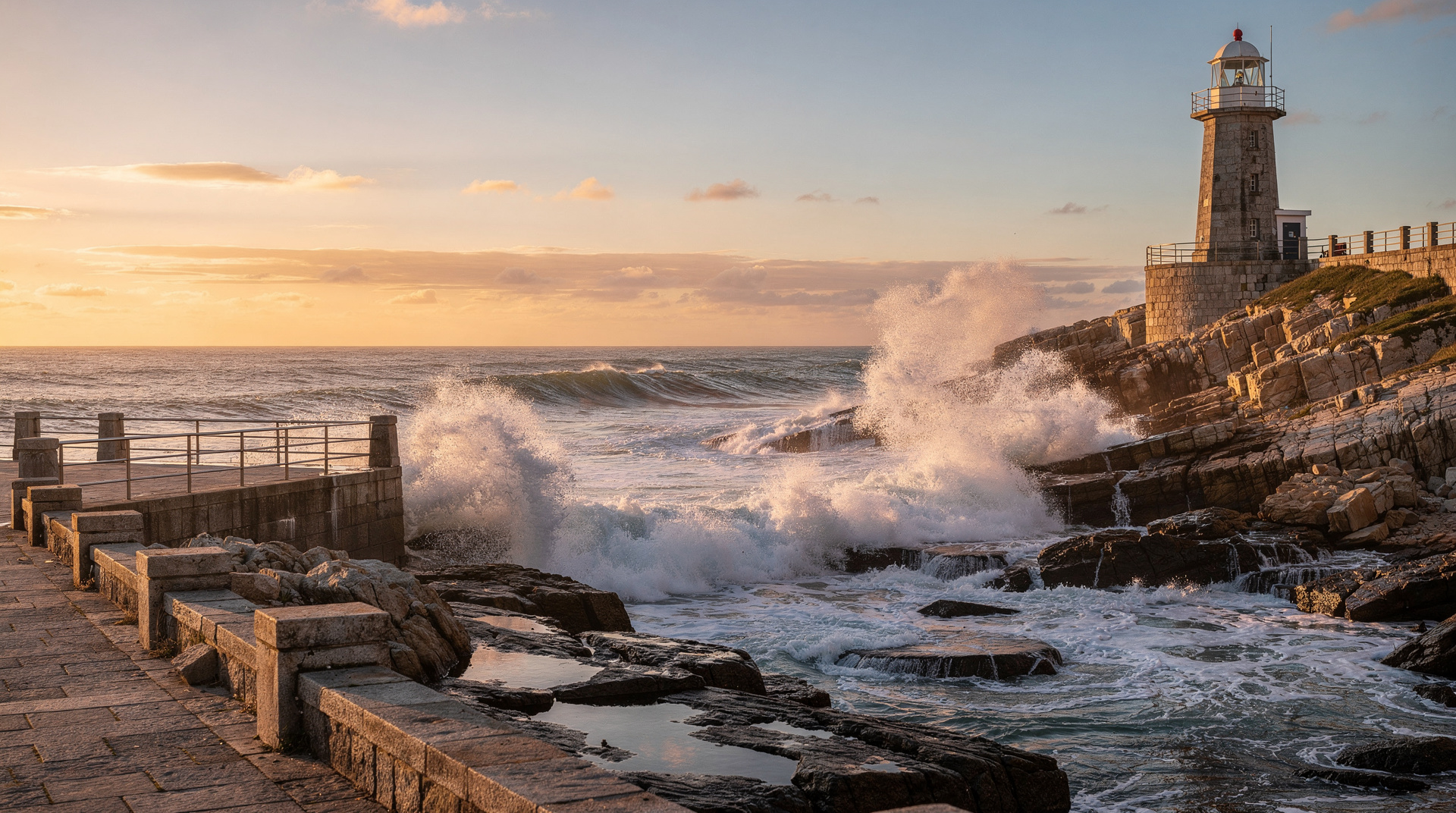
The Molhe Norte (north jetty) is worth locking your bike to explore on foot — a stone pier walkway that extends several hundred metres into the sea. In rough conditions, waves wash over the pier; in calm weather, it is a popular place to watch the sunset and photograph the lighthouse at the end. The São Paio fortress at the river mouth is another viewpoint landmark.
The Pergola da Foz — a 1930s concrete pergola walkway running along the seafront — is one of the more underrated architecture-and-scenery combinations in Porto. It is essentially the Foz promenade’s spine, with sea views on one side and gardens on the other.
At Foz, the beaches begin. Praia de Matosinhos/Foz junction is just north. The restaurant strip near the beach is good for a coffee stop — Cafés near the Passeio Alegre gardens are less crowded and better value than the seafront.
Continuing to Matosinhos
From Foz, the coastal road (Avenida Marginal da Foz) runs north with a dedicated cycle lane for most of its 3 km length to Matosinhos. The route passes Praia dos Ingleses and continues to Matosinhos beach proper — the most accessible swimming beach near Porto.
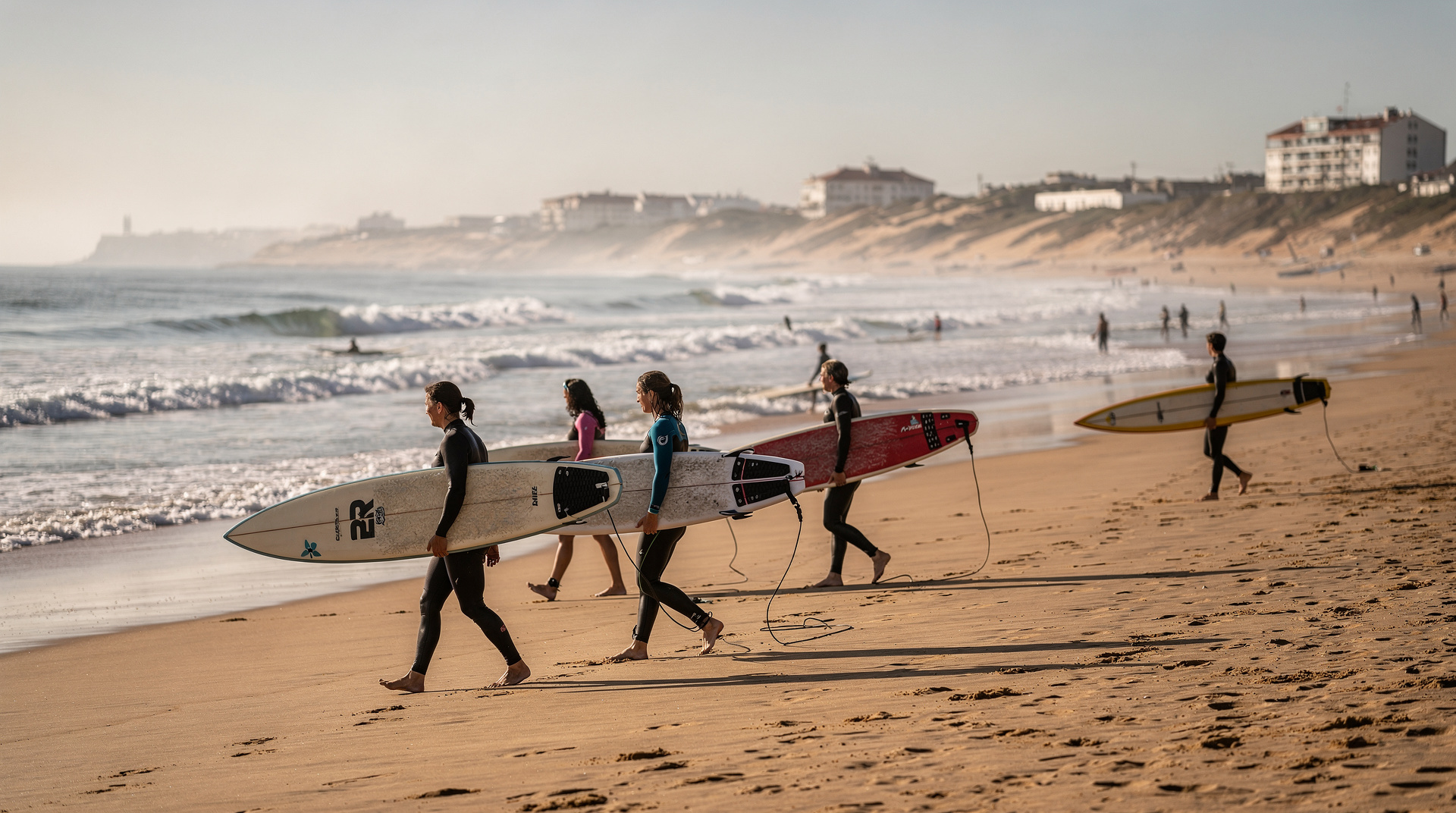
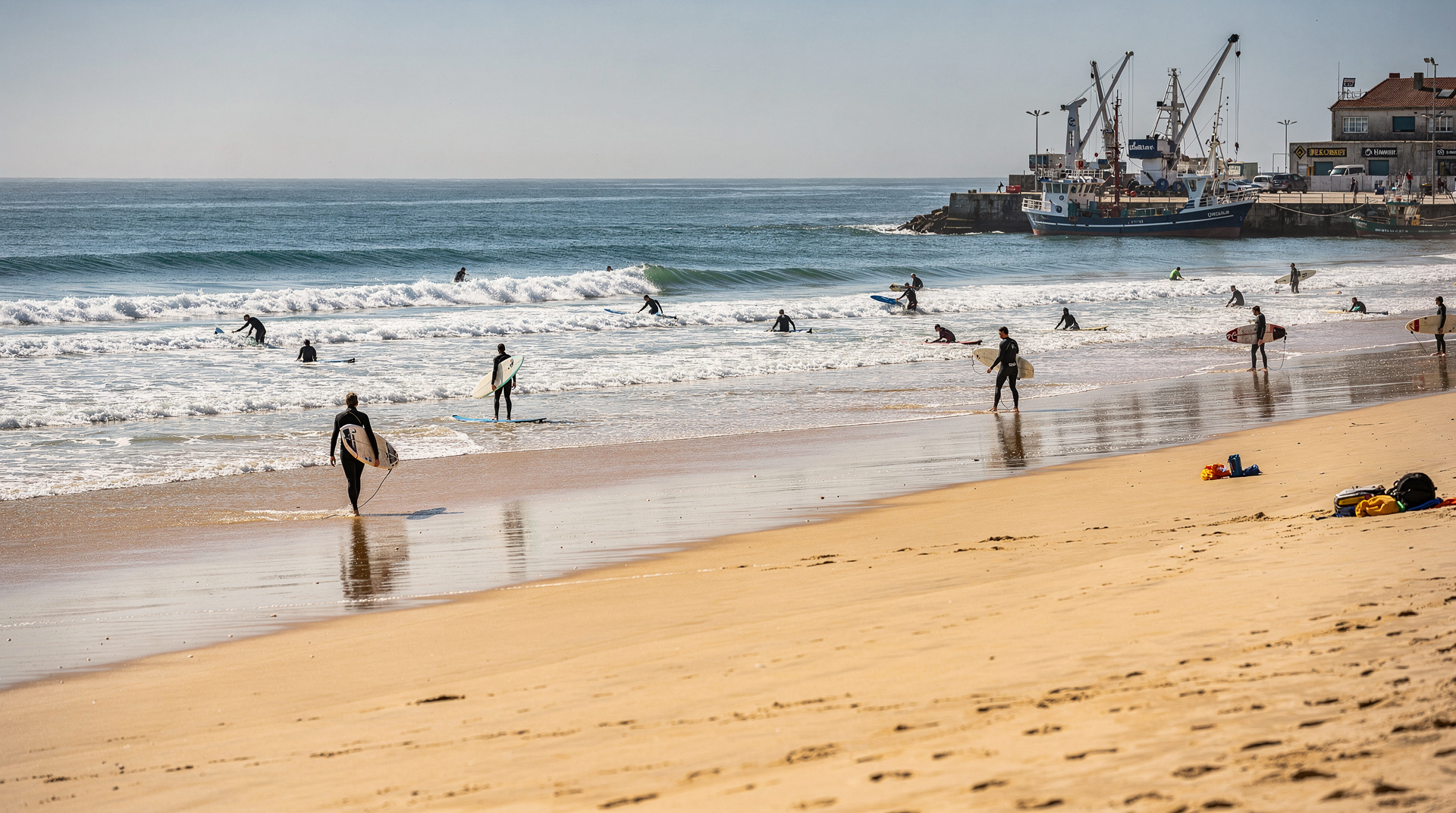
If surfing is on the agenda, this is where you arrive. Surf schools are clustered near the south end of Matosinhos beach, and board rental is available from several shops on the promenade.
The practical return logistics: the metro Line A at Matosinhos Sul station is 5 minutes’ walk from the beach. If you have rented the bike from a Porto-based shop, either:
- Return via the same cycling route (easy going east as the route is flat)
- Put the bike on the metro (off-peak hours only — before 7:30 am, 10 am–5 pm, after 8:30 pm)
- Ask the rental shop if they have drop-off/pickup arrangements in Matosinhos
Many e-bike rental operators in Porto have Matosinhos drop-off as part of their service — confirm this when booking.
Weather is rarely a serious obstacle on this route: Porto’s Atlantic climate means light rain is common outside summer, and the path itself drains reasonably well, but strong coastal wind on the Foz-to-Matosinhos stretch can slow an underpowered standard bike considerably. Check the forecast the morning of your ride if you’re planning the full loop rather than the shorter Ribeira-to-Foz section.
E-bike rental — options and prices
Book the panoramic riverside e-bike tour — a guided format that covers the Ribeira-to-Foz route with a local guide providing context on the neighbourhoods and architecture along the way.
Book the 3-hour Porto bike tour — a more structured city tour format that includes the riverside section among Porto’s broader highlights.
Book the private e-bike tour to Porto’s beaches — private format, flexible timing, specifically oriented toward the coastal and beach sections.
Independent rental for self-guided cycling: several shops near Ribeira rent e-bikes by the half day or full day. Standard prices run 25–35 € per day. A few reliable operators:
- Eco Tuk Tours / Porto Rent Bikes (Praça da Ribeira area): 28–35 € for e-bike full day
- OPO! Bikes (Av. do Aliados area): 25–32 € for e-bike; free helmet and lock included
- Bike 4 Porto: 30 € e-bike half day; delivery to accommodation possible for an extra charge
Always test the battery charge before leaving the shop. An e-bike with a depleted battery is just an overly heavy regular bike.
Cycling with children: The flat, well-surfaced Ribeira-to-Foz section is genuinely suitable for children aged 8 and up cycling independently, and younger children can be carried in a rear child seat or trailer available from most rental shops for a small supplement (typically 5–10 € per day). The busiest pedestrian stretches near Foz and Matosinhos beaches require extra care with younger riders, since the separation between the cycle lane and foot traffic becomes informal in the most crowded sections.
The Gaia side — an alternative route
The Vila Nova de Gaia bank also has cycling infrastructure, and a cross-river loop is possible using the lower deck of Ponte Dom Luís I (shared with road traffic) or the pedestrian-and-cyclist access on the upper deck (Metro viaduct level). The Gaia side takes you past the port wine lodges on the waterfront and continues west along the Eco Via do Douro toward the Gaia coastal zone.
The Gaia route is less polished than the Porto riverside path but more interesting in terms of what you pass: the cave-like cellar entrances, the rabelo boats moored at Cais de Gaia, the cable car station, and eventually the quieter coastal strip south of the river mouth.
Book the Porto e-bike highlights tour — covers both banks and uses the Dom Luís I bridge crossing as part of the route, giving the full Porto-and-Gaia river perspective.
What to eat and drink on the route
Ribeira: Coffee and pastel de nata from a café near Praça da Ribeira before departure. Avoid the waterfront restaurants for full meals — prices are 20–30% higher than streets one block back.
Massarelos/Foz approach: Several neighbourhood cafés with local prices and no tourist markup. Café Candelabro (slightly north of the route, in Bonfim) is worth a detour for coffee.
Foz do Douro: The restaurants around Passeio Alegre and the seafront have improved significantly in recent years. Casanova and Restaurante Pedro Lemos (Foz) are good higher-end options if lunch is part of the plan. For something simpler, the sandwich shops and pastelarias near the beach are 5–8 € for a proper meal.
Matosinhos: Rua Heróis de França for full seafood restaurant lunch (15–25 € per person). Grilled whole fish, seafood rice, and barnacles at genuine quality.
For a full coastal day — cycling, surfing, and lunch — see the surfing in Porto and Matosinhos guide for how to sequence the activities. The best beaches near Porto guide covers what to expect when you arrive.
The coastal cycling culture in Porto
The riverside and coastal cycling infrastructure in Porto has expanded significantly since 2015, driven by the city’s investment in sustainable transport and the popularity of e-bike tourism. The Ribeira-to-Foz route is not just a tourist activity — it is a legitimate commuting and leisure route used by Porto residents.
The city’s cycling master plan (Plano de Mobilidade Ciclável do Porto) calls for over 100 km of protected cycle lanes by 2030. The riverfront route is one of the most developed sections. Extensions north (toward Matosinhos and beyond) and south (over the Gaia bank toward the coast) are progressively improving.
For context: Porto was not historically a cycling city. The hills of the historic centre make cycling impractical for much of the urban area. The coastal route avoids the hills entirely, which is why it works as a cycling corridor where most of the city does not.
Ebike vs standard bike — the practical comparison
The route from Ribeira to Foz is flat enough that a standard bike is genuinely comfortable — the elevation changes along the riverside are minimal. The question of whether to upgrade to an e-bike is about comfort and range rather than necessity.
Standard bike (12–20 €/day): Fine for the Ribeira-to-Foz return trip (14 km round). If you plan to continue to Matosinhos (total 20 km round trip) or add any inland detours, the flat coastal section is manageable but the return can feel tiring after a full day. Best for fit cyclists comfortable with 2–3 hours of moderate cycling.
E-bike (25–35 €/day): The route becomes effortless, which means you can spend more mental energy on the scenery and stops rather than the pedalling. With an e-bike, Ribeira to Matosinhos and back is a casual 2.5-hour loop with time for a coffee stop in Foz and a beach walk at Matosinhos. Best for visitors who cycle occasionally, want to combine the ride with other activities (surf lesson, kayak session), or want the option to extend the route without fatigue.
The e-bike also handles unexpected detours — turning inland to explore the Jardins de Serralves or climbing to the Museu de Arte Contemporânea de Serralves — without the penalty of added effort that a standard bike would impose.
Beyond Foz — the Matosinhos extension in detail
The 3 km from Foz to Matosinhos runs along the Avenida Marginal da Foz, which changes names several times but remains a continuous coastal road. The cycle lane is present for most of this section, though it does briefly share pavement with pedestrians near the beach access points.
Key stops on this extension:
Praia dos Ingleses: The first beach north of Foz, with calmer water than the main river mouth area. The swimming is more reliable here than on the Foz beach proper. A good stop if you want a quick swim mid-route.
Leça da Palmeira (3 km north of Matosinhos): If you continue past Matosinhos, Leça offers the extraordinary Piscinas de Marés — Álvaro Siza Vieira’s 1966 seawater pools built into the granite rocks of the coastline. The architecture is as important as the swimming. Entry is 2–4 €. The pools are filled with seawater at high tide. Worth extending the ride for if architecture interests you.
Matosinhos Sul station: The end point for most cycling routes, with Metro Line A connections back to Porto centre. The station is a 5-minute walk from the beach, easy to find.
The Gaia south bank cycling alternative
For visitors who want to combine cycling with the port wine cellars experience, the Gaia bank cycle path offers a southern alternative to the Porto north bank route. Starting from the foot of Ponte Dom Luís I on the Gaia side, the path runs west along the waterfront past the wine lodges and their iconic display rabelo boats, then continues toward the Gaia coastal zone and eventually reaches the coast south of the Douro mouth.
This route is less developed than the Porto side — stretches of the Eco Via do Douro on the Gaia bank are still being constructed — but the waterfront section from the bridge to the Afurada fishing village (3.5 km) is well-surfaced and passes through genuinely interesting terrain.
Crossing to Gaia: the upper deck of Ponte Dom Luís I has a dedicated pedestrian/cyclist path (Metro viaduct level). The lower deck carries road traffic and is not comfortable for cyclists. Cross on the upper deck, descend via the Jardim do Morro elevator or stairs, and join the waterfront path.
Book the Porto e-bike highlights tour — this guided format crosses the Dom Luís I bridge and covers both banks, giving the complete river perspective that independent cycling of one side misses.
Which side of the river should you cycle — decision table
| Factor | Porto (north bank) | Gaia (south bank) |
|---|---|---|
| Surface quality | Fully developed, wide path | Partly developed, some rougher stretches |
| Scenery | Historic centre, Foz gardens, Atlantic esplanade | Port wine lodges, rabelo boats, quieter riverfront |
| Distance to sea | 7 km to Foz, 10 km to Matosinhos | Shorter to Afurada fishing village (3.5 km) |
| Best for | First-timers, beach/surf plans | Wine lovers, a quieter alternative route |
Most first-time visitors should default to the Porto side — it’s better surfaced and ends at a beach. Save the Gaia route for a second visit or combine both banks in a single loop using the upper deck of Ponte Dom Luís I, as covered above.
Extending the day beyond the bike
Matosinhos at the end of the ride is worth treating as a destination in its own right, not just a turnaround point. The town’s seafood restaurants along Rua Heróis de França are genuinely excellent — the Matosinhos seafood guide covers where to eat grilled fish and seafood rice after the ride, and the wider Matosinhos seafood pilgrimage piece goes deeper into why locals rate it above Ribeira for fish. If you’d rather eat back in the historic centre after returning the bike, be aware that Ribeira’s waterfront restaurants carry a tourist markup — worth reading before choosing where to sit down.
Cycling safety and rules in Porto
Portugal follows standard European cycling traffic rules. Key points for visitors:
Helmets: Not legally required for adults on cycle paths. Strongly recommended on roads shared with motor traffic. Most rental shops provide helmets; take one.
Cycle lane priority: On dedicated cycle lanes, cyclists have priority over pedestrians. In practice, the Foz promenade has a mixed pedestrian-cycling character and requires courteous speed on the sections where separation is informal rather than marked.
E-bike maximum speed: Portuguese law limits e-bike electric assist to 25 km/h. Rental e-bikes are configured to this limit. The coastal route does not require or benefit from higher speeds.
Locking: Always lock your bike even for brief stops. Use the provided lock around a fixed structure, not just the wheel. Matosinhos beach promenade has bike parking infrastructure near the surf school area.
For the most comprehensive view of outdoor Porto activities — cycling, surfing, kayaking, and sailing — the porto 4-day itinerary and the porto and Douro 5-day itinerary both include structured outdoor days on the Porto coast.
Frequently asked questions — Cycling Porto to Foz — the Douro riverside route, e-bike options, and what to expect
Is the Porto to Foz cycling route suitable for beginners?
Yes. The riverside path between Ribeira and Foz is almost entirely flat — it follows the Douro riverbank and the coastal esplanade. There are no significant hills on the direct route. Children aged 8 and above can cycle it comfortably. The only slight elevation change is if you detour through the Bonfim or Lordelo districts above the riverbank.Where can I rent a bike or e-bike in Porto for this route?
Several rental shops operate near the Ribeira, particularly around Rua Nova da Alfândega and the Praça da Ribeira area. E-bike rental costs 25–35 € per day or 15–20 € for a half day. Standard bikes (city/hybrid) cost 12–20 € per day. Some operators offer delivery to your accommodation. Bikesharing services (Gira) are also available but e-bikes must be rented from dedicated shops.How far is it from Foz to Matosinhos by bike?
Approximately 3 km north along the Avenida Marginal da Foz coastal road, which has a dedicated cycle lane for most of its length. The total Ribeira–Foz–Matosinhos route is roughly 10 km one-way. Most cyclists take the metro back from Matosinhos Sul station rather than returning the same way.Is the Gaia side of the Douro also cyclable?
Yes. There is a riverside cycle path on the Vila Nova de Gaia bank as well, running west from the Gaia waterfront toward the Atlantic. The Gaia route (Eco Via do Douro) is less developed than the Porto side but passes the wine lodge area and continues toward the coast. An e-bike tour that crosses the Dom Luís I bridge and loops back on the Gaia bank is an excellent 2-hour option.Can I bring a rental bike on the Porto metro?
Bicycles are allowed on the Porto metro during off-peak hours (before 7:30 am, between 10 am and 5 pm, and after 8:30 pm) in the dedicated bike spaces available on all trains. In practice, e-bikes are usually excluded due to battery weight restrictions — check current rules when renting. The simplest option for the Matosinhos return is to drop off the bike at the Matosinhos shop if the rental company has a branch there.Are there any significant stops along the Porto to Foz route?
Several. The route passes the historic Museu de Arte Contemporânea de Serralves (side detour north, 30 min round trip), the Fundação de Serralves park (free garden access), the Molhe Norte at Foz (the north jetty walkway into the sea), and the Pergola da Foz (a beautiful early-20th-century coastal walkway). Near Matosinhos, the Piscinas de Leça da Palmeira (Álvaro Siza Vieira's brutalist sea pools) are 2 km north of Matosinhos beach.What is the best time of day to cycle to Foz?
Early morning (8–10 am) is ideal in summer — the path is not yet crowded, the light on the river is excellent, and you arrive at Foz before the beach and promenade fill up. In autumn and spring, midday is comfortable. Avoid peak afternoon in July and August when the esplanade is very busy with pedestrians and the cycle path becomes congested near Foz.Is the Porto to Foz cycle route suitable for a hot afternoon in summer?
It is manageable but not ideal. The coastal esplanade has little shade, and the path becomes congested with pedestrians and cyclists from midday onward in July and August. If a morning slot isn't possible, cycle in the late afternoon from around 5 pm instead, when temperatures drop and the promenade thins out slightly ahead of sunset.Can I combine cycling to Foz with lunch in Matosinhos?
Yes, and it is one of the best ways to structure the day. Cycle the full Ribeira-to-Matosinhos route in the morning, arriving by late morning, and have a proper seafood lunch on Rua Heróis de França before returning by metro or cycling back at a relaxed pace in the cooler late afternoon.
Top experiences
Bookable activities with verified prices and instant confirmation on GetYourGuide.