Types of port wine explained — ruby, tawny, LBV, vintage, white and rosé
Porto: Port Wine Class with 5 Port Tasting and Pairings
What are the main types of port wine?
There are six main styles: ruby (young, fruity, red), tawny (aged in barrel, nutty and amber), LBV or Late-Bottled Vintage (deeper ruby, one harvest year), vintage (exceptional harvests, decades of bottle aging), white (dry to sweet, served chilled), and rosé (light, modern). Start with a 10-year tawny if you want to understand what makes port wine distinctive.
Walking into a Gaia tasting room without knowing the difference between a ruby and a colheita means missing most of what makes the wine interesting — and most tasting menus assume you already know. This guide breaks down every style in plain language so a cellar visit becomes an informed choice rather than a guess at the pouring list.
| Styles covered | ruby, reserve ruby, LBV, tawny, colheita, vintage, white, rosé |
| Where to taste | any major Vila Nova de Gaia lodge |
| Cost to try | around €15–35 for a multi-style tasting flight |
| Best first style | a 10-year tawny, slightly chilled |
| Alcohol | 19–22% across all styles (fortified) |
Why port wine has so many styles
Port wine is not one thing. It is a family of wines united by the fortification process — grape spirit added during fermentation to preserve sweetness and raise alcohol — but divided by how each style is subsequently aged. The aging environment, duration, and oxygen contact determine whether the end product is fresh and red or oxidised and amber, young and fruity or old and complex.
Understanding this single concept — that different aging methods produce fundamentally different wines from the same grapes — makes every cellar visit in Vila Nova de Gaia considerably more interesting.
Here is each style explained in plain language, with what to expect when you taste it and which Gaia cellars do it best.
Ruby port — the starting point
Ruby is the most widely produced port style and the cheapest. It spends a short time in large wood tanks (usually two to three years), which limits oxidation and preserves a deep red-purple colour and forward fruit flavours: cherry, raspberry, plum, sometimes dark chocolate or black pepper.
Ruby is the style you encounter most often in restaurants, supermarkets, and on cocktail menus. It is the gateway wine. It is not — despite what some tourist-facing tastings suggest — the most interesting style of port, but it is the most approachable.
What to expect when tasting: Fresh, fruity, easy. If a cellar’s standard tasting pours only ruby, it suggests they are not aiming at serious wine enthusiasts. Look for LBV or tawny in the tasting list.
When ruby excels: Paired with dark chocolate, red fruit desserts, or drunk simply as a sweet finish to a meal. It is the style used in most port-based cocktails.
Best ruby in Gaia: Taylor’s and Graham’s standard ruby expressions are well-made; Sandeman’s premium ruby is reliable. For a ruby with more depth, look for Graham’s Six Grapes or Taylor’s First Estate — both are styled as premium ruby and show considerably more complexity than generic shelf ruby.
Reserve ruby — the upgrade
Reserve ruby (sometimes called Ruby Reserve) is an improvement over standard ruby: higher quality base wines, selection from better parcels, longer barrel maturation. It sits between ruby and LBV in the quality hierarchy.
The most famous reserve ruby in the world is Graham’s Six Grapes — a wine that has been produced since the 1890s and is widely regarded as the benchmark for the style. Taylor’s First Estate is the equivalent expression from Fladgate. Both are available to taste in their respective lodges and both demonstrate what ruby can be when taken seriously.
What to expect: More structure than standard ruby, darker fruit, longer finish, a touch more complexity. Still fundamentally a fresh, red-fruit style rather than an oxidative one.
LBV — Late-Bottled Vintage
LBV is port from a single harvest year, kept in wood for four to six years before bottling. The single-year origin gives it more specific character than a standard ruby blend; the extra barrel time develops complexity that ruby lacks.
Two versions matter:
Filtered LBV: Clarified before bottling, no sediment, ready to drink immediately. Most mass-market LBV is this style. It is reliable and approachable but rarely transcendent.
Unfiltered LBV: Bottled with sediment, requires decanting. Producers like Graham’s, Ramos Pinto, Niepoort, and Quinta do Crasto produce unfiltered LBV that shows considerably more depth and complexity than the filtered version. If you see “unfiltered” or “traditional” on an LBV label, it is worth trying over the standard version.
What to expect when tasting: More structure and depth than ruby, dark fruit (blackcurrant, plum), a hint of spice, a longer finish. Good LBV is one of the best-value wine propositions in Portugal — complexity at a price that premium Douro reds would charge significantly more for.
When to drink LBV: At room temperature, slightly cool (16–18°C), with red fruit desserts, game birds, or a mature hard cheese. Many Portuguese households open an LBV after Sunday lunch.
A port wine tasting with seven styles includes LBV alongside the other styles for comparison — a useful format if you want to understand LBV in context rather than in isolation.
Tawny port — the aged style
Tawny is the style that most distinguishes port wine from other fortified wines. It ages in small 550-litre barrels called pipes over many years — typically 10, 20, 30 or 40 years — which causes controlled oxidation. The wine gradually loses its red colour, turning amber then tawny-brown. The flavours shift from fresh fruit to dried fruit, roasted nuts, toffee, caramel, and sometimes orange peel or coffee.
The age designations on tawny labels (10-year, 20-year etc.) refer to the average age of the blended wines, not a single vintage. A 10-year tawny is a blend whose average barrel age is around ten years; a 20-year is older and more complex. This blending is deliberate — the winemaker adjusts the blend each year to maintain a consistent house style.
What to expect when tasting:
- 10-year: Amber in colour, dried cherry and almond notes, lighter oxidation. The entry point for understanding tawny character.
- 20-year: Deeper amber, complex dried fruit (fig, raisin, apricot), roasted nut, a hint of orange peel. This is the most broadly praised style in Gaia tastings.
- 30-year and 40-year: Mahogany in colour, intensely complex, sometimes a note of rancio (a particular aged walnut quality found in old oxidative wines). Expensive and worth it for serious wine enthusiasts.
Serving temperature: Tawny is best slightly chilled — around 12–14°C. Many lodges serve it at cellar temperature which is too warm to show the wine at its best. Ask for it slightly chilled.
Best tawny in Gaia: Taylor’s 20-year tawny, Graham’s 20-year, and Ramos Pinto aged tawnies are consistently excellent. Burmester’s 10-year and 20-year tawnies offer exceptional quality at accessible prices.
A dedicated port wine class with food pairings covers tawny styles alongside other port types with structured guidance — a good option if you want to understand tawny properly rather than through a quick cellar pour.
Colheita — single-vintage tawny
A colheita (pronounced col-YAY-ta, the Portuguese word for harvest) is a tawny-style port from a single vintage year, aged in wood for a minimum of seven years before bottling. Where age-designated tawnies blend multiple years to achieve a consistent style, a colheita reveals what one specific harvest tasted like after decades of oxidative maturation.
The best colheitas are extraordinary wines — complex, specific, and unlike anything produced in the same format outside the Douro. Producers who specialise in this style include Niepoort, Burmester, Kopke, and Barros. The most serious colheita collections in Gaia span fifty or more years; tasting a 1980 and a 1960 side by side at Burmester or Kopke is a genuine wine education.
What to expect: Similar in colour and texture to aged tawny but with more vintage-specific character. A colheita from a warmer year will show riper, more concentrated fruit; a cooler year will show more acidity and freshness even after decades of barrel aging.
If a cellar has a colheita on their tasting menu, it is worth ordering over a standard age-designated tawny — you see something that cannot be replicated.
Vintage port — the pinnacle
Vintage port is only declared in exceptional years — roughly three to four times per decade — when the harvest quality is deemed sufficient by each individual producer (and historically ratified by the IVDP, the Port Wine Institute). It spends two years in wood before bottling and then requires significant bottle aging, typically 15–25 years, to reach maturity.
Most visitors will not taste a mature vintage port in a standard Gaia cellar visit. Mature vintages appear on premium experience menus at Taylor’s, Graham’s, and Quinta do Noval, but they are expensive — a glass of a 1994 Taylor’s Vintage might cost €35–60. Undeclared-vintage years produce wines sold under other labels rather than as vintage port.
The great declared vintages of recent decades: 2017 (exceptional), 2016 (excellent), 2011 (excellent), 2007 (very good), 2003 (excellent but drink now for most producers), 2000, 1994, 1992, 1977, 1970. These are the years worth seeking at wine merchants if you want to buy a bottle for cellaring.
Single-quinta vintage: On years not declared by the major houses, some quintas declare a single-quinta vintage using only their own estate’s grapes. These are generally ready to drink sooner than a declared vintage and are good entry points for exploring the style.
The Douro Valley quinta visit guide covers the estates that explain vintage port in the context of the vineyard, which is where the style starts to make sense.
White port — the aperitif style
White port is produced from white Douro grapes (Rabigato, Malvasia Fina, Viosinho, Gouveio) rather than red varieties. It ranges from bone dry to medium sweet. Its most important cultural role is as the base for porto tónico — white port over ice with tonic water and a slice of lemon, which has become a genuine institution in Porto’s bars and is genuinely more refreshing than it sounds.
Dry white port chilled in a glass is an excellent aperitif — complex and nutty from its barrel time, but bright and fresh enough to drink before a meal. Most tourists ignore white port entirely; this is a mistake. Niepoort Extra Dry White, Ramos Pinto Laedem, and Quinta do Noval Branco are the most interesting expressions worth seeking.
Sweet white port: Richer, honeyed, with dried fruit notes. Works as a dessert wine or digestif. Less common in Gaia tastings but worth asking about.
Tasting note: White port looks like an amber table wine in the glass, slightly deeper than Oloroso sherry. Aromas of almond, dried apricot, honey, citrus peel. On the palate: nutty, with a clean acid finish on the dry styles.
Rosé port — the modern addition
Rosé port is the newest major style, developed in the early 2000s primarily by Croft (owned by the Fladgate Partnership, same family as Taylor’s). It is produced like a red port but with very brief skin contact, resulting in a salmon-pink colour and light berry flavours without the tannin structure of ruby.
Rosé port is aimed squarely at a casual drinking market — it is pleasant over ice with lemonade or as a cocktail base, particularly in summer. Most serious port wine enthusiasts do not prioritise it; it does not show the complexity or regional character that defines the great port styles. But it is approachable, visually striking, and perfectly good as a warm-afternoon drink at a riverside table.
Best known brand: Croft Pink, available in most wine shops and Gaia lodge gift shops.
All the styles, side by side
| Style | Colour | Typical aging | Serving temp | Try if you like |
|---|---|---|---|---|
| Ruby | Deep red-purple | 2–3 years, tank | Room temp | Fresh, fruity red wine |
| Reserve ruby | Deep red | 4–6 years | Room temp | Structured reds, Six Grapes-style |
| LBV | Deep ruby | 4–6 years, single year | Slightly cool (16–18°C) | Good-value complexity |
| Tawny (10/20yr) | Amber to brown | 10–40 years, barrel | Chilled (12–14°C) | Nutty, dried-fruit sherry styles |
| Colheita | Amber, vintage-specific | 7+ years, single year | Chilled (12–14°C) | Rare, specific vintage character |
| Vintage | Deep, opaque young | 2 yrs wood + decades in bottle | Room temp, decanted | Serious cellaring reds |
| White | Pale gold to amber | Varies, dry to sweet | Well chilled | Aperitifs, porto tónico |
| Rosé | Salmon pink | Minimal | Well chilled, over ice | Light summer drinks |
Buying port to take home — what’s actually worth it
Not every style travels or ages well after purchase, and lodge-shop prices vary meaningfully by category. Vintage port is the one style genuinely worth investing in for cellaring, since it improves for decades in bottle — but only buy from a declared year and expect to store it correctly (on its side, cool, away from light) if you plan to hold it. Aged tawny and colheita are ready to drink on purchase and travel well since they are already fully matured; a 20-year tawny or a good colheita makes a far better gift than a young ruby, which rarely impresses anyone who has not tasted the better styles for comparison. LBV is the best value-for-money bottle to bring home — genuine complexity at a price well below tawny or vintage.
Duty-free allowances vary by destination; check your home country’s limits before buying multiple bottles, since port at 19–22% ABV counts as spirits-strength for some customs allowances rather than as wine.
How the styles relate to each other
Think of port as a spectrum with two axes:
Colour axis (red to amber): Ruby styles stay red because they see limited oxygen. Tawny styles shift amber because they see more oxygen over longer periods.
Age axis (young to old): Standard ruby is the youngest style. Colheitas and old tawnies represent decades of barrel aging. Vintage port in bottle can represent decades more.
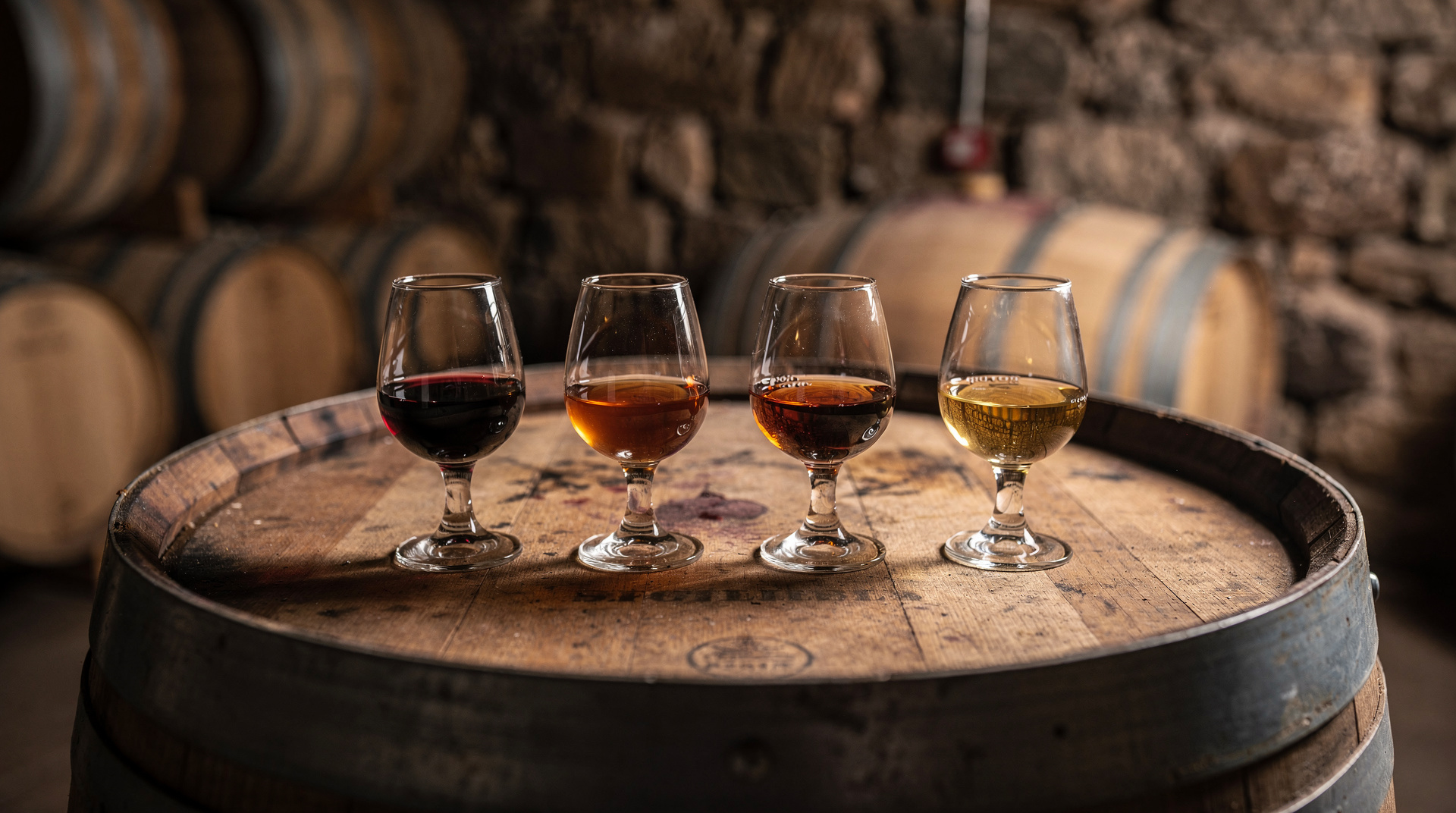
The most interesting tastings work across both axes — a young ruby alongside a 20-year tawny shows the full range in two glasses. The port wine tasting guide for beginners covers how to structure a tasting visit to get the most from this comparison.
Common misconceptions worth correcting before you taste
A few assumptions trip up first-time visitors repeatedly. “Port is just sweet dessert wine” — only some styles are genuinely sweet; dry white port and most LBV are not dessert-sweet at all. “Older automatically means better” — a well-made 10-year tawny can be more enjoyable to drink right now than a 40-year that needs a specific occasion and mindset to appreciate; age is a style choice, not a quality ladder. “Vintage port is the best style” — it is the most prestigious and the most expensive to buy young, but it needs decades to show its best; a mature 20-year tawny delivers more pleasure per euro for most drinkers today. “All tawny tastes the same” — house style varies meaningfully between producers; Graham’s, Taylor’s, Burmester and Niepoort all have a distinct character even at the same age designation, which is exactly why comparing two 20-year tawnies from different lodges is worth the extra tasting.
Where to taste each style in Gaia
Ruby and reserve ruby: Available everywhere. Taylor’s and Graham’s pour the best premium ruby expressions.
LBV: All major lodges. Ask specifically for unfiltered LBV at Graham’s, Ramos Pinto or Niepoort.
Tawny (10-year and 20-year): Taylor’s and Graham’s in their premium tasting tiers. Burmester at the best value for quality ratio.
Colheita: Burmester, Kopke, Niepoort. These are worth visiting specifically for colheita if this style interests you.
Vintage port: Premium experience menus at Taylor’s, Graham’s, Quinta do Noval. Expensive; book in advance.
White port: Ask at any major lodge — they usually have it available. Ramos Pinto and Niepoort do the best dry expressions.
Rosé port: Croft’s lodge in Gaia, or simply buy a bottle from any gift shop.
The best port wine cellars guide ranks every major Gaia lodge by what they do best — useful for matching your interest in specific styles to the cellar that does that style best.
Frequently asked questions about port wine styles
Which port wine style is the best introduction for someone who doesn’t like sweet wine?
White port in the dry or extra dry style, drunk as porto tónico (with tonic, ice and lemon), is the best entry point for someone who resists sweet wine. Dry white port is genuinely not sweet — it is nutty, complex, and refreshing. Among red styles, LBV shows less sweetness than standard ruby and has more structure. Avoid going straight to aged tawny if you’re sweetness-averse — the oxidative nutty character can read as odd rather than appealing without a frame of reference.
Can port wine be paired with savoury food rather than dessert?
Absolutely. Tawny port is a classic pairing for aged hard cheeses — Portuguese Queijo Serra da Estrela, British Stilton, aged Manchego. LBV pairs well with game, duck liver, and cured meats. Dry white port is a legitimate aperitif before any meal. The pairing format at Graham’s specifically explores this territory; the Graham’s port lodge guide has more detail on what the pairing involves.
Is port wine made only from Portuguese grapes?
Port wine must be produced from grapes grown in the Douro Demarcated Region using approved grape varieties. These are all indigenous Portuguese varieties — Touriga Nacional, Touriga Franca, Tinta Roriz (the same variety as Spanish Tempranillo), Tinta Barroca, Tinto Cão, and around 80 others. No international varieties (Cabernet Sauvignon, Syrah, etc.) are permitted in port production.
What is the difference between port and Madeira?
Both are fortified Portuguese wines but from completely different regions and aging methods. Madeira comes from the island of the same name and undergoes a unique heating process (estufagem or canteiro) that gives it distinctive caramel and rancio character. Madeira is famously almost indestructible once opened; port, especially vintage port, needs careful storage. Tawny port and aged Madeira share some similarities in their nutty, oxidative character, but they are quite distinct.
Frequently asked questions — Types of port wine explained — ruby, tawny, LBV, vintage, white and rosé
What is the difference between ruby and tawny port?
Ruby ages in large tanks or casks for a short period, keeping a deep red colour and fresh fruit character — cherry, raspberry, plum. Tawny ages in small 550-litre oak barrels for many years, which causes oxidation and turns the wine amber-brown. Tawny develops nutty, dried-fruit and caramel flavours. They are fundamentally different styles produced from the same base material by different aging methods.What does LBV mean in port wine?
LBV stands for Late-Bottled Vintage. It is port from a single harvest year that was kept in wood for four to six years before bottling. This extra barrel time develops more complexity than basic ruby while making the wine ready to drink without the long bottle aging required by true vintage port. There are two types: filtered LBV (ready to drink immediately) and unfiltered LBV, which has sediment and shows more complexity.How long do I need to age a vintage port before drinking it?
Vintage port requires significant bottle aging — typically 15 to 25 years from the declared vintage before it reaches maturity. Some exceptional vintages peak at 30 to 40 years. Drinking a vintage port too young (under 10 years) can feel tight and tannic. If you buy a recently declared vintage, plan to cellar it or purchase an older bottle from a wine merchant.What is colheita port and how does it differ from tawny?
A colheita is a tawny-style port from a single vintage year rather than a blend. Standard 10-year and 20-year tawnies blend wines from multiple harvests to achieve a consistent house style; a colheita shows the character of one specific year. Colheitas must age in wood for at least seven years. They are more specific and often more complex than age-designated tawnies.Is white port a dessert wine?
Not necessarily — white port ranges from bone dry to medium sweet. The dry styles are drunk as aperitifs, often mixed with tonic water and lemon (porto tónico) which is ubiquitous in Porto's bars. Sweet white port works as a dessert wine. Most tourists default to red port styles; asking for dry white port at a Gaia tasting room reveals a different and underappreciated dimension of port wine production.Which port wine style has the highest alcohol?
All port styles sit in a similar alcohol range of 19–22%, since fortification with grape spirit is what defines port. The specific level varies slightly by style and producer, but there is no meaningful difference in alcohol between ruby and tawny. Both are significantly higher in alcohol than table wine (11–14%), which is why tasting portions are small and limiting visits to two or three cellars per day is sensible.
Top experiences
Bookable activities with verified prices and instant confirmation on GetYourGuide.