Rabelo boat cruise explained — history, tourist versions, and honest quality guide
Porto: Porto 6 Bridges Cruise on a Traditional Rabelo Boat
What is a rabelo boat and are the tourist cruises worth it?
The rabelo is a flat-bottomed wooden boat historically used to carry port wine barrels downriver from the Douro Valley quintas to the Gaia lodges. Today's tourist rabelos are modern reproductions that cover the Six Bridges route. They are atmospheric, smaller and more open than standard cruise boats — worth the slight price premium if you care about the historic aesthetic.
| What it is | A traditional flat-bottomed wooden boat, once used to carry port wine barrels |
| Today’s cruise route | The Six Bridges loop, ~8 km, 50 minutes |
| Capacity | 12–20 passengers (smaller than standard launches) |
| Cost | Similar to a standard launch, slight premium on some operators |
| Where else | Pinhão, in the Douro Valley itself |
The rabelo — what it actually was
The barco rabelo is a flat-bottomed wooden riverboat, long and narrow in profile, with a tall square sail and a heavy stern oar called the espadela used for steering in the Douro’s fast-moving currents. For roughly three centuries — from the early 1700s until the 1960s — the rabelo was the primary means of transporting port wine barrels from the Douro Valley quintas downstream to the lodges in Vila Nova de Gaia.
The journey was not straightforward. The Douro between Pinhão and Porto runs through deep gorges and over rapids that made navigation genuinely dangerous, particularly at high water. The espadela required constant adjustment, and the crew — typically three to five men — needed considerable skill to keep the heavily loaded vessel on course through narrow rock-walled channels. A full rabelo laden with barrels could carry 50 to 70 pipes of port wine (a pipe is approximately 550 litres).
The construction of dams on the Douro in the 1960s changed everything. The Carrapatelo dam, built in 1971, created a series of locks that tamed the river’s flow but also made the traditional sailing rabelo largely redundant. Road transport had already been taking over; the dams finished the transition. The last working rabelos on the river made their final commercial runs in the early 1960s.
What remained were the boats themselves — some preserved, most lost — and the image of the rabelo that had become inseparable from port wine marketing. The tall sail, the stacked barrels, the dramatic gorge scenery: it was an image the port wine lodges understood had lasting appeal.
Why you see rabelos on the Gaia waterfront
If you cross Ponte Dom Luís I to the lower Gaia waterfront, you will immediately notice a row of wooden boats moored along Cais de Gaia, their sails painted with the names and crests of the major port wine houses — Taylor’s, Graham’s, Cockburn’s, Sandeman, Ramos Pinto. These are display rabelos, not working vessels.
The practice of maintaining a moored rabelo as a lodge emblem began in the mid-20th century, when the major shippers recognised the marketing power of the boats even as commercial use ended. Each lodge tends its display rabelo with pride: they are repainted regularly, and in some cases reconstructed entirely when age demands it. The boats at Cais de Gaia are among the most photographed objects in Porto.
The best port wine cellars in Gaia guide covers the waterfront lodges in detail, including which ones have the most photogenic rabelos.
How the tourist rabelo cruises work today
The tourist rabelo cruise emerged in the 1990s and early 2000s as Porto’s river tourism industry developed. Operators commissioned new rabelos built in the traditional style — flat-bottomed, wooden, with the characteristic high prow and low freeboard — specifically for passenger cruises on the urban stretch of the Douro.
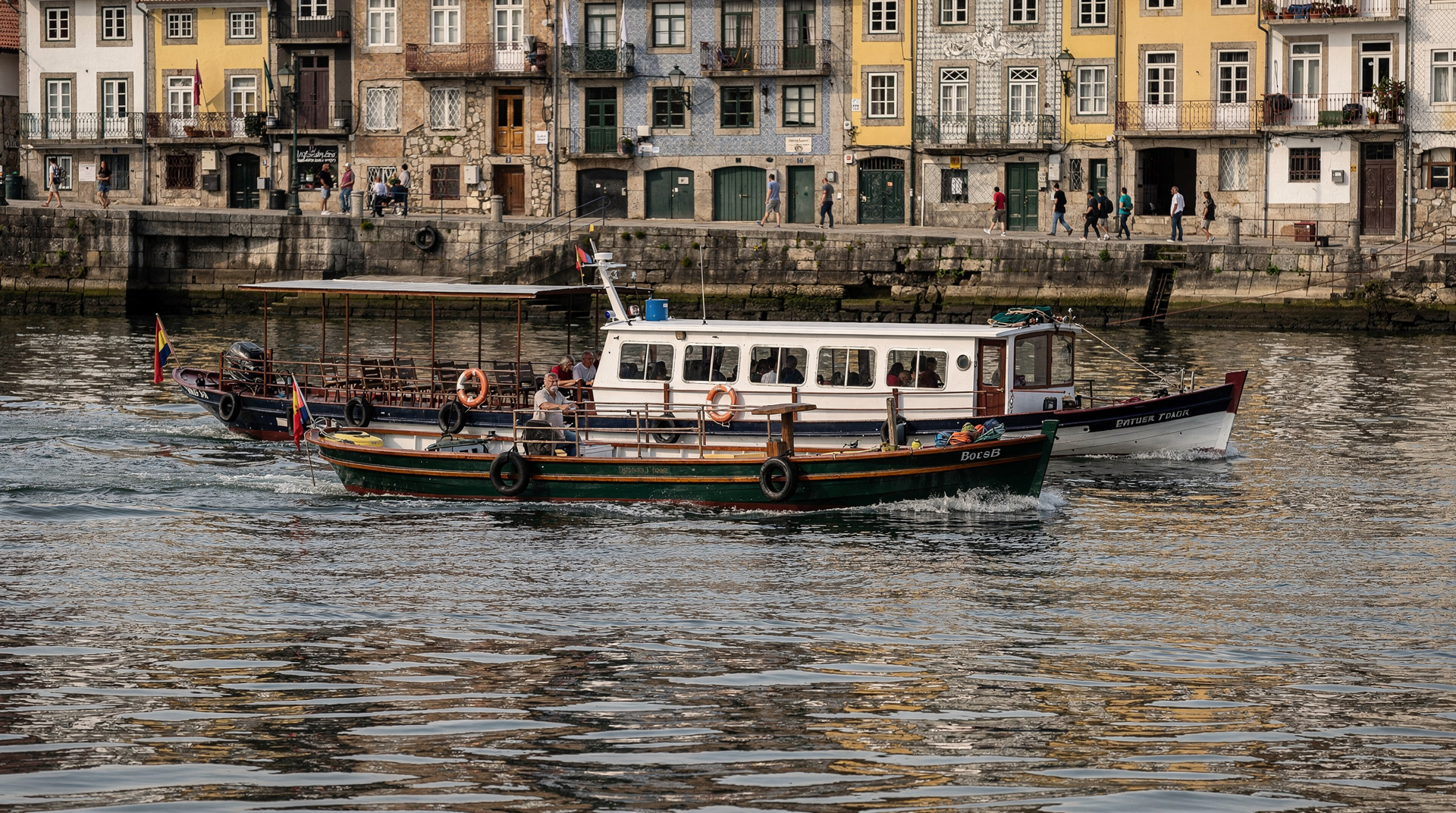
These are genuine wooden boats, not fibreglass or plastic shells. Most are built by traditional boat builders in the Douro region using oak and pine, following plans derived from historical examples. They do not have the tall working sails of original cargo rabelos — modern safety requirements and river traffic make sail-powered navigation impractical — but they retain the shape, the open deck arrangement, and the low-slung profile that makes the rabelo visually distinctive.
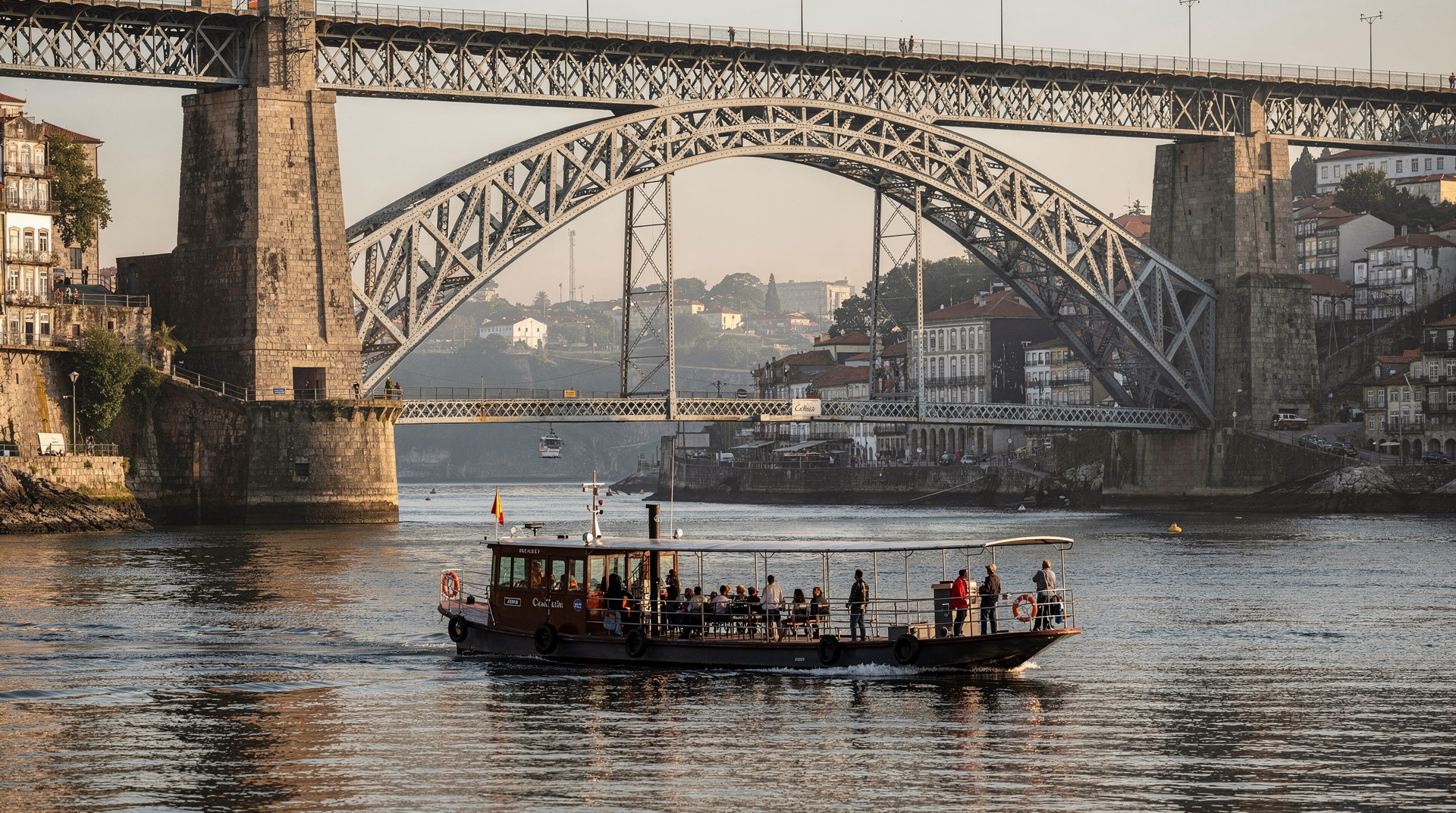
The route covered is the Six Bridges circuit: roughly 8 km, 50 minutes, departing from the Ribeira quay or Cais de Gaia. Most tourist rabelos carry 12–20 passengers, compared to 40–80 on a standard covered motor launch. Departures run less frequently — typically every 60–90 minutes in peak season, less in winter — because the smaller capacity means slower throughput.
The honest comparison — rabelo vs standard launch
The question most visitors eventually ask is whether the rabelo experience is worth the premium.
What you get on a rabelo: An open deck with benches, closer to the water level and the breeze. A boat that moves with the river more noticeably than a heavy launch. The aesthetic coherence of travelling on a vessel that is at least descended from something historically significant. Fewer fellow passengers and a more personal feel.
What you give up: The covered lower deck of a standard launch (useful in rain or very strong sun). The more frequent departures. In some cases, commentary — not all rabelo operators provide recorded or live narration.
The honest verdict: For most visitors who simply want the river view and the six bridges, a standard launch does the job as well for less money. The view of the bridges and the city skyline is identical from any vessel on the river. The rabelo makes the most sense for visitors who have some interest in the port wine story and find the connection to that history meaningful — or for those travelling with a photographer’s eye who want a more atmospheric foreground subject in their shots.
Book the Six Bridges rabelo boat cruise — compare the departure schedule against the standard launches before you commit, since the gaps between rabelo departures can be significant in low season.
Rabelo vs standard launch vs sunset cruise
| Rabelo | Standard launch | Sunset cruise | |
|---|---|---|---|
| Vessel | Traditional wooden reproduction | Modern covered motor launch | Usually a standard launch |
| Passengers | 12–20 | 40–80 | 40–80 |
| Shelter | Open deck, less cover | Covered lower deck | Covered lower deck |
| Atmosphere | Historic, intimate | Practical, efficient | Scenic, romantic timing |
| Best for | Port wine history enthusiasts | First-timers wanting the view | Couples, evening light |
If the historic angle isn’t the draw, the sunset cruise guide and the best Douro river cruise guide cover the standard launch options in more depth than fits here.
The espadela and why the rabelo needed such an unusual design
The espadela deserves closer attention because it’s the single feature that made the rabelo’s job possible. Unlike a conventional rudder mounted at the stern below the waterline, the espadela was a long steering oar — up to six metres on the largest boats — mounted above the water and worked by hand. This mattered because the Douro’s fast, shallow, rock-strewn stretches (particularly before the dams tamed the river in the 1970s) would have snapped or grounded a conventional rudder repeatedly. The espadela let the helmsman make instant, powerful corrections, essentially steering by feel through rapids that shifted in depth and force with every season’s rainfall.
Handling the espadela was a specialist skill, not something any crew member could pick up. The pilot at the stern needed years of experience reading the river’s current patterns, and a skilled espadela handler was among the most valued members of a rabelo crew — pay for the role reflected the danger and expertise involved, since a misjudged rapid could capsize a boat carrying an entire season’s worth of a quinta’s production.
Rabelo cruises in Pinhão — a different experience entirely
If you travel into the Douro Valley — by the Porto to Régua cruise or by train — you will find a separate category of rabelo experience based in Pinhão, roughly 25 km east of Régua.
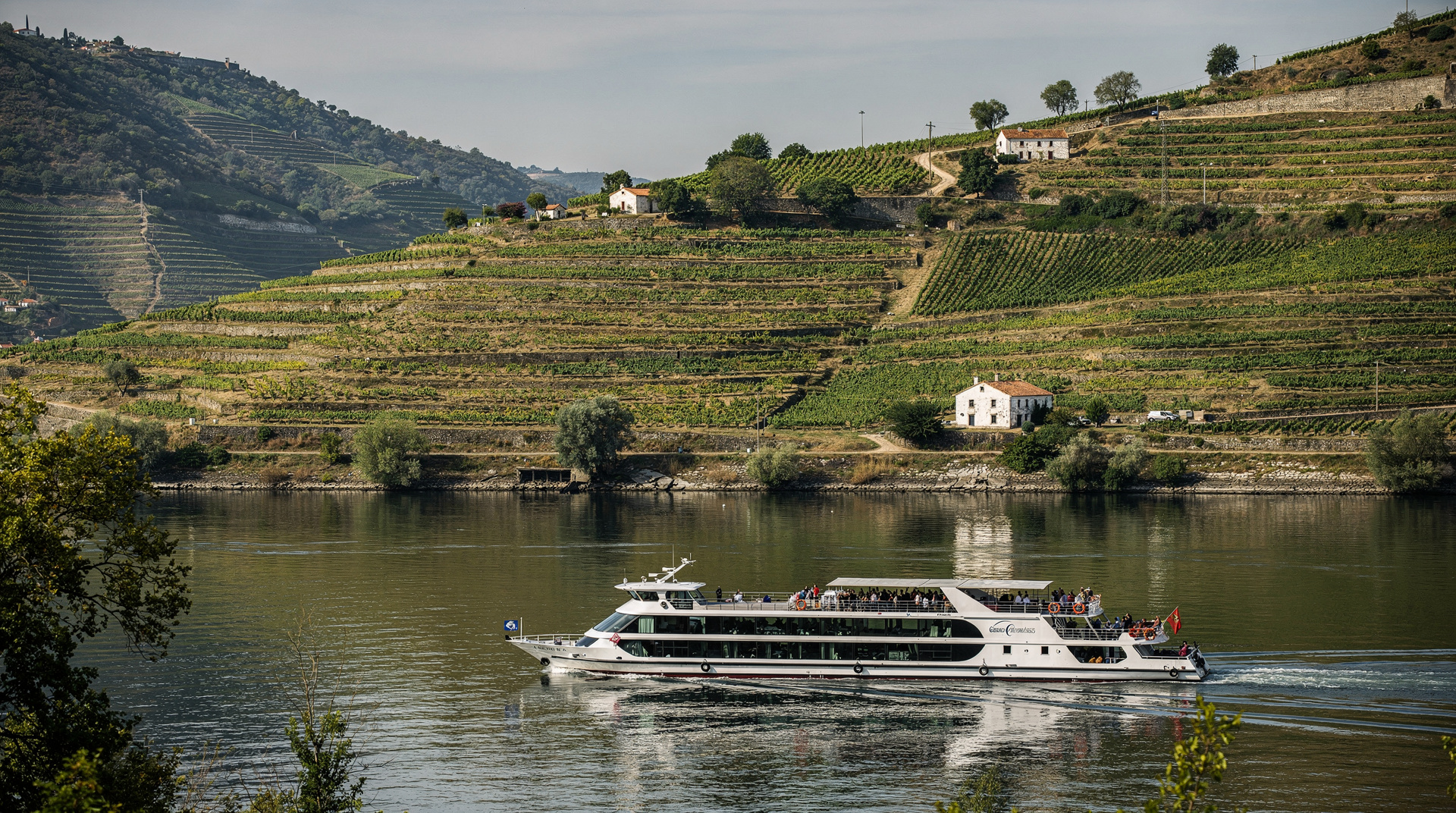
Pinhão rabelo cruises operate on a completely different stretch of river. Here the banks are lined with terraced vineyards, the schist hillsides rise steeply above the water, and the quintas of some of Portugal’s most celebrated port wine producers are visible from the river. A one-hour or two-hour rabelo cruise from Pinhão is surrounded by the landscape that made the port wine trade possible — which gives the historical connection considerably more force than the urban Porto version.
Book the one-hour rabelo cruise from Pinhão if you are already planning a valley visit. The two-hour version with audio guide provides considerably more context about the quintas and vine varieties visible from the water.
The kayak and rabelo combination from Pinhão is a good option for active travellers: paddle the river in the morning, return to a quinta for a tasting, and see the boats from the perspective of someone also on the water. The kayak and SUP on the Douro guide covers the Porto end of this activity.
Boat construction and historical context
The design of the rabelo evolved over centuries to suit the specific challenges of the Douro. The flat bottom allowed the boat to navigate extremely shallow sections of the river, particularly in summer when water levels dropped. The high prow helped push through standing waves at the base of rapids. The espadela — a steering oar up to six metres long, positioned at the stern — allowed for sharp corrections in fast water where a conventional rudder would be inadequate.
A fully loaded working rabelo carrying port wine barrels rode very low in the water: the freeboard (distance between waterline and deck edge) could be as little as 20–30 cm. Crews worked in cramped conditions with cargo piled high. The downstream journey from Pinhão to Gaia typically took two to three days; the upstream return, rowing against the current, could take ten to fifteen days and was often done by mule-track rather than river.
This context gives the tourist rabelo its genuine significance. It is not simply a picturesque boat — it was the operational infrastructure of an entire trade economy. The port wine that made Vila Nova de Gaia one of the most prosperous wine-trading centres in Europe moved through the gorge on these boats, season after season, for 250 years.
Where to photograph rabelos in Porto
Cais de Gaia: The moored display rabelos of the major wine lodges are best photographed from the Ribeira side of the river, particularly in early morning light (the sun is behind you looking south). The boats are clearly named and painted in lodge colours.
Ponte Dom Luís I lower deck: Walking across the lower road deck of Dom Luís I gives you eye-level views of the moored Gaia rabelos to your right and the Porto waterfront to your left. This is also where you see tourist rabelos passing below if the timing works.
Ribeira quay: Rabelo cruise boats are moored at the Ribeira quay between departures. The best photographs come from the stone steps along the quay, shooting across the water with Gaia and the bridge as the backdrop.
From the water: If you are on the Six Bridges cruise on a standard boat and a rabelo happens to be running simultaneously, the juxtaposition of vessels can make for interesting shots. This is not something you can reliably plan, but it happens regularly in peak season.
From Vila Nova de Gaia’s upper viewpoints: The Serra do Pilar viewpoint above the Gaia cable car station gives a high, wide-angle view over the moored rabelos, the bridge and the Ribeira skyline together — worth the climb for a single photograph that captures most of what this guide has described.
Practical information for booking
Rabelo cruises depart from the Ribeira quay (Porto side) and from Cais de Gaia. Both boarding points are within 200 metres of each other — separated by Ponte Dom Luís I — so your choice of boarding point depends on which bank you are starting from.
In high season (June–August), aim for a morning departure if you want the best light and smaller queues at the ticket window. The 10 am and 11 am departures are significantly less crowded than the 3–5 pm slots. In peak July, even rabelo tickets can be gone for the next two departures by early afternoon.
Book the 50-minute rabelo cruise from Porto for the standard urban circuit. This is the most direct option for visitors who want the rabelo experience without committing to a longer format.
For a full comparison of all cruise lengths and formats — including where the rabelo sits against the 2-hour sunset cruise and the full-day Régua options — see the Douro cruise comparison guide. If you’re building a longer valley stay around the rabelo experience, the Douro wine lovers 4-day itinerary shows how it fits alongside quinta visits and other river time.
The rabelo in context — how it fits into Portuguese maritime history
Portugal’s maritime history is dominated by the Age of Discovery narratives — the caravels, the spice routes, the circumnavigation of Africa. The rabelo does not belong to that story. It is a river working boat, not a deep-sea explorer. But within the specific economy of the Douro Valley and the port wine trade, it is as historically significant as anything on the high seas.
The port wine trade began in earnest in the late 17th century, driven partly by the Methuen Treaty of 1703 between Portugal and Britain, which gave Portuguese wines preferential import duties in England. Demand grew rapidly. The quintas of the Douro Valley began producing in volume. The challenge was getting the wine from inland mountain estates to the coast and export markets.
The rabelo solved this problem for roughly 250 years. Without the rabelo, the port wine industry as it developed historically would not have been possible. The boats carried pipes of young port downriver from the valley in autumn and early winter, then returned upstream empty — or loaded with goods from Porto’s merchants — for the next season. The rhythm of this trade shaped the agricultural calendar of the Douro Valley and the economic structure of Porto and Gaia.
The transition from working boat to symbol
The death of the working rabelo came gradually, then suddenly. Road transport had been improving throughout the first half of the 20th century, and by the 1950s lorries were already carrying a significant proportion of port wine production by road rather than river. The construction of the Carrapatelo dam (1971), the Régua dam (1973), and the Valeira dam (1976) eliminated the remaining practical rationale for rabelo transport — the lock system that replaced the rapids was not designed for the traditional rabelo hull, and the economics of river transport could not compete with road.
The last commercial rabelo run is variously dated to the early 1960s, though some operators maintained the boats in ceremonial form longer. The port wine lodges quickly recognized that the rabelo had become more valuable as a brand emblem than as a working vessel. The moored display rabelos at Cais de Gaia, now a defining feature of the Porto waterfront, are the commercial successors to that recognition.
The transition from tool to symbol is not unique in maritime history — similar stories apply to tall ships in many European ports. What makes the rabelo case interesting is the speed of the transition (effectively complete within a generation) and the degree to which the symbol has become inseparable from the product it once carried. Try to imagine a port wine advertisement without the rabelo. It is difficult.
Recognising a quality tourist rabelo operation
Not all tourist rabelo boats are equally well-maintained or historically accurate. Here is what to look for:
Construction material: A genuine wooden boat, not fibreglass or GRP with a wooden-look finish. Real tourist rabelos are built from oak and pine. You can tell by knocking on the hull — solid wood has a different resonance from hollow fibreglass.
Hull shape: The correct rabelo hull is flat-bottomed with a pronounced upward curve at the bow (prow) and a squared-off stern. The sides should be relatively low (low freeboard). If the boat looks more like a conventional motorboat with a decorative sail, it is not really a rabelo design.
Crew knowledge: Staff on a quality rabelo tour should be able to answer basic questions about the boat’s history and the port wine trade. If the crew cannot explain what a rabelo is or why it matters, the “rabelo experience” is cosmetic rather than educational.
Departure reliability: Tourist rabelos run on a schedule that is necessarily more flexible than standard launches (fewer boats, more operational complexity). Quality operators communicate changes promptly and do not leave passengers waiting at the quay without explanation.
Group size and pacing: A rabelo crew that keeps groups to 12–20 passengers and allows time for questions about the boat’s history, rather than rushing straight into the Six Bridges commentary, is generally the more thoughtful operation. If the crew’s focus is entirely on moving people on and off the boat as fast as possible, the historical element of the experience is being treated as a marketing label rather than something genuinely delivered.
What the rabelo looked like in daily use
Beyond the barrels themselves, a working rabelo carried a small crew who effectively lived aboard for the two-to-three-day downstream run: a simple cooking fire in a sand-lined box near the stern, minimal shelter from rain, and long hours of physically demanding rowing or poling through the calmer stretches between rapids. The romantic image of a rabelo under full sail obscures how much of the journey was manual labour rather than sailing — the sail helped on open, favourable-wind stretches, but the gorge sections required oars, poles pushed against the riverbed, and the espadela working constantly. Understanding this makes the modern tourist cruise easier to appreciate for what it is: a comfortable, curated echo of a genuinely arduous trade, not a recreation of the working conditions themselves.
Connecting the rabelo to the port wine cellar experience
The most coherent way to understand the rabelo is in the context of the full port wine story. Seeing the display rabelos at Cais de Gaia while visiting a port cellar gives the boats meaning — you have just emerged from the lodge where the wine was aged, and the boat that brought it there is moored five minutes away.
The best port wine cellars in Gaia guide covers which lodges have the most impressive display rabelos and positions them in the broader Gaia visit. A half-day that pairs a Taylor’s or Cálem cellar visit in the morning with a rabelo boat cruise in the afternoon is one of the more historically coherent Porto experiences available.
The port wine tasting guide for beginners provides vocabulary and context for the wines you will encounter in the cellars — which enhances rather than replaces the rabelo experience, since the two are deeply intertwined.
If you want the full Douro landscape, not just the boat
The urban Six Bridges rabelo is a genuine taste of Porto’s river heritage, but it doesn’t reach the actual Douro Valley vineyards that made the rabelo trade necessary in the first place. If the terraced hillsides in port wine marketing are what you actually want to see, the Porto to Régua cruise or the Douro Valley transport guide are the better starting points — both cover the valley itself, with the Pinhão rabelo experience described above as one option once you’re there.
Frequently asked questions — Rabelo boat cruise explained — history, tourist versions, and honest quality guide
Are rabelo cruises the same route as standard Six Bridges cruises?
Yes. Tourist rabelos cover the same Six Bridges loop — roughly 8 km, 50 minutes — that standard motor launches do. The route is identical. The difference is the vessel: a traditional flat-bottomed wooden boat versus a modern covered cruiser. Same bridges, same river, different atmosphere.How many passengers fit on a rabelo boat?
Tourist rabelos typically carry 12 to 20 passengers — significantly fewer than standard cruise launches, which can hold 40 to 80. This smaller capacity means a more intimate experience but also means the rabelo departures are less frequent and can sell out faster in high season.Are the tourist rabelos authentic original boats?
Almost all are reproductions, not original working vessels. Authentic 18th and 19th century rabelos are museum pieces — a few are on permanent display at the Museu do Douro in Régua and on the Gaia waterfront. The tourist versions are historically accurate in shape and construction method but built in the last few decades. This is not a drawback — they are genuinely wooden boats, not fiberglass replicas.Do rabelo cruises run in winter?
Yes, with reduced frequency. Most rabelo operators run a winter schedule from November through February with departures every 60–90 minutes rather than every 30 minutes in summer. Cancellations are more likely in strong winds or heavy rain since the open deck design offers less shelter than enclosed cruise boats.Where can I see a rabelo at the Gaia waterfront?
Several port wine houses display rabelos moored at the Cais de Gaia quay, painted with their lodge names and logos. Taylor's, Graham's, Cockburn's and Sandeman all maintain moored display rabelos visible from the waterfront and Ponte Dom Luís I. These are not operational tour boats — they are moored display vessels, essentially floating advertisements.Can I do a rabelo cruise in Pinhão rather than Porto?
Yes, and it is a different experience entirely. Pinhão-based rabelo cruises operate on a stretch of river surrounded by terraced Douro Valley vineyards rather than Porto's urban bridges. They run for one to two hours and are a genuinely atmospheric way to see the wine country from the water. These are separate tour products from the Porto six-bridges circuit.Is a rabelo cruise better than a standard Six Bridges cruise?
Better is subjective. The rabelo is more atmospheric and historically resonant — if you have any interest in port wine history, sailing on the same style of boat that moved thousands of barrels downriver for three centuries is a worthwhile experience. The trade-off is less shelter from sun and rain, fewer departures, and a slightly higher price. For first-time visitors who simply want the river view, a standard launch does the job equally well.
Top experiences
Bookable activities with verified prices and instant confirmation on GetYourGuide.