Porto funicular and Gaia cable car — complete guide
Porto: Porto Hop on Hop Off Bus Tram Tour Funicular
Is the Porto funicular worth taking?
Yes, for practical reasons. The Funicular dos Guindais costs 2.50 € one way and covers a 61-metre elevation drop in 2 minutes — replacing a 15-minute steep uphill walk on cobblestones. The Gaia cable car (teleférico) on the Vila Nova de Gaia side costs 6 € return and provides spectacular views of Porto's skyline. Both are tourist attractions in themselves and practical shortcuts.
Porto’s vertical transport: the context
Porto’s topography forces its visitors to confront altitude in a way that flat cities do not. The city’s historic centre spans multiple levels connected by steep hillside lanes, and the difference between the Douro waterfront at Ribeira and the upper city at Batalha is 61 metres over a short horizontal distance. Walking this every day adds up — and two specific mechanical connections make the vertical journey both faster and more scenic.
The Funicular dos Guindais and the Teleférico de Gaia (Gaia cable car) serve different routes, different sides of the river, and are operated by different companies. This guide covers both, including the practical transport function, the experience of riding them, the honest cost-versus-value assessment, and how to incorporate them into a Porto itinerary.
| Funicular dos Guindais | Batalha ↔ Ribeira, 2 min, from 2.50 € (Porto Card: free) |
| Teleférico de Gaia | Gaia waterfront ↔ Jardim do Morro, 5 min, 6 € return |
| Combined ticket | None — separate operators, separate tickets |
| Best for views | Gaia cable car, especially late afternoon |
| Best for practicality | Funicular, replacing a 15-min uphill walk |
The Funicular dos Guindais
History and background
Porto’s hillside funicular has a longer history than most visitors realise. A funicular first operated on the Guindais hillside in 1891, powered by a steam engine and connecting the Batalha square with the Ribeira waterfront. The original funicular operated for several decades before closing due to an accident and the subsequent decline in usage.
The current funicular reopened in 2004 after a thorough reconstruction — new cars, new safety systems, and significantly improved infrastructure, though following the original 1891 route. The reopening was timed to coincide with Euro 2004, when Porto hosted several matches and invested substantially in tourist infrastructure.
The funicular is now operated as part of the STCP (Sociedade de Transportes Colectivos do Porto) network, the same company that operates Porto’s buses and heritage trams.
The route and what you see
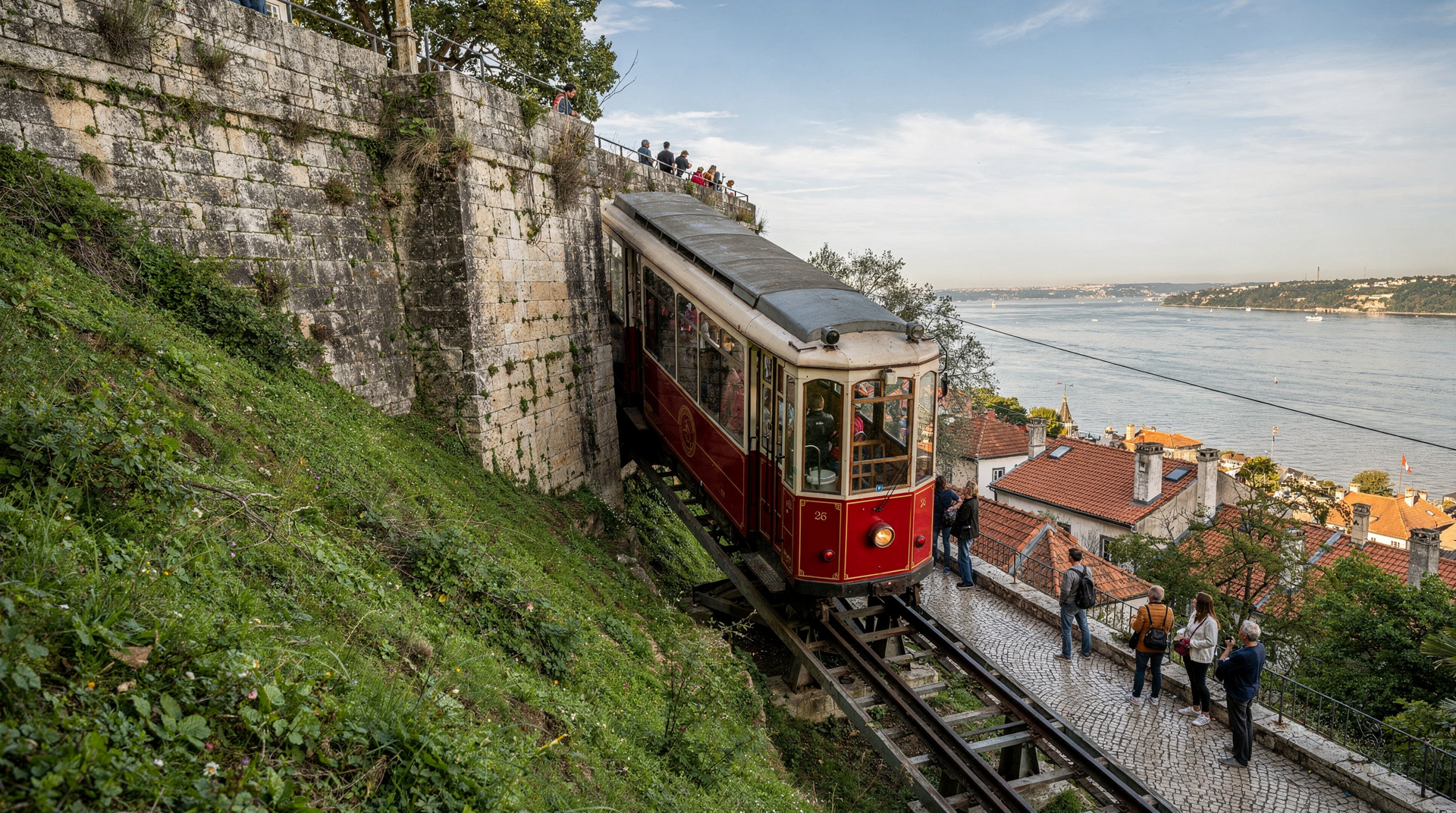
The journey covers 281 metres from the Estação do Funicular at Batalha (at the top of the Alfândega hill, adjacent to Batalha square) to the station at Ribeira (at the bottom, near the Douro waterfront). The car descends at an average gradient of approximately 28 percent — steep enough to feel distinctly inclined throughout the ride.
During the descent, you pass through a section of Porto’s historic Bairro da Vitória neighbourhood — old residential buildings immediately adjacent to the track, laundry on balconies, tiles on façades. The lower portion opens a view across the Douro to the Gaia hillside and the Serra do Pilar monastery. These two minutes of architecture and city reveal more about Porto’s layered fabric than many longer tours.
Practical transport function
The funicular’s primary practical value is replacing a 15-minute steep uphill walk. If you have descended to Ribeira on foot and want to return to the upper city (toward Batalha, São Bento, or the Aliados metro area), the funicular saves the effort and the time.
Direction that matters: The funicular runs downhill (Batalha to Ribeira) and uphill (Ribeira to Batalha) — both directions. The downhill direction is less important as a transport tool (walking down is easier than walking up) but is often taken for the experience. The uphill direction is where it earns its cost.
Connection to the metro: The Batalha station end of the funicular is a 10 to 12 minute walk from Aliados metro station (lines A, B, C, E, F) or approximately 8 minutes from Bolhão metro station. The funicular does not connect directly to a metro station, but the walks between them are on the upper plateau level and are flat.
Cost and Porto Card
- Single journey: 2.50 €
- Return ticket: 4.00 €
- Porto Card: included — the funicular is one of the Porto Card’s more clearly valuable inclusions
The funicular does not use the Andante card for fare payment — it has a separate ticket system. Buy a ticket at the machine inside each station. Both card and cash payment are accepted.
Is it worth 2.50 €? Almost always yes. For a solo traveller on a tight budget, the 2.50 € is justified once or twice during a stay — the experience is worth having, and the transport function is real. For visitors using the Porto Card, it is free and should be used without hesitation.
When to visit
The funicular runs approximately every 8 to 10 minutes during operational hours. Queue times are typically short outside of peak summer afternoons (when tour groups arrive en masse at the Ribeira end). The best timing for photography is mid-morning (good light, smaller queues) or early evening (golden light on the buildings, but longer queues in summer).
Summer hours: approximately 8:00 am to 10:00 pm. Winter hours: approximately 8:00 am to 8:00 pm, with extended hours on weekends. Check at the station for current seasonal hours as they adjust through the year.
Accessibility
The funicular car requires stepping onto a moving vehicle at a slight angle — the entry is through a door at the car’s end, and the car’s interior is steeply inclined during the ride. This is not challenging for most visitors but is not fully wheelchair accessible. Visitors with significant mobility limitations should assess the step height (approximately 30 cm) before committing. See the accessible Porto guide for alternative mobility solutions.
The Teleférico de Gaia (Gaia cable car)
What it is and where it runs
The Teleférico de Gaia is a gondola cable car located on the Vila Nova de Gaia side of the Douro River — across the bridge from Porto. It was installed in 2011 as part of an infrastructure investment in the Gaia riverside area and runs between two stations:
- Lower station: Adjacent to the Gaia waterfront quay (Cais de Gaia), near the port lodge cellars and the foot of Ponte Dom Luís I
- Upper station: Jardim do Morro, at the top of the Gaia hillside, adjacent to the D-line metro station (Jardim do Morro) and the Serra do Pilar monastery viewpoint
The cable car spans 563 metres in horizontal distance, rises 67 metres in altitude, and takes approximately 5 minutes. Up to 8 passengers travel in each gondola.
The view — the main reason to ride it
The view from the Teleférico de Gaia is one of the best perspectives of Porto’s historic skyline available without climbing a building. As the gondola rises from the Gaia waterfront, the panorama opens across the Douro to Porto’s hillside — the Ribeira coloured buildings, Ponte Dom Luís I in full view, Clérigos Tower visible above the roofline, and the Serra do Pilar monastery dome directly adjacent as you arrive at the top station.
For photographers, the mid-ascent and upper station viewpoint offer angles on Porto that are not available from the Porto side itself. The golden hour in the evening — looking west across the Douro at Porto with the last light catching the coloured building facades — is particularly effective from the Gaia side.
Practical transport function
The cable car serves a legitimate transport function: it connects the Gaia waterfront (where the port cellar visits concentrate at the lower end of Gaia, near Cálem and Ramos Pinto) with the upper Gaia plateau (where Taylor’s and Graham’s are located, and where the D-line metro stops at Jardim do Morro).
Without the cable car, walking from the waterfront to the upper cellars takes 15 to 20 minutes uphill on steep lanes. The cable car reduces this to 5 minutes, making the combination of a lower-level cellar visit (Cálem, Ramos Pinto) and an upper-level cellar visit (Taylor’s, Graham’s) in a single afternoon considerably more practical.
The most logical itinerary using the cable car:
- Arrive in Gaia from Porto via Ponte Dom Luís I on foot (lower deck)
- Visit Cálem or another waterfront-level cellar
- Take the cable car up to Jardim do Morro (4 € one way from lower to upper)
- Visit Taylor’s or Graham’s at the upper cellar level
- Sit on Taylor’s terrace with the view
- Return to Porto via the D-line metro from Jardim do Morro to São Bento (one stop), or walk back across the bridge using the upper deck
Cost
- One way (lower to upper or upper to lower): 4 €
- Return: 6 €
- Children (typically 4–12 years): reduced rate
- Porto Card: not included — the Teleférico de Gaia is on the Gaia side and operated independently
The cable car is not included in the Porto Card, which covers Porto-side transport. It is not included in the Andante card. It is a separate purchase with its own ticket machines at each station.
Is 6 € worth it? For the view alone — yes. For the practical transport function — yes, if you are planning to visit both lower and upper Gaia cellars. For visitors who are only visiting one cellar level and have already seen the view from the upper side, the second ride is less essential.
Hours and queue times
The Teleférico de Gaia operates approximately 10:00 am to 8:00 pm in winter and 10:00 am to 8:00 pm (often extended to 10:00 pm) in summer. Check the official Teleférico de Gaia website for current hours, which adjust seasonally.
Queue times at the lower station in peak summer (July and August) can run 15 to 30 minutes at midday and early afternoon when port cellar visit groups arrive. Earlier (opening time) and later (evening) visits have shorter waits.
The hop-on hop-off combination
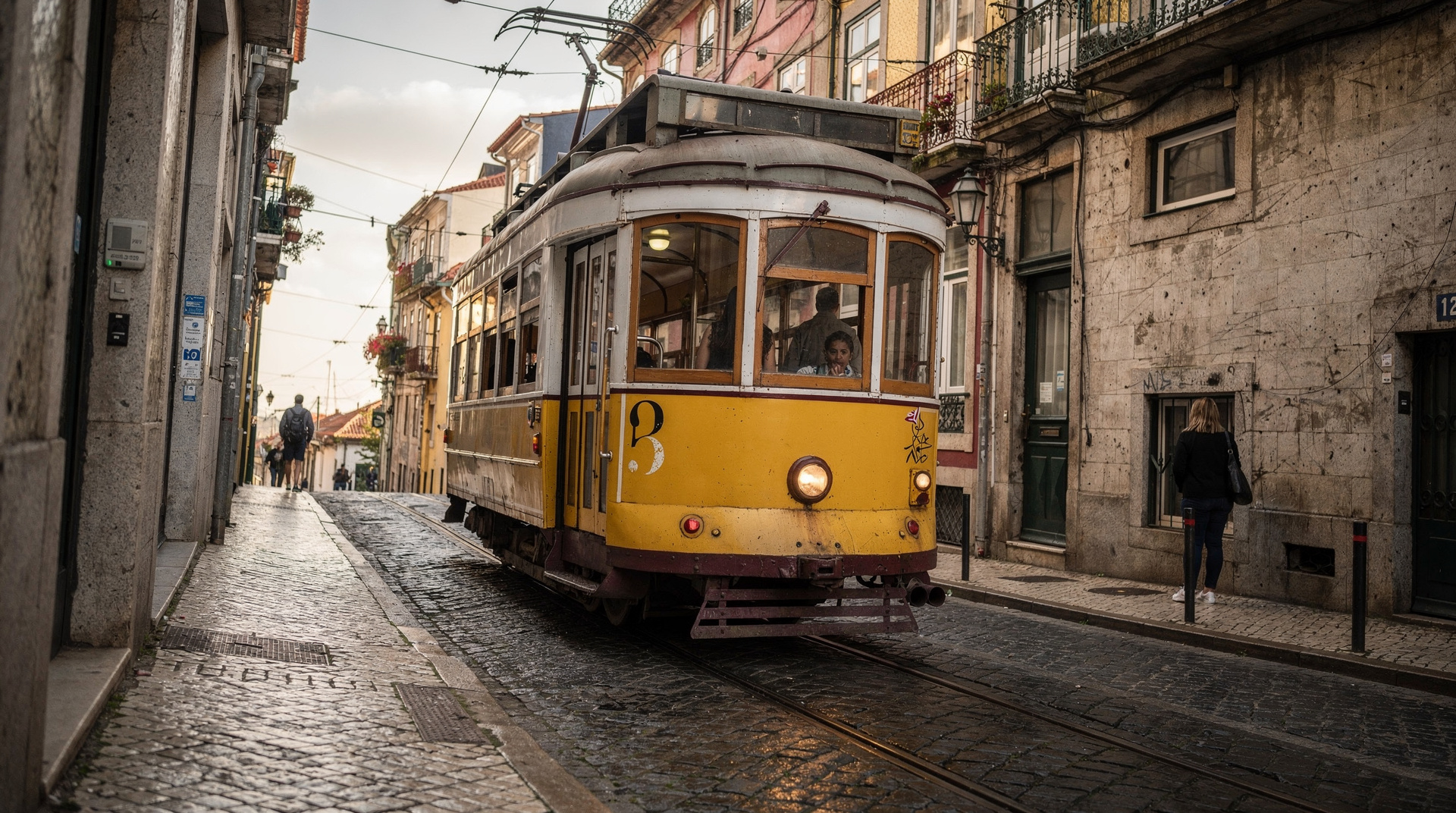
Book the hop-on hop-off tram and funicular combo — a popular format that incorporates the heritage tram circuit with funicular access, covering Porto’s key visual sections without requiring constant decision-making about which transport to use. This format does not include the Gaia cable car, which remains a separate purchase.
Funicular vs cable car, side by side
| Funicular dos Guindais | Teleférico de Gaia | |
|---|---|---|
| Route | Batalha ↔ Ribeira (Porto side) | Gaia waterfront ↔ Jardim do Morro (Gaia side) |
| Duration | ~2 minutes | ~5 minutes |
| Elevation change | 61 m | 67 m |
| Single fare | 2.50 € | 4 € |
| Porto Card | Included | Not included |
| Wheelchair access | Step entry, not fully accessible | Level-entry gondola, generally easier |
| Main value | Practical shortcut | Panoramic photo opportunity |
Alternatives if you’d rather walk or take a different route
Both rides are optional. The funicular’s route can be walked in about 15 minutes via the steep lanes of Bairro da Vitória — a legitimate choice if you want to see the neighbourhood at street level rather than glimpse it from the funicular window, and the accessible Porto guide has notes on gentler gradients nearby for visitors who find steep cobbles difficult. On the Gaia side, the walk between waterfront and upper cellars is steeper and longer (15–20 minutes), which is where the cable car’s practical case is strongest; walking it is feasible but genuinely more strenuous than the Porto-side equivalent. For visitors staying in Vila Nova de Gaia itself, the cable car effectively functions as local transport rather than a one-off tourist ride.
Combining both in a Porto itinerary
The most logical way to use both the funicular and the cable car in a single Porto visit:
Morning: Start in the upper city (Aliados area). Walk through the historic centre to the top of the Guindais hillside. Take the funicular down to Ribeira. Walk the Ribeira waterfront and cross Ponte Dom Luís I to Gaia on the lower deck.
Afternoon: Visit a Gaia waterfront cellar (Cálem, Ramos Pinto, or similar). Take the Teleférico de Gaia cable car up to Jardim do Morro. Visit Taylor’s or Graham’s for a premium tasting. Sit on the terrace until sunset. Return to Porto by metro from Jardim do Morro (D line to São Bento) or walk back across the upper deck of Ponte Dom Luís I.
This route uses both vertical transport systems in a single day, makes both cellar tiers accessible without demanding uphill walks in both directions, and covers the best visual experiences in Porto and Gaia in sequence.
The best port wine cellars guide details which cellars are at which levels in Gaia and how to choose between them, and the getting around Porto guide provides the full metro and transport network context for planning the rest of your day.
Frequently asked questions — Porto funicular and Gaia cable car — complete guide
What is the Funicular dos Guindais?
The Funicular dos Guindais is Porto's hillside railway linking Batalha square in the upper historic city with the Ribeira waterfront at river level. The journey is 281 metres long, drops 61 metres in altitude, and takes approximately 2 minutes. It has operated in some form since 1891 and was renovated and reopened in 2004. It runs daily and is covered by the Porto Card.How much does the Porto funicular cost?
The Funicular dos Guindais costs 2.50 € for a single journey and 4 € for a return ticket. The Porto Card includes unlimited funicular use. The funicular does not accept the standard Andante transport card for its own ticket pricing — it has a separate ticketing system.What are the opening hours of the Porto funicular?
The Funicular dos Guindais typically operates from 8:00 am to 10:00 pm daily during summer and from 8:00 am to 8:00 pm in winter (extended hours apply on weekends and during peak summer). Check current hours at the Batalha station before planning to use it for a specific time, as hours adjust seasonally.What is the Gaia cable car (teleférico)?
The Teleférico de Gaia is a gondola cable car on the Vila Nova de Gaia side of the Douro River. It connects the Gaia waterfront (quayside level) to Jardim do Morro at the top of the Gaia hillside, near the D-line metro station and with views across Porto. The journey is 563 metres long and takes approximately 5 minutes. It is operated separately from the Porto funicular.How much does the Gaia cable car cost?
The Teleférico de Gaia costs approximately 6 € for a return ticket and 4 € for a single journey in 2026. Reduced rates apply for children. The cable car is not included in the Porto Card (the Porto Card covers Porto-side transport; the cable car is on the Gaia side and operated by a different company). The cable car is also not covered by the Andante metro card.Is the funicular accessible for wheelchairs?
The Funicular dos Guindais has step access at both stations — the funicular car requires stepping onto and off a moving vehicle. It is not classified as fully wheelchair accessible. Visitors who can manage a step with assistance can use it. The Gaia cable car gondolas have a small step to enter; they are generally easier than the funicular for visitors with limited mobility, as the gondola is level-entry with the platform. Always confirm current accessibility arrangements with the operator.Can I use the same ticket for both the funicular and the Gaia cable car?
No. The Funicular dos Guindais and the Teleférico de Gaia are operated by different companies with separate ticketing systems. A Porto Card covers the funicular but not the cable car. There is no combined ticket covering both — budget for each separately.Is the Gaia cable car worth it if I only visit one level of cellars?
If you're only visiting a lower-level cellar (Cálem, Ramos Pinto) or only an upper-level one (Taylor's, Graham's), a single one-way ride still buys you Porto's best panoramic skyline view, which most visitors consider worth the 4 €. It becomes clearly worthwhile as a transport tool specifically when you're combining both cellar tiers in one visit.
Top experiences
Bookable activities with verified prices and instant confirmation on GetYourGuide.