Arouca — the 516 bridge, Paiva walkways and an honest outdoor day
Honest guide to Arouca: the 516 Arouca suspension bridge, Paiva walkways, geopark, what to expect, how to book and how to do the day trip from Porto.
Porto: From Porto 516 Arouca Bridge Paiva Walkways Guided Tour
Quick facts
- From Porto
- ~1 h by car, ~1 h 40 min by tour transfer
- Bridge length
- 516 metres (world's longest pedestrian suspension bridge)
- Paiva walkways
- 8.7 km trail along the Paiva river
- Bridge entry
- Booking required in advance
- Currency
- Euro (€)
The bridge, the walkways and what they actually involve
The 516 Arouca suspension bridge opened in 2021 and immediately became one of Portugal’s most talked-about attractions: at 516 metres long, suspended 175 metres above the Paiva river gorge, it held the title of the world’s longest pedestrian suspension bridge on opening. Combined with the Passadiços do Paiva (Paiva walkways) — an 8.7-km wooden-board trail along the river canyon below — the Arouca Geopark offers the most physically engaging day trip available from Porto.
Being honest about what you are signing up for: the 516 bridge is not a gentle stroll. The approach involves a descent and ascent on both sides; the bridge itself moves perceptibly underfoot and the view down to the river is vertiginous. The Paiva walkways take 3–4 hours to complete and require reasonable fitness, appropriate footwear (trail shoes or boots — not sandals or flat-soled trainers) and the ability to manage 530 metres of total elevation change along the wooden boards.
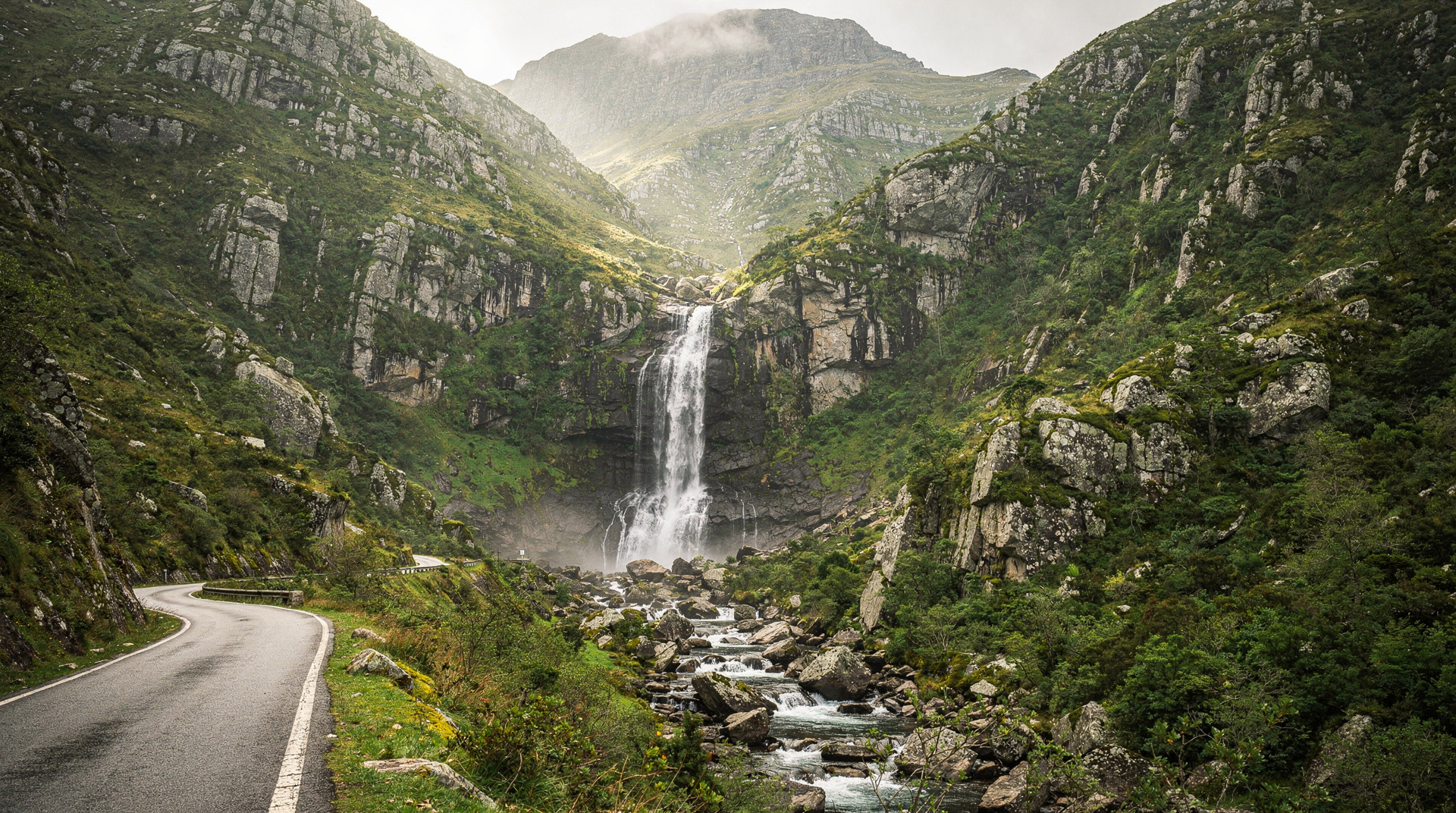
The reward is proportionate: the Paiva river gorge is wild and genuinely beautiful, the schist rock formations above the trail are unlike anything in the northwest of Portugal, and the physical experience of walking the full route feels like something earned rather than consumed. For visitors who want an active day out and are prepared to work for it, Arouca consistently delivers.
| Where | Arouca Geopark, ~1 h south-east of Porto |
| Time needed | Full day (bridge plus walkways runs 4–6 hours combined) |
| Cost | Around 11–15 € for the bridge; walkways ticketed separately, often bundled on tours |
| Getting there | ~1 h 20–30 by car; no direct public transport, guided tour recommended |
| Best time | May, June and October for cooler hiking conditions and manageable crowds |
What to do in Arouca
The 516 Arouca suspension bridge
The Ponte 516 Arouca spans the Paiva river gorge at Alvarenga, 16 km from the town of Arouca. The bridge is 1.02 metres wide and suspended by two sets of cables from pylons at each end, allowing movement as visitors cross. The central section of the bridge has steel-mesh flooring through which you can see the river 175 metres below. This is not a glass-floor attraction designed for momentary vertigo; the mesh floor runs the length of the bridge and some visitors find it more intense than expected.
Entry to the bridge requires advance booking — tickets are not sold on the day and sell out weeks in advance in summer. Book through the official Arouca Geopark website. Prices run around 11–15 € per person. The bridge is accessible from a car park at the Alvarenga end; a shuttle service connects the Arouca side with the opposite bank where the bridge terminates. The bridge is open year-round but closes in strong wind; check conditions before your visit.
Passadiços do Paiva (Paiva walkways)
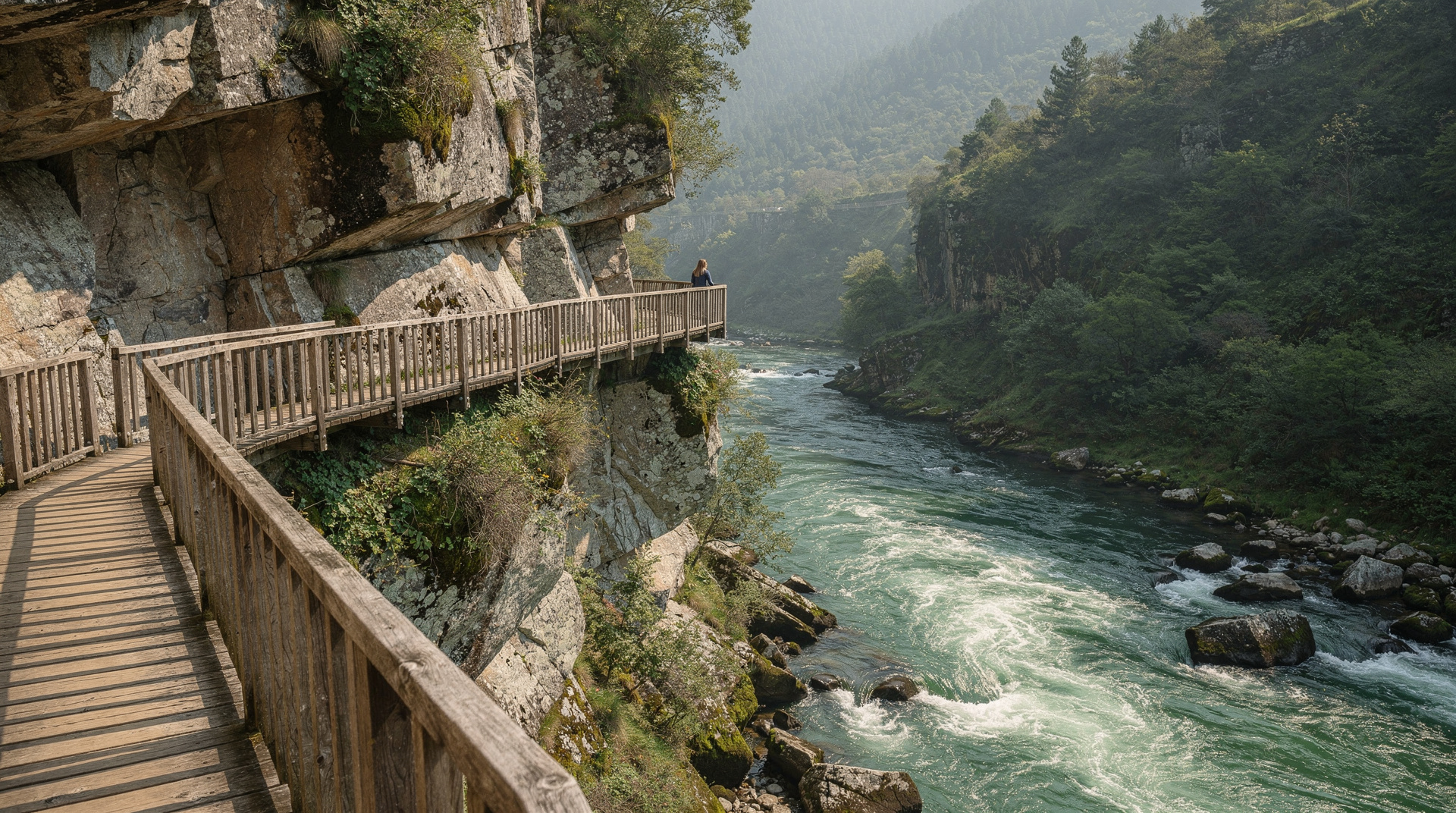
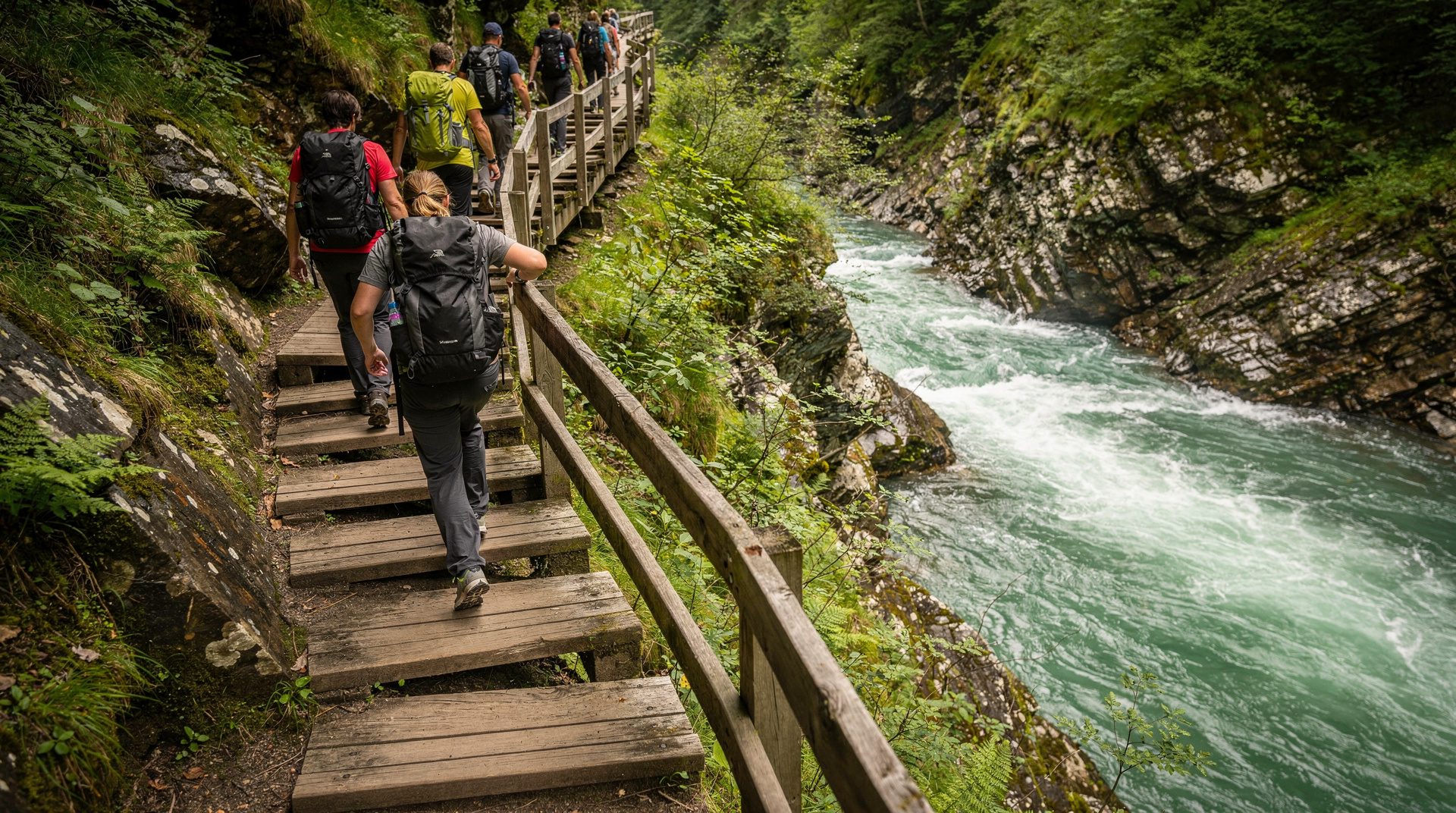
The Paiva walkways are an 8.7-km wooden-board trail built along the left bank of the Paiva river between Espiunca and Areinho, passing through the river gorge below the 516 bridge. The trail is one-directional (you cannot walk back the way you came; a shuttle bus connects the two ends) and involves 530 metres of total elevation change with sections of steep wooden steps at the river crossings.
Time required: 3–4 hours for most visitors at a moderate pace. The trail is waymarked and well-maintained; the wooden boards accommodate all trail users including children over about 8–10 years. Swimming in the Paiva at the designated points along the trail is possible in summer.
The combination of the 516 bridge and the Paiva walkways in a single day is the standard Arouca programme. A full-day guided tour from Porto to the 516 bridge and Paiva walkways includes return transport, entry tickets and a local guide — the recommended format for first-time visitors, since the logistics (parking, shuttle connections, ticket windows) are more complex than they appear from Porto.
Arouca Geopark
The Arouca Geopark covers 328 km² of schist and granite landscape in the western Iberian mountains and holds UNESCO Global Geopark status. The geopark’s geological interest centres on fossilised trilobites (some of the largest in the world) found in the Cambrian-era sedimentary rock of the Valongo Formation, exposed in the quarries of São Pedro da Cova near Arouca town. The Centro de Interpretação do Geopark in Arouca town (free entry) introduces the geology and has a small display of fossilised specimens.
A private tour of the Paiva walkways and 516 bridge from Porto can include the geopark visitor centre and fossil sites if you want to understand the landscape you are walking through — particularly worthwhile for visitors travelling with children who find the geology more engaging than the hiking itself.
Serra da Freita and Jeep tours
The Serra da Freita (the mountain massif above Arouca, reaching 1,100 metres) has boulder-strewn moorland, wind turbines and long-distance views. A network of 4x4 tracks makes it accessible by jeep tour if you want a high-altitude perspective without the full Paiva walkway commitment. A jeep tour on the Serra da Freita from Porto is a lower-intensity alternative to the walkways for visitors who want the landscape without extended hiking.
Combining Arouca with Aveiro
Arouca and Aveiro sit on roughly the same southward route from Porto, and several tour operators combine the two into a single long day: the 516 bridge and Paiva walkways in the morning, then a transfer to Aveiro for the moliceiro canal cruise and a late lunch. It is a demanding day — the hiking alone takes most people’s energy — but it works for visitors with limited time in Portugal who want both the adventure activity and the canal-town scenery without a second full day trip. If the pace sounds too rushed, treat them as separate outings; Costa Nova pairs more naturally with Aveiro on its own.
How to get to Arouca from Porto
By car: The most practical route is via the A29 south from Porto to Sta. Maria da Feira, then the A32 inland to Arouca — approximately 1 hour in light traffic. From Arouca town, the 516 bridge and Paiva walkways access points are 16–20 km further on mountain roads. Total driving time from Porto to the bridge car park: 1 hour 20–30 minutes.
By organised tour: Without a car, an organised tour is the only sensible option. Guided day tours from Porto to Arouca depart in the morning, handle the shuttle logistics between trailheads and return to Porto in the late afternoon. Prices typically run 50–70 € per person including tickets.
There is no direct public transport from Porto to the Arouca bridge or trailheads. Regional buses serve Arouca town but not the outdoor sites.
Where to stay in Arouca
Most visitors do Arouca as a day trip from Porto. For an overnight stay: Arouca Geopark Resort (near the town centre) is a modern hotel designed around the geopark experience; rates 70–110 € per night. Casa do Fontão is a rural guest house near the trailhead area with rooms and a garden; rates 55–80 € per night.
Where to eat in Arouca
Restaurante O Agroal (Arouca town) is recommended by locals for regional cooking: roasted kid (cabrito), lamprey in season (February to April), and river trout from the Paiva. Budget 15–22 € per person.
Café Palácio (near the start of the Paiva walkways) serves sandwiches, soup and coffee to groups preparing for the trail. Useful for a practical early lunch before the walk; limited options after 2 pm.
Post-hike food is limited in the immediate area; if you have driven independently, Arouca town offers better options than the trailhead area. Factor this into your timing.
Best time to visit Arouca
May, June and October are the best months: manageable temperatures for hiking (the Paiva trail gains significant heat in full summer), full water in the river, and manageable visitor numbers.
April is excellent if you are comfortable with the possibility of rain on the wooden boards — the walkways become slippery and the geopark can close sections in heavy rain.
July and August: Peak season. The bridge and walkways book out weeks in advance. Heat on the exposed sections of trail can be significant (above 30°C). Start as early as possible — gates open at 8 am — and expect the most popular sections to be crowded.
September is a good compromise: cooler than August, the river swimmable, and advance booking required but less pressured than peak summer.
November to March: The walkways remain open (with some weather-dependent closures) and visitor numbers are minimal. The gorge has a raw, dramatic quality in winter light. The bridge is colder and windier; high-wind closures are more frequent. Not a swimming season.
| Month | Conditions | Crowds |
|---|---|---|
| May–June | Mild, full river, occasional light rain | Moderate; book bridge tickets ahead |
| July–August | Hot on exposed sections, above 30°C possible | Peak; sells out weeks in advance |
| September | Cooler, river still swimmable | Manageable, still requires booking |
| October | Cool, comfortable hiking temperatures | Low to moderate |
| November–March | Cold, windier bridge closures possible | Minimal |
Families planning around school holidays should read the Porto with kids guide for how the Paiva walkways fit alongside gentler activities, and drivers building a longer stay can slot Arouca into the Porto 4-day itinerary or check getting around Porto for car rental logistics before the trip.
Practical tips
- Advance booking for the 516 bridge is non-negotiable in season. Do not drive to Arouca without a confirmed ticket; you will be turned away. Book via the official Arouca Geopark website or through your tour operator.
- Trail shoes or low hiking boots are the minimum footwear requirement. The Paiva walkways have wooden steps that become slippery when wet, and the approach to the bridge involves an uneven stone path.
- The shuttle bus connecting the two ends of the Paiva walkways runs on a schedule; ask the ticket office for the current departure times on your visit date.
- Carry at least 1.5 litres of water per person for the full Paiva walkway; there are no water refill points along the trail itself.
- The trail is not accessible for pushchairs; child carriers for infants and older children (6+) on foot are the appropriate format.
- There is a bag storage/locker service at both trailheads; use it rather than carrying unnecessary weight on the walk.
Frequently asked questions about Arouca and the 516 bridge
Is the 516 Arouca bridge scary?
For visitors with no fear of heights, it is exciting rather than frightening. For visitors with moderate acrophobia, the mesh-floor section in the middle of the bridge (where the 175-metre drop is visible through the floor) is genuinely challenging and cannot be avoided. The bridge moves perceptibly, which adds to the experience. Several visitors report that it is more intense than expected; a small number turn back partway across. If heights are a genuine fear rather than a mild anxiety, the Paiva walkways below the bridge are still worth doing independently of the bridge crossing.
How physically demanding is the Paiva walkways trail?
Moderately demanding. The total distance is 8.7 km with 530 metres of elevation change; the average completion time is 3–4 hours. The difficulty is concentrated in the wooden staircases at the river crossings, which are steep and can be slippery when wet. Children of around 8–10 years and above manage the trail without difficulty. The main physical requirement is being comfortable on uneven surfaces for several hours — genuine fitness is not required, but flat shoes will make the descent sections unpleasant.
Do I need to book the Paiva walkways and the bridge separately?
Yes. The 516 Arouca bridge and the Paiva walkways are separate ticketed attractions operated by the Arouca Geopark with separate entry points and tickets. An organised day tour from Porto usually includes both tickets in the price. If you are going independently, book both in advance via the official website — they are managed together but require separate reservations.
What should I bring for the Arouca day?
The practical list: trail shoes or hiking boots, at least 1.5 litres of water per person, sun protection (the bridge and exposed sections of the walkway have no shade), a windproof layer (the bridge is elevated and can be breezy even on warm days), and a snack for the walkway (no food available mid-trail). Leave unnecessary luggage in your car or use the locker service at the trailhead.
Can I visit Arouca without doing the full Paiva walkway?
Yes. Crossing the 516 bridge and returning the same way, without continuing onto the full 8.7-km walkway, is a valid shorter option and takes under an hour including the approach paths. It misses the gorge scenery the walkway delivers, but it is a reasonable choice for visitors short on time or unable to manage the longer hike. The Arouca 516 and Paiva walkways guide breaks down shorter and longer route options in more detail.
Top experiences
Bookable activities with verified prices and instant confirmation on GetYourGuide.