Palácio da Bolsa Porto — the Arab Room and what the guided tour is really like
Palácio da Bolsa: Porto Visita Guiada Ao Palacio da Bolsa
Is the Palácio da Bolsa guided tour worth it?
Yes — the Salão Árabe alone justifies the ~€12 ticket, and self-guided entry is not permitted. The tour lasts 30 minutes and runs every 30 minutes in English. Arrive 15 minutes early to guarantee the next tour slot, especially in summer.
A 19th-century palazzo that earns its reputation
Porto does not lack for impressive 19th-century public buildings — the stock exchange of a major port city that was at the height of its commercial power has to signal that importance in stone and plaster. Palácio da Bolsa does this with remarkable confidence, room by room, through a sequence of elaborately decorated state rooms culminating in the Salão Árabe, which is by any measure one of the most extraordinary interior spaces in Portugal.
The catch is that you cannot simply wander through it. Self-guided entry is not permitted, which means you take the 30-minute guided tour or you don’t see the building at all. This turns out to be fine — the tour is well-run, the guides knowledgeable, and 30 minutes is exactly the right amount of time to absorb what is on offer without feeling rushed or overstuffed.
| Where | Ribeira, next to Igreja de São Francisco |
| Cost | Around €12 adults, ~€7.50 reduced |
| Time needed | 30-minute guided tour, plus queuing time in peak season |
| Getting there | 10 minutes from São Bento on foot, or a few minutes uphill from the Ribeira quay |
| Best time | First tour of the morning, around 9 am |
Background: what the building is and why it exists
The full name, Palácio da Bolsa, translates as Stock Exchange Palace. It was built as the headquarters of Porto’s Commercial Association — the Associação Comercial do Porto, founded in 1834 — at a moment when Porto was the commercial capital of the Portuguese empire, its merchants controlling wine exports to Britain, textile production, and significant colonial trade.
The site chosen for the building was the ruins of the convent of São Francisco, partly damaged by fire in 1832 during the Liberal Wars. Construction began in 1842 under the architect João de Almeida, and the building was worked on by successive architects over the following decades. The eclecticism of the interior — each room in a different historical style, from Neoclassical to Moorish — reflects both the era’s aesthetic preferences and the fact that different architects worked on different rooms at different periods.
The building was designated a National Monument in 1910 and has been carefully maintained since. It continues to serve its original function as the headquarters of the Commercial Association alongside its role as Porto’s most formally impressive tourist attraction.
The pátio das Nações (Nations’ Hall)
The guided tour begins in the Pátio das Nações, the central courtyard of the building and its organisational heart. What makes this space immediately striking is the roof: a large glass-and-iron dome that floods the courtyard with natural light, designed in a structural style that reflects the enthusiasm for industrial materials (iron, glass, steel) that characterised advanced architecture in the 1840s to 1870s.
Around the perimeter of the upper level of the courtyard, a continuous band of painted coats of arms represents the nations with which Porto had commercial relations in the mid-19th century. Twenty flags are depicted — the commercial world of a Portuguese port city at its economic peak, including Britain, France, the United States, Brazil, and a number of other trading partners. The choice of which nations to include and the relative prominence given to each reflects the diplomatic and economic hierarchies of the period.
The courtyard functions as a reception and transition space — where formal business was conducted, guests received, and the power of the institution communicated to visitors. The combination of natural light, heraldic symbolism, and grand proportions achieves this with considerable sophistication.
The state rooms
Beyond the courtyard, the tour moves through a sequence of state rooms, each elaborately decorated in a distinct historical style:
The Golden Room (Sala Dourada): Neoclassical in inspiration, with heavy gilded stucco work on the ceiling, decorative panels, and a polished parquet floor. The room was used for formal dinners and receptions. The gilding is genuine — gold leaf applied over a plaster base — and the ceiling paintings are allegorical representations of commerce, justice, and industry in the manner of academic 19th-century painting.
The Tribunal Room: This room demonstrates the building’s dual function: it was used both for commercial arbitration and for formal receptions. The painted ceiling and elaborately carved wainscoting reflect the serious judicial atmosphere that the Commercial Association wanted to project when hosting formal proceedings.
The Plenaries Hall (Sala das Assembleias Gerais): The largest of the state rooms, used for general assemblies of the commercial association’s membership. Tiered seating faces a formal dais and speaker’s platform. The room is Neoclassical in its overall organisation but with decorative details that shade toward the eclectic. The acoustic quality is notable — the room was designed for public speaking in the pre-microphone era, and voices carry clearly.
Each of these rooms is substantial in scale and more elaborately decorated than most comparable spaces in Portugal. They prepare you for the Salão Árabe, but each has its own merit.
The Salão Árabe: what you are actually looking at
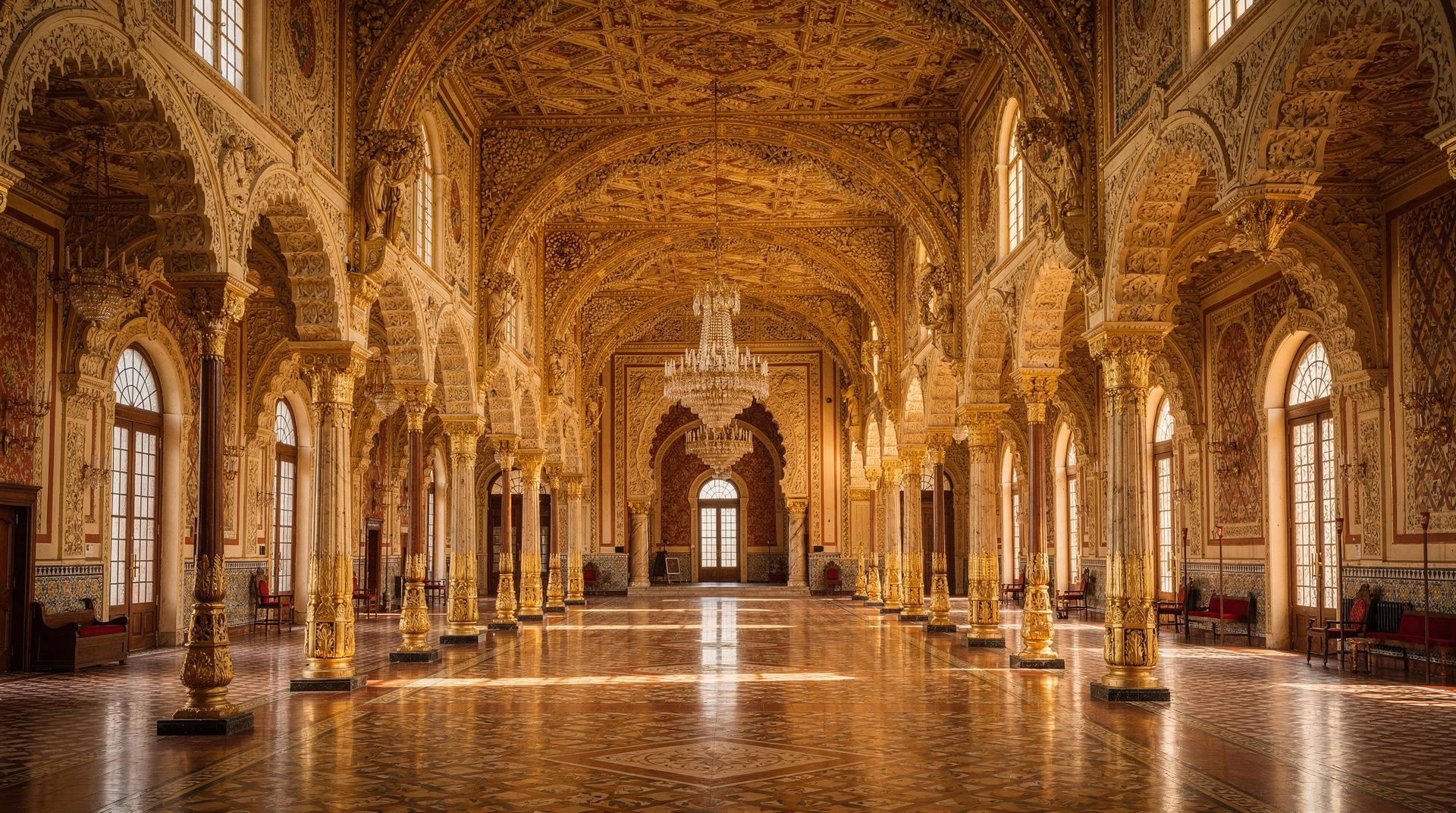
The Arab Room is the climax of the visit, and most visitors find that the 18 years Gustavo Adolfo Gonçalves e Sousa spent working on it (1862–1880) are unmistakably visible in the result.
The room is Moorish Revival in style — a deliberate evocation of Nasrid Andalusia, specifically the Alhambra palace in Granada, which had become a European architectural obsession following Washington Irving’s account of it in 1832 and the subsequent publications of Owen Jones’s Plans, Elevations, Sections, and Details of the Alhambra (1842–1845). Every European royal court and major public institution of the 1850s and 1860s seemed to want a Moorish room; the Porto Commercial Association had the ambition and the resources to make theirs one of the finest.
What distinguishes the Salão Árabe from many Moorish Revival interiors is the density and quality of the surface treatment. The walls are covered in stucco muqarnas — the stalactite-like carved plaster decorative work associated with Islamic architecture — supplemented by gilded panels, painted arabesques, and complex geometric border patterns. The ceiling is a muqarnas vault in which multiple layers of carved and painted stucco create a three-dimensional surface of extraordinary intricacy.
Around the upper register of the walls, an inscription in Arabic script runs as a continuous band. It reads “Glory be to Allah” — a Koranic phrase that the guide will explain was chosen to evoke authentic Islamic decorative practice rather than as a statement of religious affiliation by the Catholic Portuguese merchants who commissioned the room. The paradox is deliberate and somewhat surreal: a room designed for Portuguese commercial diplomacy inscribed with praise of Allah in a building run by a Catholic commercial association in a city of port wine and Baroque churches.
The floor is elaborate tilework in geometric patterns. The door surrounds and window frames are carved wood inlaid with ivory and other materials. The total effect, in a room of modest dimensions (about 25 by 10 metres), is one of controlled excess — every surface has been given attention, and the cumulative result is overwhelming in the best sense.
The room took 18 years because Sousa was working to an extraordinarily fine level of detail, largely by hand, on a project of this scale. Photography is permitted in the Salão Árabe but no photograph fully captures the three-dimensionality of the muqarnas ceiling or the way the gilding catches the light from different angles.
The guided tour in practice
Tours depart every 30 minutes from the main reception desk. English-language tours are standard during peak visiting hours (9 am to approximately 5 pm); Portuguese-language tours are more frequent. Other languages — French, Spanish, German — may be available at specific times; check when booking or on arrival.
The tour group typically includes 15 to 25 people. The guide leads the group through the rooms in a fixed sequence, providing contextual information and pausing for questions. The pace is measured rather than rushed — you spend 3 to 5 minutes in each of the main state rooms and 8 to 10 minutes in the Salão Árabe.
Questions from the group tend to cluster around the Arab Room and the gilding techniques. Guides are well-prepared for the standard questions; if you have specific interests in the architectural history or the Commercial Association’s historical role, a question in the Arab Room usually prompts a more detailed response.
The tour ends back at the reception area. There is a gift shop selling books and reproductions.
Booking: In summer, book in advance via the official Bolsa guided tour listing. Walk-in is usually possible outside peak season but involves waiting for the next available slot. If you arrive without a booking and the next tour is in Portuguese only, it is worth waiting for the English tour rather than taking the Portuguese version unless your Portuguese is solid.
For a more personalised visit with a private guide, the private Bolsa walking experience combines the palace visit with the surrounding São Francisco church and Ribeira neighbourhood. This option suits visitors who want a flexible schedule rather than fitting into the fixed 30-minute departure times of the standard guided tour, or who have specific historical or architectural questions that a smaller group setting handles better than a 15-to-25-person tour.
São Francisco church: don’t skip it
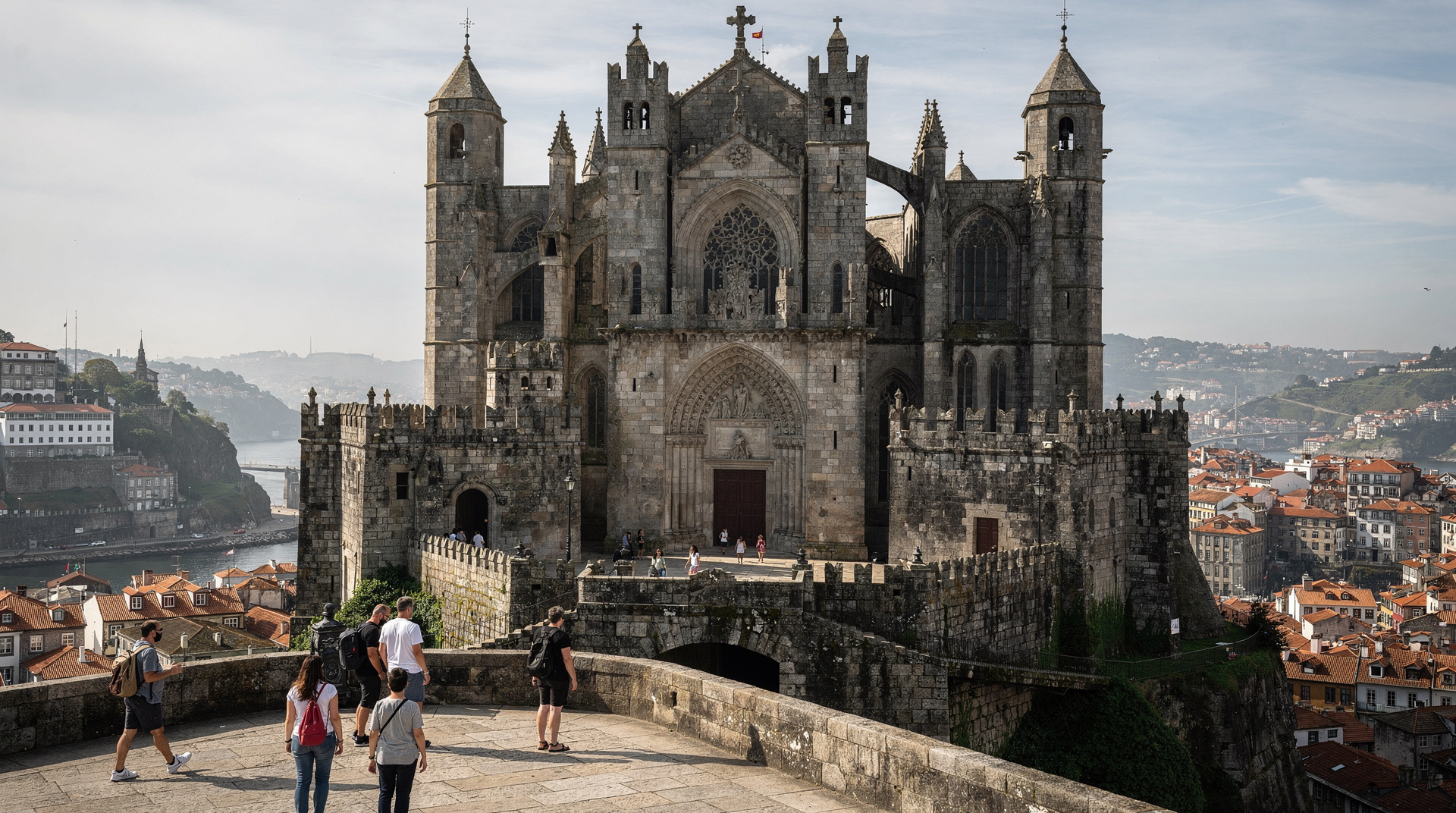
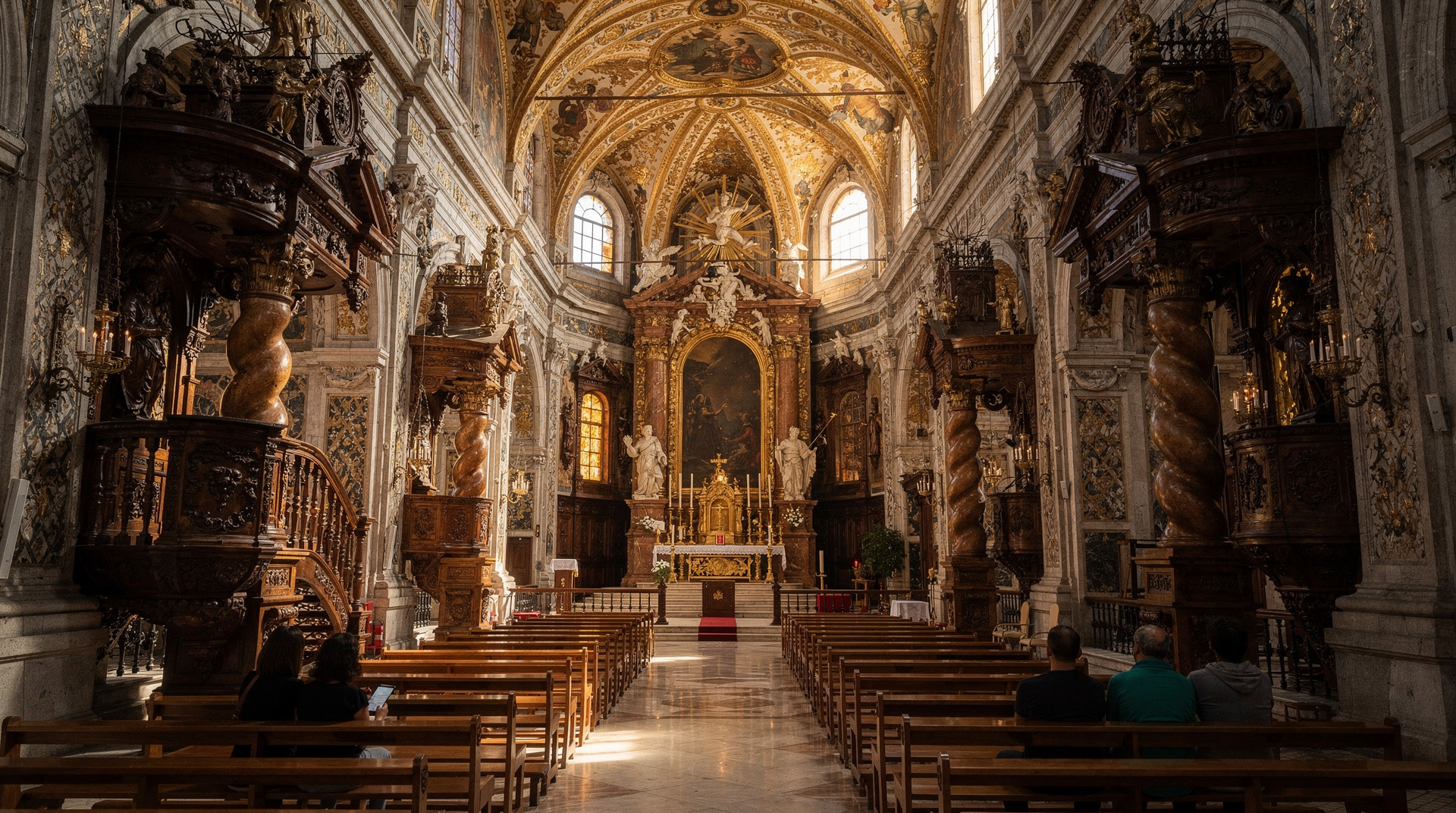
Immediately adjacent to Palácio da Bolsa stands the Igreja de São Francisco, and the combination of the two visits makes one of the most rewarding cultural half-days in Porto. São Francisco’s Gothic exterior (14th century) is unassuming; the interior is the opposite — an explosion of gilded Baroque woodwork, one of the most ornate church interiors in Portugal, with an estimated 400 kilograms of gold leaf applied to every surface.
São Francisco charges a separate entry fee (approximately €6), and the combined ticket for Bolsa plus São Francisco is available at both sites. If you are interested in the history of religious decoration in Porto, the contrast between São Francisco’s Baroque excess and the secular Moorish opulence of the Salão Árabe is worth experiencing in sequence. Both represent the 19th-century’s most extravagant exercises in surface decoration, in entirely different traditions.
See the churches of Porto guide for more detail on São Francisco and the other major religious buildings near the Ribeira.
The neighbourhood: Ribeira and surroundings
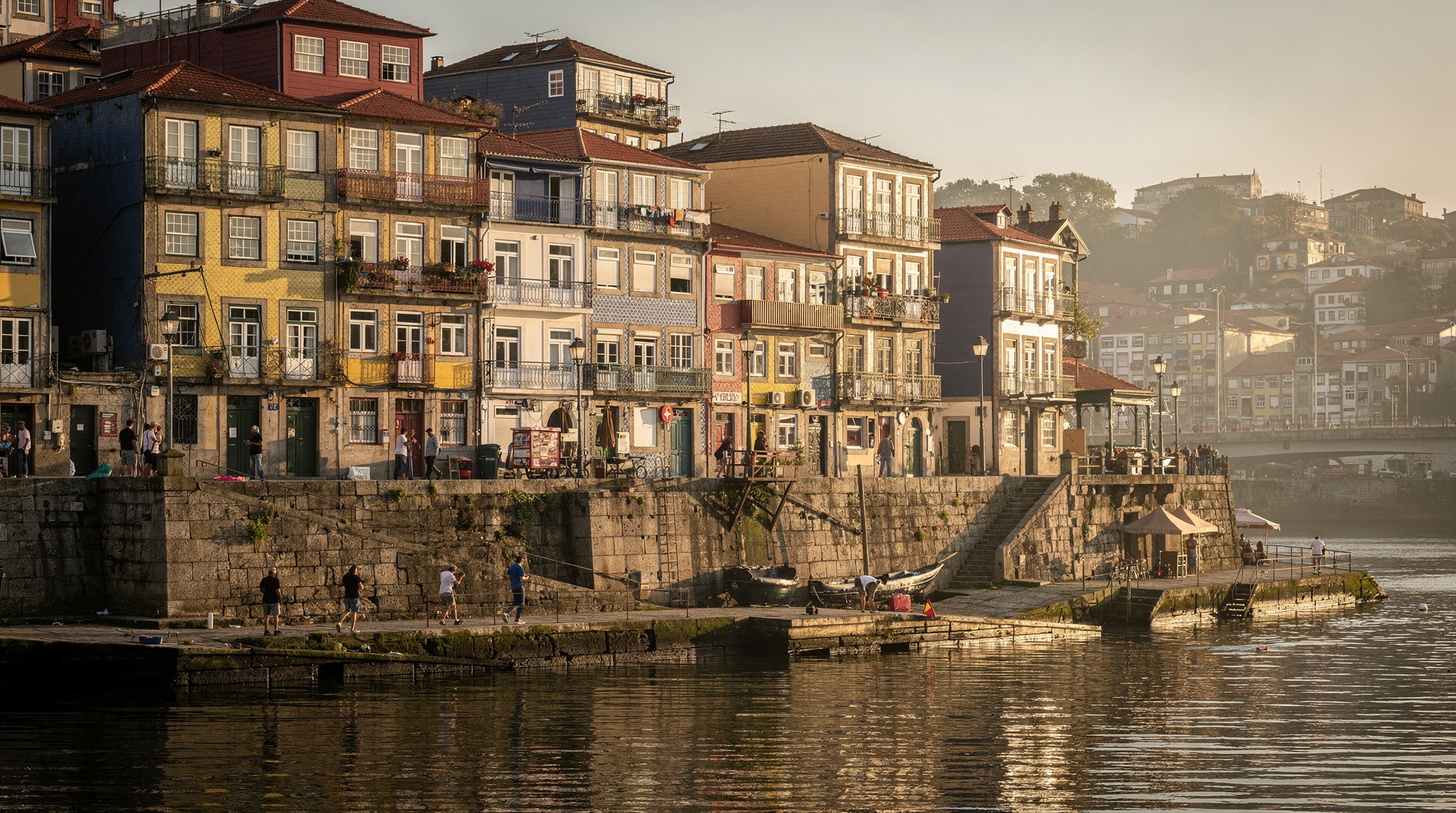
Palácio da Bolsa is in the Ribeira district — the riverside neighbourhood at the foot of the city’s historic hillside, UNESCO-listed and Porto’s most visited area. The palace sits immediately above the waterfront, a five-minute walk from the quay where tour boats depart for the six-bridge cruise up the Douro.
The Ribeira square (Praça da Ribeira) is the social heart of the waterfront, flanked by colourful townhouses with laundry-strung balconies, populated by cafes and restaurants. Most of the restaurants around the square are priced for tourists — add 20 to 30% above what you would pay in comparable establishments one or two streets behind the waterfront. Rua Coentrão and the streets running uphill from the Ribeira have more honest pricing and similar or better food.
For the best combined day in this part of Porto: morning at the Sé and Nasoni loggia (free), São Francisco church after opening, Palácio da Bolsa tour at 11 am, lunch behind the waterfront, afternoon boat cruise from the Ribeira quay.
Starting from São Bento station
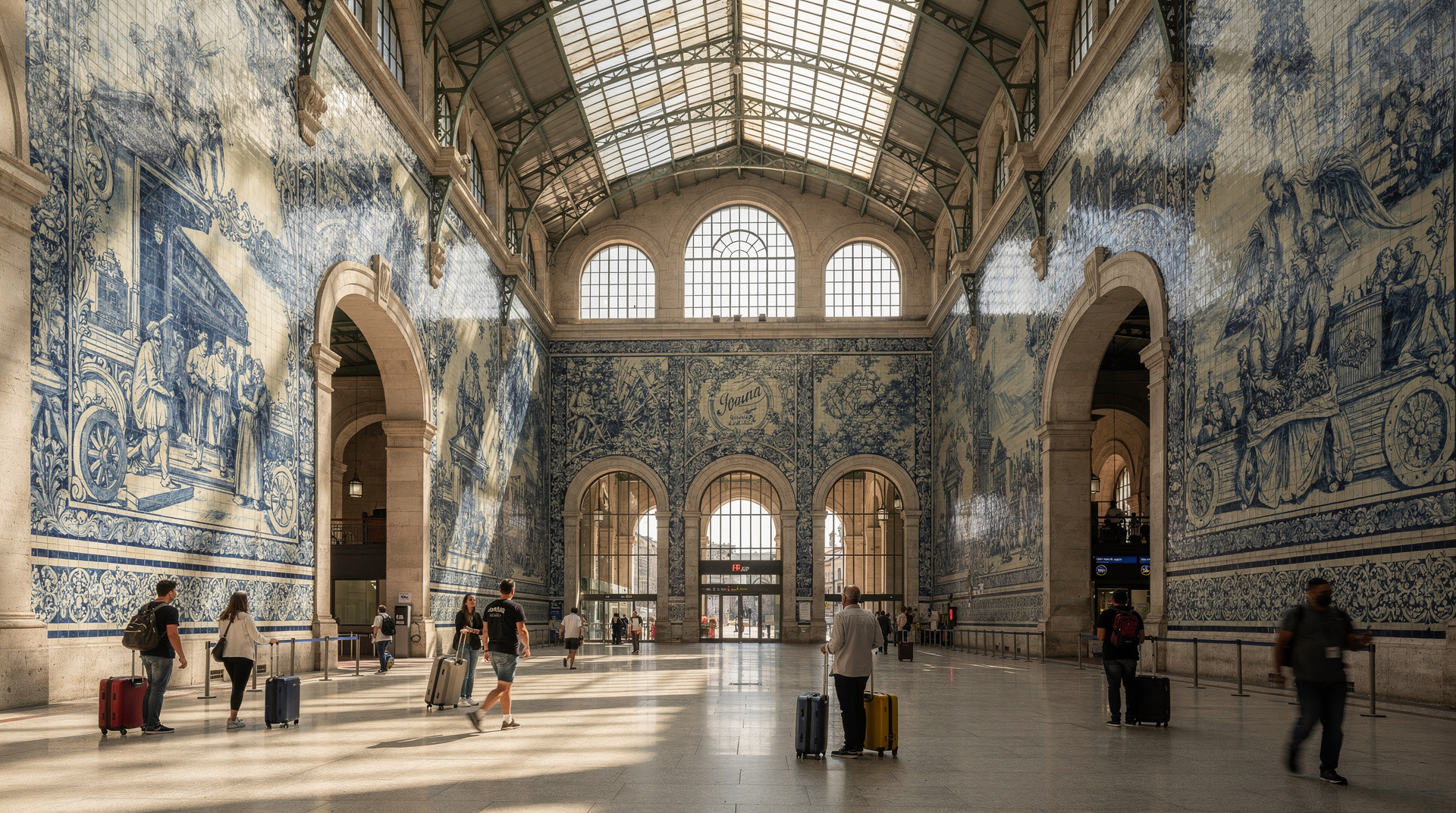
Most visitors’ first stop in Porto is São Bento railway station, itself a major azulejo attraction with its early-20th-century tiled entrance hall depicting scenes of Portuguese history. Starting a cultural morning at São Bento, then walking the 10 minutes downhill to Palácio da Bolsa, sequences two of the city’s best interior spaces back to back without requiring transport. For visitors interested in the wider azulejo tradition that both São Bento and, in a different way, the Salão Árabe’s tilework represent, the azulejos of Porto guide covers the full range of the city’s tile heritage, from station halls to church façades.
Getting to Palácio da Bolsa
From São Bento station: walk south and downhill along Rua Mouzinho da Silveira for about 10 minutes, then turn right toward the Ribeira.
From the Ribeira waterfront: the palace is directly above the quay — walk uphill from the Praça da Ribeira, turn left at the top of the stairs into Rua do Infante Dom Henrique. The entrance is about 3 minutes from the waterfront.
From Torre dos Clérigos: walk east and downhill for about 15 minutes through the Baixa, following the streets toward the river and Ribeira.
Palácio da Bolsa vs Porto’s other paid interiors
Porto has several ticketed interior attractions competing for the same time slot, and it helps to know where Bolsa sits among them.
| Palácio da Bolsa | Livraria Lello | Torre dos Clérigos | |
|---|---|---|---|
| What you see | 19th-century state rooms, Salão Árabe | Neo-gothic bookshop interior | Baroque tower, city viewpoint |
| Format | Mandatory 30-min guided tour | Self-guided, timed entry | Self-guided, climb 240 steps |
| Typical cost | Around €12 | Around €10-12 (redeemable against a book) | Around €8-10 |
| Time needed | 30 minutes plus queue | 15-30 minutes | 30-45 minutes including the climb |
If you only have time for one, the Salão Árabe is the single most spectacular interior of the three, but Lello and Clérigos are each faster to fit into a tight schedule. Many visitors combine all three with São Francisco church into a single Ribeira-Baixa cultural morning, starting at Clérigos or Lello in the Baixa and finishing at Bolsa and São Francisco closer to the river, which roughly follows the natural downhill slope of the old town and avoids doubling back uphill.
Booking through GetYourGuide vs at the door
A combined Clérigos Tower and museum walking ticket is worth considering if you’re planning to see both Clérigos and the historic centre on the same outing as Bolsa, since it bundles the queue-skipping benefit with a guided introduction to the surrounding streets. Buying Bolsa tickets at the door works fine outside peak season; in summer, a pre-booked slot removes the uncertainty of whether the next English tour has space.
Frequently asked questions about Palácio da Bolsa
How much does Palácio da Bolsa cost to visit?
Approximately €12 for adults in 2026. Reduced rates around €7.50 for students and seniors. No self-guided entry is permitted — the guided tour is the only access option.
How long does the guided tour take?
Approximately 30 minutes. Tours run every 30 minutes in Portuguese and English during peak hours.
Why is the Salão Árabe so celebrated?
It is one of the finest Moorish Revival interiors in Europe: 18 years of work by Gustavo Adolfo Gonçalves e Sousa, covering every surface in stucco muqarnas, gilding, and painted arabesques. The inscription of Koranic text around the room adds to its unusual character.
Do I need to book in advance?
In summer, yes. Tour slots fill and you may wait over an hour for the next available English tour. In low season, walk-in is usually possible.
What else is in Palácio da Bolsa besides the Arab Room?
The Nations’ Hall with its glass-and-iron dome and international coats of arms; the Golden Room; the Tribunal Room; and the Plenaries Hall. Each is elaborately decorated in a distinct 19th-century historical revival style.
Is Palácio da Bolsa still a working institution?
Yes — it remains the headquarters of Porto’s Commercial Association and is used for official functions. Some rooms may occasionally be unavailable during formal events.
Is photography allowed inside?
Yes, without flash, throughout the tour including the Salão Árabe. Ask at reception if you’re carrying a tripod or professional equipment.
Frequently asked questions — Palácio da Bolsa Porto — the Arab Room and what the guided tour is really like
How much does Palácio da Bolsa cost to visit?
The guided tour ticket costs approximately €12 for adults in 2026. Reduced rates of around €7.50 apply for students and seniors. Children under 12 typically enter free. There is no option to enter the building without a guided tour — self-guided visits are not permitted.How long does the Palácio da Bolsa guided tour take?
The standard guided tour lasts approximately 30 minutes and covers the main state rooms including the Nations' Hall, the Golden Room, the Plenaries Hall, and the Salão Árabe (Arab Room). Tours run every 30 minutes in Portuguese and English (other languages may be available at specific times — check the schedule when booking).Why is the Salão Árabe so celebrated?
The Salão Árabe (Arab Room) was designed by Gustavo Adolfo Gonçalves e Sousa and took 18 years to complete (1862–1880). It is decorated in a Moorish Revival style, with every surface — walls, ceiling, arches, floor — covered in stucco work, gilding, and painted panels. The inscription from the Koran repeated around the room reads 'Glory be to Allah.' The room was used for diplomatic receptions and is still occasionally used for official functions today. Most visitors consider it the finest interior space in Porto.Do I need to book Palácio da Bolsa in advance?
In summer (June through September) and during busy weekends, booking in advance is strongly recommended — tour slots fill and you may wait an hour or more for the next available English-language tour. In low season, walk-in is usually possible. The safest approach year-round is to arrive 15 minutes before your desired tour time to guarantee a slot.What else is in Palácio da Bolsa besides the Arab Room?
The tour also covers the Nations' Hall (Pátio das Nações), which has a magnificent glass-and-iron roof with the coats of arms of the nations with which 19th-century Porto had commercial relations; the Golden Room (Sala Dourada); the Tribunal Room; and the Plenaries Hall. Each room is elaborately decorated in different historical revival styles reflecting the eclecticism of 19th-century taste.Is Palácio da Bolsa still a working institution?
Yes. Palácio da Bolsa (Stock Exchange Palace) was built as the headquarters of Porto's Commercial Association (Associação Comercial do Porto), and the association continues to use the building for its administrative functions and formal events. The tour visits the state rooms that are not in regular use; some rooms may occasionally be unavailable when the building is in use for official functions.What is the best time of day to visit Palácio da Bolsa?
Morning visits (first tours at 9 am) tend to have smaller groups and are quieter. The building is busiest from 11 am to 2 pm. Late afternoon visits have good light in some rooms but tour frequency may decrease in the final hour before closing. November through February sees consistently smaller groups at all times.Is photography allowed inside Palácio da Bolsa?
Yes, photography without flash is permitted in all the state rooms including the Salão Árabe. Flash is generally discouraged because it can be distracting in a group tour setting and adds little to photographs of a room already well-lit by chandeliers and natural light. Tripods and professional equipment may need separate permission — ask at the reception desk if you're carrying more than a phone or compact camera.
Top experiences
Bookable activities with verified prices and instant confirmation on GetYourGuide.